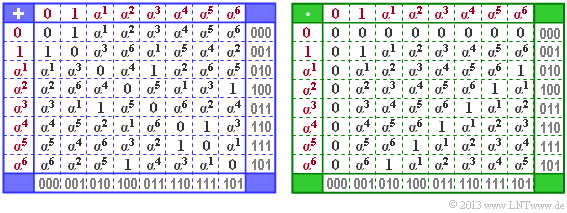
$\rm GF(2^3)$: Incomplete addition and multiplication tables
The graph shows the addition and multiplication table for the finite field $\rm GF(2^3)$. The tables are not complete. Some fields $($highlighted in color$)$ should be completed.
The elements are given both
in the exponent representation $($with red lettering, left and above$)$ and
in the coefficient representation (gray lettering, right and below).
From this assignment one can already recognize the underlying irreducible polynomial $p(\alpha)$.
Additions $($and subtractions$)$ are best done in the coefficient representation $($or with polynomials firmly linked to it$)$.
For multiplications, however, the exponential representation is more convenient.
(1) Adding any element of an extension field based on $\rm GF(2)$ to itself always yields $0$, as can be easily seen from the coefficient representation, for example:
(5)All proposed solutions are correct, as can be seen from row 2 (multiplication with the "identity element"):
$\rm GF(2^3)$: Complete addition and multiplication tables
The complete tables for addition and multiplication are shown opposite.
Because of the validity of $\alpha^i \cdot \alpha^j = \alpha^{(i+j)\hspace{0.1cm} {\rm mod}\hspace{0.1cm} 7} $, multiplication yields a symmetry that could be used to solve.
(6) Correct here is the proposed solution 3:
All polynomials are indeed irreducible. However, one needs a degree-3 polynomial for $\rm GF(2^3)$.
The third proposed solution results from the relation