Die Seite wurde neu angelegt: „ {{quiz-Header|Buchseite=Modulationsverfahren/Fehlerwahrscheinlichkeit der PN–Modulation }} [[File:|right|]] ===Fragebogen=== <quiz display=simple> {Mul…“
Let the delay on the secondary path be $τ = 1 \ \rm µ s$.
Drawn below is the structure of a rake receiver (green background) with general coefficients $K$, $h_0$, $h_1$, $τ_0$ and $τ_1$.
===Fragebogen===
*The purpose of the rake receiver is to combine the energy of the two signal paths, making the decision more reliable.
*The combined impulse response of the channel (German: "Kanal" ⇒ subscript "K") and the rake receiver can be expressed in the form
:but only if the rake coefficients $h_0$, $h_1$, $τ_0$ and $τ_1$ are appropriately chosen.
*The main part of $h_{\rm KR}(t)$ is supposed to be at $t = τ$.
*The constant $K$ is to be chosen so that the amplitude of the main path $A_1 = 1$ :
:$$K= \frac{1}{h_0^2 + h_1^2}.$$
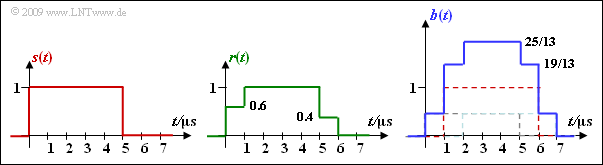
Apart from the rake parameters, the signals $r(t)$ and $b(t)$ are sought when $s(t)$ is a rectangle of height $s_0 = 1$ and width $T = \ \rm 5 µ s$.
Notes:
*The exercise belongs to the chapter [[Modulation_Methods/Error_Probability_of_Direct-Sequence_Spread_Spectrum_Modulation|Error Probability of Direct-Sequence Spread Spectrum Modulation]].
*Reference is made in particular to the section [[Modulation_Methods/Error_Probability_of_Direct-Sequence_Spread_Spectrum_Modulation#Principle_of_the_rake_receiver |Principle of the rake receiver]].
===Questions===
<quiz display=simple>
<quiz display=simple>
{Multiple-Choice Frage
{Which statements are valid for the channel impulse response $h_{\rm K}(t)$?
|type="[]"}
|type="[]"}
- Falsch
+ $h_{\rm K}(t)$ consists of two Dirac delta functions.
+ Richtig
- $h_{\rm K}(t)$ is complex-valued.
- $h_{\rm K}(t)$ is a function periodic with delay time $\tau$.
{Which statements are true for the channel frequency response $H_{\rm K}(f)$?
|type="[]"}
- $H_{\rm K}(f = 0) = 2$ is true.
+ $H_{\rm K}(f)$ is complex-valued.
+ $|H_{\rm K}(f)|$ is a function periodic with frequency $1/τ$.
{Set $K = 1$, $h_0 = 0.6$ and $h_1 = 0.4$. Determine the delays $τ_0$ and $τ_1$ so that the $h_{\rm KR}(t)$ equation is satisfied with $A_0 = A_2$.
|type="{}"}
$τ_0 \ = \ $ { 1 3% } $\ \rm µ s$
$τ_1 \ = \ $ { 0. } $\ \rm µ s$
{Input-Box Frage
{What value should be chosen for the constant $K$?
|type="{}"}
|type="{}"}
$\alpha$ = { 0.3 }
$K \ = \ $ { 1.923 3% }
{Which statements are valid for the signals $r(t)$ and $b(t)$?
|type="[]"}
+ The maximum value of $r(t)$ is $1$.
- The width of $r(t)$ is $7 \ µ s$.
- The maximum value of $b(t)$ is $1$.
+ The width of $b(t)$ is $7 \ µ s$.
Line 23:
Line 65:
</quiz>
</quiz>
===Musterlösung===
===Solution===
{{ML-Kopf}}
{{ML-Kopf}}
'''1.'''
'''(1)''' <u>Solution 1</u> is correct:
'''2.'''
*The impulse response $h_{\rm K}(t)$ is obtained as the received signal $r(t)$ when there is a Dirac delta pulse at the input ⇒ $s(t) = δ(t)$. It follows that:
'''(2)''' <u>Solutions 2 and 3</u> are correct:
'''7.'''
*By definition, the channel frequency response $H_{\rm K}(f)$ is the Fourier transform of the impulse response $h_{\rm K}(t)$. With the shift theorem this results in:
*For $f = 0$, $|H_{\rm K}(f)| = 1$. This value is repeated in the respective frequency spacing $1/τ$.
'''(3)''' We first set $K = 1$ as agreed.
*Altogether we get from $s(t)$ to the output signal $b(t)$ via four paths.
*To satisfy the given $h_{\rm KR}(t)$ equation, either $τ_0 = 0$ must hold or $τ_1 = 0$. With $τ_0 = 0$ we obtain for the impulse response:
The impulse response $h_{\rm K}(t)$ is obtained as the received signal $r(t)$ when there is a Dirac delta pulse at the input ⇒ $s(t) = δ(t)$. It follows that:
By definition, the channel frequency response $H_{\rm K}(f)$ is the Fourier transform of the impulse response $h_{\rm K}(t)$. With the shift theorem this results in: