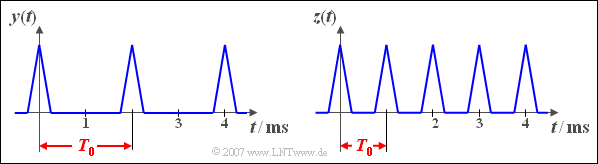
{What is the circular frequency $\omega_0$ of the signal $z(t)$?
{What is the basic circular frequency $\omega_0$ of the signal $z(t)$?
|type="{}"}
|type="{}"}
$\omega_0 \ = \ $ { 6283 3% } $\text{1/s}$
$\omega_0 \ = \ $ { 6283 3% } $\text{1/s}$
Line 58:
Line 58:
'''(2)''' The period duration $x(t)$ is $T_0 = 2\,\text{ms}$. The inverse amounts to the base frequency $f_0 \hspace{0.1cm}\underline{ = 500\,\text{Hz}}$.
'''(2)''' The period duration $x(t)$ is $T_0 = 2\,\text{ms}$. The inverse magnitudes to the base frequency $f_0 \hspace{0.1cm}\underline{ = 500\,\text{Hz}}$.
Line 71:
Line 71:
__NOEDITSECTION__
__NOEDITSECTION__
[[Category:Signal Representation: Exercises|^2.1 Description of Periodic Signals^]]
[[Category:Signal Representation: Exercises|^2.1 Description of Periodic Signals^]]
The non-linear characteristic $y = g(x)$ describes a half-wave rectifier.
$z = h(x) = |x|$ describes a full-wave rectifier.
(2) The period duration $x(t)$ is $T_0 = 2\,\text{ms}$. The inverse magnitudes to the base frequency $f_0 \hspace{0.1cm}\underline{ = 500\,\text{Hz}}$.
(3) The half-wave rectification does not change the duration of the period, see the left graph: $T_0 \hspace{0.1cm}\underline{= 2\,\text{ms}}$.
Periodic triangular signals
(4) After full-wave rectification, the signal $z(t)$ has double the frequency (see right graph). The following values apply here: