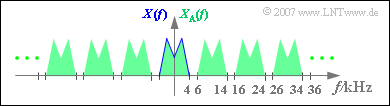
The range between the frequencies $f_1$ and $f_2 > f_1$ is not relevant for the solution of this task.
The range between the frequencies $f_1$ and $f_2 > f_1$ is not relevant for the solution of this task.
Line 31:
Line 25:
''Hints:''
''Hints:''
*This task belongs to the chapter [[Signal_Representation/Time_Discrete_Signal_Representation|Time-Discrete Signal Representation]].
*This task belongs to the chapter [[Signal_Representation/Time_Discrete_Signal_Representation|Discrete-Time Signal Representation]].
*There is an interactive applet for the topic dealt with here: [[Applets:Sampling_of_Analog_Signals_and_Signal_Reconstruction|Sampling of Analog Signals and Signal Reconstruction]]
*There is an interactive applet for the topic dealt with here: [[Applets:Sampling_of_Analog_Signals_and_Signal_Reconstruction|Sampling of Analog Signals and Signal Reconstruction]]
Line 86:
Line 80:
__NOEDITSECTION__
__NOEDITSECTION__
[[Category:Signal Representation: Exercises|^5.1 Time Discrete Signal Representation^]]
[[Category:Signal Representation: Exercises|^5.1 Discrete-Time Signal Representation^]]
The range between the frequencies $f_1$ and $f_2 > f_1$ is not relevant for the solution of this task.
The corner frequencies $f_1$ and $f_2$ are to be determined in such a way that the output signal $y(t)$ of the low-pass filter exactly matches the signal $x(t)$ .
(4) Likewise, it must be guaranteed that all spectral components of $X_{\rm A}(f)$, that are not contained in $X(f)$ are removed by the low-pass filter.
According to the sketch, the following must apply: