[[File:P_ID1126__Sig_A_5_1.png|right|frame|Sampling of an analog signal $x(t)$]]
Gegeben ist ein Analogsignal x(t) entsprechend der Skizze. Bekannt ist, dass dieses Signal keine höheren Frequenzen als BNF = 4 kHz beinhaltet. Durch Abtastung (Abtastrate fA) erhält man das in der Grafik rot eingezeichnete Signal xA(t).
Given is an analog signal $x(t)$ according to the sketch:
Zur Signalrekonstruktion wird ein Tiefpass mit dem Frequenzgang
*It is known that this signal does not contain any frequencies higher than $B_{\rm NF} = 4 \ \text{kHz}$.
*By sampling with the sampling rate $f_{\rm A}$ , the signal $x_{\rm A}(t)$ sketched in red in the diagram is obtained.
*For signal reconstruction a low-pass filter is used, for whose frequency response applies:
eingesetzt. Der Bereich zwischen den Frequenzen f1 und f2 > f1 ist für die Lösung dieser Aufgabe nicht relevant.
The range between the frequencies $f_1$ and $f_2 > f_1$ is not relevant for the solution of this task.
Die Eckfrequenzen f1 und f2 sind so zu bestimmen, dass das Ausgangssignal y(t) des Tiefpasses mit dem Signal x(t) exakt übereinstimmt.
Hinweis: Die Aufgabe bezieht sich auf die theoretischen Grundlagen von Kapitel 5.1. Zu der hier behandelten Thematik gibt es auch ein Interaktionsmodul:
The corner frequencies $f_1$ and $f_2$ are to be determined in such a way that the output signal $y(t)$ of the low-pass filter exactly matches the signal $x(t)$ .
Abtastung periodischer Signale und Signalrekonstruktion
===Fragebogen===
''Hints:''
*This task belongs to the chapter [[Signal_Representation/Time_Discrete_Signal_Representation|Discrete-Time Signal Representation]].
*There is an interactive applet for the topic dealt with here: [[Applets:Sampling_of_Analog_Signals_and_Signal_Reconstruction|Sampling of Analog Signals and Signal Reconstruction]]
===Questions===
<quiz display=simple>
<quiz display=simple>
{Ermitteln Sie aus der Grafik die zugrundeliegende Abtastrate.
{Determine the underlying sampling rate from the graph.
|type="{}"}
|type="{}"}
$f_A=$ { 10 } kHz
$f_{\rm A}\ = \ $ { 10 3% } $\text{kHz}$
{Bei welchen Frequenzen besitzt XA(f) mit Sicherheit keine Anteile?
{At which frequencies does the spectral function $X_{\rm A}(f)$ have <u>no components</u> with certainty?
|type="[]"}
|type="[]"}
- $f= $ { 2.5 } kHz
- $f = 2.5 \ \text{kHz},$
+ $f= $ { 5.5 } kHz
+ $f= 5.5 \ \text{kHz},$
- $f= $ { 6.5 } kHz
- $f= 6.5 \ \text{kHz},$
+ $f= $ { 34.5 } kHz
+ $f= 34.5 \ \text{kHz}.$
{Bis zu welcher Eckfrequenz f1 wird das Signal perfekt rekonstruiert?
{What is the minimum size of the lower cut-off frequency $f_1$ that the signal is perfectly reconstructed?
'''1.''' a) Der Abstand zweier benachbarter Abtastwerte beträgt TA = 0.1 ms. Somit erhält man für die Abtastrate fA = 1/TA = 10 kHz.
'''(1)''' The distance between two adjacent samples is $T_{\rm A} = 0.1 \ \text{ms}$. Thus, for the sampling rate $f_{\rm A} = 1/ T_{\rm A} \;\underline {= 10 \ \text{kHz}}$is obtained.
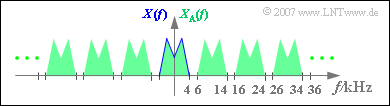
b) Das Spektrum XA(f) des abgetasteten Signals erhält man aus X(f) durch periodische Fortsetzung im Abstand fA = 10 kHz. Aus der Skizze erkennt man, dass XA(f) durchaus Anteile bei f = 2.5 kHz und f = 6.5 kHz besitzen kann, nicht jedoch bei f = 5.5 kHz. Auch bei f = 34.5 kHz wird XA(f) = 0 gelten. Richtig sind also die Lösungsvorschläge 2 und 4.
[[File:P_ID1127__Sig_A_5_1_b.png|450px|right|frame|Spectrum $X_{\rm A}(f)$ of the sampled signal <br>(schematic representation)]]
'''(2)''' Proposed <u>solutions 2 and 4</u> are correct:
*The spectrum $X_{\rm A}(f)$ of the sampled signal is obtained from $X(f)$ by periodic continuation at a distance of $f_{\rm A} = 10 \ \text{kHz}$.
*From the sketch you can see that $X_{\rm A}(f)$ can have signal parts at $f = 2.5 \ \text{kHz}$ and $f = 6.5 \ \text{kHz}$;.
*In contrast, there are no components at $f = 5.5 \ \text{kHz}$.
*Also at $f = 34.5 \ \text{kHz}$ will be valid $X_{\rm A}(f) = 0$.
<br clear=all>
'''(3)''' It must be ensured that all frequencies of the analog signal are weighted with $H(f) = 1$.
[[File:P_ID1127__Sig_A_5_1_b.png|250px|right|Zum Abtasttheorem (ML zu Aufgabe A5.1)]]
'''(4)''' Likewise, it must be guaranteed that all spectral components of $X_{\rm A}(f)$, that are not contained in $X(f)$ are removed by the low-pass filter.
*According to the sketch, the following must apply:
c) Es muss sichergestellt sein, dass alle Frequenzen des Analogsignals mit H(f) = 1 bewertet werden. Daraus folgt (siehe Skizze): f1, min = BNF = 4 kHz.
d) Ebenso muss garantiert werden, dass alle Spektralanteile von XA(f), die in X(f) nicht enthalten sind, durch den Tiefpass entfernt werden. Entsprechend der Skizze gilt f2, max = fA – BNF = 6 kHz.
{{ML-Fuß}}
{{ML-Fuß}}
__NOEDITSECTION__
__NOEDITSECTION__
[[Category:Aufgaben zu Signaldarstellung|^4. Bandpassartige Signale^]]
[[Category:Signal Representation: Exercises|^5.1 Discrete-Time Signal Representation^]]
The range between the frequencies $f_1$ and $f_2 > f_1$ is not relevant for the solution of this task.
The corner frequencies $f_1$ and $f_2$ are to be determined in such a way that the output signal $y(t)$ of the low-pass filter exactly matches the signal $x(t)$ .
(4) Likewise, it must be guaranteed that all spectral components of $X_{\rm A}(f)$, that are not contained in $X(f)$ are removed by the low-pass filter.
According to the sketch, the following must apply: