[[File: P_ID278_Sig_A_2_3neu.png|right|Spektrum von Cosinus- und Sinusanteilen]]
[[File: P_ID278_Sig_A_2_3neu.png|right|frame|Spectra of DC, cosine and sine components]]
Given is the amplitude spectrum $X(f)$ of a signal $x(t)$ according to the graph.
*Let $f_1 = 4\,\text{kHz}$ be the normalisation frequency.
*Thus the frequencies of the signal components are $0\,\text{kHz}$, $4\,\text{kHz}$ and $10\,\text{kHz}$.
This signal $x(t)$ is at the input of a linear differentiator whose output can be represented with $\omega_1 = 2\pi f_1$ as follows:
*This exercise belongs to the chapter [[ Signal_Representation/Harmonic_Oscillation|Harmonic Oscillation]].
Gegeben ist das Amplitudenspektrum $X(f)$ eines Signals $x(t)$ entsprechend der siehe Grafik.
Die Normierungsfrequenz sei $f_1 = 4\,\text{kHz}$ . Damit liegen die tatsächlichen Frequenzen der Signalanteile bei $0\,\text{kHz}$, $4\,\text{kHz}$ und $10\,\text{kHz}$ .
Dieses Signal $x(t)$ liegt am Eingang eines linearen Differenzierers, dessen Ausgang mit $\omega_1 = 2\pi f_1$ wie folgt dargestellt werden kann:
$$y(t)=\frac{1}{\omega_1}\cdot\frac{\rm d \it x(t)}{\rm d \it t}.$$
''Hinweise:''
*Die Aufgabe gehört zum Kapitel [[Signaldarstellung/Harmonische_Schwingung|Harmonische Schwingung]].
*Sollte die Eingabe des Zahlenwertes „0” erforderlich sein, so geben Sie bitte „0.” ein.
===Fragebogen===
===Questions===
<quiz display=simple>
<quiz display=simple>
{Geben Sie $x(t)$ analytisch an. Wie groß ist der Signalwert bei $t = 0$?
{Give $x(t)$ analytically. What is the signal value at $t = 0$?
|type="{}"}
|type="{}"}
$x(t=0)$ = { 1 3% } ${\rm V}$
$x(t=0)\ = \ $ { 1 3% } ${\rm V}$
{Wie groß ist die Periodendauer des Signals $x(t)$?
{What is the period duration of the signal $x(t)$?
|type="{}"}
|type="{}"}
$T_0$ = { 0.5 } ${\rm ms}$
$T_0\ = \ $ { 0.5 3% } ${\rm ms}$
{Berechnen Sie das Ausgangssignal $y(t)$ des Differenzierers. Wie groß ist der Signalwert zum Zeitpunkt $t = 0$?
{Calculate the output signal $y(t)$ of the differentiator. What is the signal value at time $t = 0$?
|type="{}"}
|type="{}"}
$y(t=0)$ = { 10 } ${\rm V}$
$y(t=0)\ = \ $ { 10 3% } ${\rm V}$
{Welche der nachfolgenden Aussagen sind bezüglich des Signals $y(t)$ bzw. seines Spektrums $Y(f)$ zutreffend?
{Which of the following statements are true regarding the signal $y(t)$ or its spectrum $Y(f)$ ?
|type="[]"}
|type="[]"}
+ $y(t)$ hat die gleiche Periodendauer wie das Signal $x(t)$.
+ $y(t)$ has the same period duration as the signal $x(t)$.
- $Y(f)$ beinhaltet eine Diracfunktion bei der Frequenz $f$ = 0.
- $Y(f)$ contains a Dirac function at the frequency $f = 0$.
- $Y(f)$ beinhaltet eine Diracfunktion bei $f_1$ mit Gewicht j · 1V.
- $Y(f)$ contains a Dirac function at $+f_1$ with weight $\rm{j} · 1\,{\rm V}$.
+ $Y(f)$ beinhaltet eine Diracfunktion bei –2.5$f_1$ mit Gewicht 5V.
+ $Y(f)$ contains a Dirac function at $–\hspace{-0.1cm}2.5 \cdot f_1$ with weight $5\,{\rm V}$.
</quiz>
</quiz>
===Musterlösung===
===Solution===
{{ML-Kopf}}
{{ML-Kopf}}
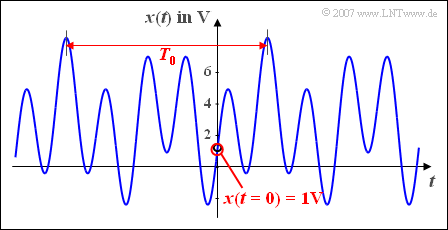
'''1.''' Das Zeitsignal hat die folgende Form:
'''(1)''' The time signal has the following form:
[[File:P_ID294__Sig_A_2_3_d_neu.png|250px|right|Spektrum mit diskreten Anteilen (ML zu Aufgabe A2.3)]]
*For $t = 0$ the value $y(t=0)\hspace{0.15cm}\underline{=10\,\rm V}$ follows.
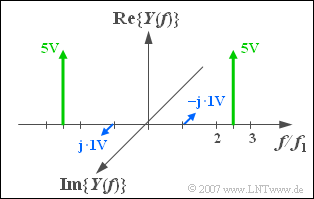
*The spectrum $Y(f)$ is shown on the right.
Für den Nullzeitpunkt ergibt sich der Wert 10 V. Nebenstehend sehen Sie das Spektrum $Y(f)$.
'''4.''' Die Periodendauer $T_0$ wird durch die Amplitude und die Phase der beiden Anteile nicht verändert. Das bedeutet, dass weiterhin $T_0$ = 0.5 ms gilt.
'''(4)''' The <u>solutions 1 and 4</u> are correct:
Der Gleichanteil verschwindet aufgrund der Differentiation. Der Anteil bei $f_1$ ist sinusförmig. Somit hat $X(f)$ einen (imaginären) Dirac bei $f = f_1$, jedoch mit negativem Vorzeichen. Der Cosinusanteil mit der Amplitude 10 V hat die beiden Diracfunktionen bei $\pm 2.5 \cdot f_1$ zur Folge, jeweils mit dem Gewicht 5 V. Richtig sind somit die Lösungsvorschläge 1 und 4.
*The period duration $T_0$ is not changed by the amplitude and phase of the two components.
*This means, that $T_0 = 0.5 {\,\rm ms}$ still applies.
*The DC component disappears due to the differentiation.
*The component $f_1$ is sinusoidal. Thus $X(f)$ has an (imaginary) Dirac at $f = f_1$, but with a negative sign.
*The cosine component with amplitude ${10\,\rm V}$ results in the two Dirac functions at $\pm 2.5 \cdot f_1$ , each with weight ${5\,\rm V}$ .
{{ML-Fuß}}
{{ML-Fuß}}
__NOEDITSECTION__
__NOEDITSECTION__
[[Category:Aufgaben zu Signaldarstellung|^2. Periodische Signale^]]
Here $\omega_1 = 2\pi f_1$ denotes the circular frequency of the cosine component.
At time $t = 0$ the signal has the value $x(t=0)\hspace{0.15 cm}\underline{=1\,\rm V}$.
(2) The basic frequency $f_0$ is the greatest common divisor
of $f_1 = 4{\,\rm kHz}$
and $2.5 · f_1 = 10{\,\rm kHz}$.
From this follows $f_0 = 2{\,\rm kHz}$ ⇒ period duration $T_0 = 1/f_0 \hspace{0.1cm}\underline{= 0.5 {\,\rm ms}}$.
(3) The following applies to the output signal $y(t)$ of the differentiatior: