Aufgaben:Exercise 2.3: Cosine and Sine Components: Difference between revisions
From LNTwww
No edit summary |
Fix interlanguage link: resolve redirect chain |
||
| (10 intermediate revisions by 4 users not shown) | |||
| Line 3: | Line 3: | ||
}} | }} | ||
[[File: P_ID278_Sig_A_2_3neu.png|right|frame| | [[File: P_ID278_Sig_A_2_3neu.png|right|frame|Spectra of DC, cosine and sine components]] | ||
Given is the amplitude spectrum $X(f)$ of a signal $x(t)$ according to the graph. | Given is the amplitude spectrum $X(f)$ of a signal $x(t)$ according to the graph. | ||
*Let $f_1 = 4\,\text{kHz}$ be the normalisation frequency. | *Let $f_1 = 4\,\text{kHz}$ be the normalisation frequency. | ||
*Thus the | *Thus the frequencies of the signal components are $0\,\text{kHz}$, $4\,\text{kHz}$ and $10\,\text{kHz}$. | ||
| Line 21: | Line 21: | ||
''Hint:'' | ''Hint:'' | ||
*This exercise belongs to the | *This exercise belongs to the chapter [[ Signal_Representation/Harmonic_Oscillation|Harmonic Oscillation]]. | ||
| Line 41: | Line 41: | ||
$T_0\ = \ $ { 0.5 3% } ${\rm ms}$ | $T_0\ = \ $ { 0.5 3% } ${\rm ms}$ | ||
{Calculate the output signal $y(t)$ of the differentiator What is the signal value at time $t = 0$? | {Calculate the output signal $y(t)$ of the differentiator. What is the signal value at time $t = 0$? | ||
|type="{}"} | |type="{}"} | ||
$y(t=0)\ = \ $ { 10 3% } ${\rm V}$ | $y(t=0)\ = \ $ { 10 3% } ${\rm V}$ | ||
{ | {Which of the following statements are true regarding the signal $y(t)$ or its spectrum $Y(f)$ ? | ||
|type="[]"} | |type="[]"} | ||
+ $y(t)$ | + $y(t)$ has the same period duration as the signal $x(t)$. | ||
- $Y(f)$ | - $Y(f)$ contains a Dirac function at the frequency $f = 0$. | ||
- $Y(f)$ | - $Y(f)$ contains a Dirac function at $+f_1$ with weight $\rm{j} · 1\,{\rm V}$. | ||
+ $Y(f)$ | + $Y(f)$ contains a Dirac function at $–\hspace{-0.1cm}2.5 \cdot f_1$ with weight $5\,{\rm V}$. | ||
</quiz> | </quiz> | ||
=== | ===Solution=== | ||
{{ML-Kopf}} | {{ML-Kopf}} | ||
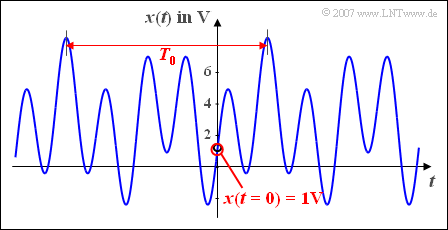
'''(1)''' The time signal has the following form: | |||
'''(1)''' | |||
:$$x(t)={\rm 3V}-{\rm 2V}\cdot \cos(\omega_{\rm 1} \cdot t)+{\rm 4V} \cdot \sin(2.5 \cdot \omega_{\rm 1} \cdot t).$$ | :$$x(t)={\rm 3V}-{\rm 2V}\cdot \cos(\omega_{\rm 1} \cdot t)+{\rm 4V} \cdot \sin(2.5 \cdot \omega_{\rm 1} \cdot t).$$ | ||
[[File:P_ID293__Sig_A_2_3_a.png|right|frame|Sum signal of DC, cosine and sine components]] | |||
*Here $\omega_1 = 2\pi f_1$ denotes the circular frequency of the cosine component. | |||
*At time $t = 0$ the signal has the value $x(t=0)\hspace{0.15 cm}\underline{=1\,\rm V}$. | |||
'''(2)''' | '''(2)''' The basic frequency $f_0$ is the greatest common divisor | ||
* | *of $f_1 = 4{\,\rm kHz}$ | ||
* | *and $2.5 · f_1 = 10{\,\rm kHz}$. | ||
From this follows $f_0 = 2{\,\rm kHz}$ ⇒ period duration $T_0 = 1/f_0 \hspace{0.1cm}\underline{= 0.5 {\,\rm ms}}$. | |||
<br clear=all> | <br clear=all> | ||
'''(3)''' The following applies to the output signal $y(t)$ of the differentiatior: | |||
'''(3)''' | |||
:$$y(t)=\frac{1}{\omega_1}\cdot\frac{ {\rm d}x(t)}{{\rm d}t}=\frac{ {\rm -2V}}{\omega_1}\cdot\omega_1 \cdot (-\sin(\omega_1 t))+\frac{\rm 4V}{\omega_1}\cdot 2.5\omega_1\cdot {\rm cos}(2.5\omega_1t).$$ | :$$y(t)=\frac{1}{\omega_1}\cdot\frac{ {\rm d}x(t)}{{\rm d}t}=\frac{ {\rm -2V}}{\omega_1}\cdot\omega_1 \cdot (-\sin(\omega_1 t))+\frac{\rm 4V}{\omega_1}\cdot 2.5\omega_1\cdot {\rm cos}(2.5\omega_1t).$$ | ||
[[File:P_ID294__Sig_A_2_3_d_neu.png|right|300px|frame|Spectrum with discrete components]] | |||
* | *This leads to the solution: | ||
:$$y(t)={\rm 2V}\cdot\sin(\omega_1 t)+{\rm 10V}\cdot\cos(2.5\omega_1 t).$$ | :$$y(t)={\rm 2V}\cdot\sin(\omega_1 t)+{\rm 10V}\cdot\cos(2.5\omega_1 t).$$ | ||
* | *For $t = 0$ the value $y(t=0)\hspace{0.15cm}\underline{=10\,\rm V}$ follows. | ||
* | *The spectrum $Y(f)$ is shown on the right. | ||
'''(4)''' | '''(4)''' The <u>solutions 1 and 4</u> are correct: | ||
* | *The period duration $T_0$ is not changed by the amplitude and phase of the two components. | ||
* | *This means, that $T_0 = 0.5 {\,\rm ms}$ still applies. | ||
* | *The DC component disappears due to the differentiation. | ||
* | *The component $f_1$ is sinusoidal. Thus $X(f)$ has an (imaginary) Dirac at $f = f_1$, but with a negative sign. | ||
* | *The cosine component with amplitude ${10\,\rm V}$ results in the two Dirac functions at $\pm 2.5 \cdot f_1$ , each with weight ${5\,\rm V}$ . | ||
{{ML-Fuß}} | {{ML-Fuß}} | ||
__NOEDITSECTION__ | __NOEDITSECTION__ | ||
[[Category: | [[Category:Signal Representation: Exercises|^2.3 Harmonic Oscillation^]] | ||
[[de:Aufgaben:Aufgabe 2.3: cos- und sin-Anteil]] | |||
Latest revision as of 17:53, 16 March 2026

Given is the amplitude spectrum $X(f)$ of a signal $x(t)$ according to the graph.
- Let $f_1 = 4\,\text{kHz}$ be the normalisation frequency.
- Thus the frequencies of the signal components are $0\,\text{kHz}$, $4\,\text{kHz}$ and $10\,\text{kHz}$.
This signal $x(t)$ is at the input of a linear differentiator whose output can be represented with $\omega_1 = 2\pi f_1$ as follows:
- $$y(t)=\frac{1}{\omega_1}\cdot\frac{ {\rm d} x(t)}{{\rm d} t}.$$
Hint:
- This exercise belongs to the chapter Harmonic Oscillation.
Questions
Solution
(1) The time signal has the following form:
Sum signal of DC, cosine and sine components 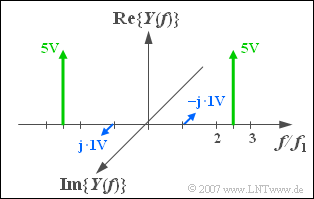
Spectrum with discrete components
- $$x(t)={\rm 3V}-{\rm 2V}\cdot \cos(\omega_{\rm 1} \cdot t)+{\rm 4V} \cdot \sin(2.5 \cdot \omega_{\rm 1} \cdot t).$$

- Here $\omega_1 = 2\pi f_1$ denotes the circular frequency of the cosine component.
- At time $t = 0$ the signal has the value $x(t=0)\hspace{0.15 cm}\underline{=1\,\rm V}$.
(2) The basic frequency $f_0$ is the greatest common divisor
- of $f_1 = 4{\,\rm kHz}$
- and $2.5 · f_1 = 10{\,\rm kHz}$.
From this follows $f_0 = 2{\,\rm kHz}$ ⇒ period duration $T_0 = 1/f_0 \hspace{0.1cm}\underline{= 0.5 {\,\rm ms}}$.
(3) The following applies to the output signal $y(t)$ of the differentiatior:
- $$y(t)=\frac{1}{\omega_1}\cdot\frac{ {\rm d}x(t)}{{\rm d}t}=\frac{ {\rm -2V}}{\omega_1}\cdot\omega_1 \cdot (-\sin(\omega_1 t))+\frac{\rm 4V}{\omega_1}\cdot 2.5\omega_1\cdot {\rm cos}(2.5\omega_1t).$$

- This leads to the solution:
- $$y(t)={\rm 2V}\cdot\sin(\omega_1 t)+{\rm 10V}\cdot\cos(2.5\omega_1 t).$$
- For $t = 0$ the value $y(t=0)\hspace{0.15cm}\underline{=10\,\rm V}$ follows.
- The spectrum $Y(f)$ is shown on the right.
(4) The solutions 1 and 4 are correct:
- The period duration $T_0$ is not changed by the amplitude and phase of the two components.
- This means, that $T_0 = 0.5 {\,\rm ms}$ still applies.
- The DC component disappears due to the differentiation.
- The component $f_1$ is sinusoidal. Thus $X(f)$ has an (imaginary) Dirac at $f = f_1$, but with a negative sign.
- The cosine component with amplitude ${10\,\rm V}$ results in the two Dirac functions at $\pm 2.5 \cdot f_1$ , each with weight ${5\,\rm V}$ .
