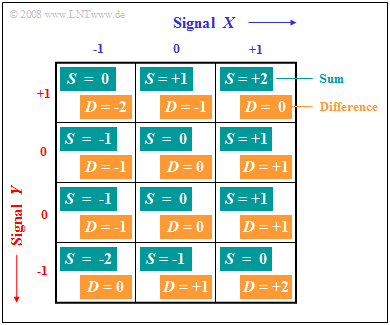
[[File:P_ID146__Sto_Z1_1.png|right|framed|Sum $S$ of two <br>ternary signals $X$ and $Y$]]
[[File:P_ID146__Sto_Z1_1.png|right|framed|Sum $S$ of two <br>ternary signals $X$ and $Y$]]
Let two three-stage message sources $X$ and $Y$, be given, whose output signals can only assume the values $-1$, $0$ and $+1$ respectively. The signal sources are statistically independent of each other.
Let two three-stage message sources $X$ and $Y$ be given, whose output signals can only assume the values $-1$, $0$ and $+1$ respectively. The signal sources are statistically independent of each other.
*A simple circuit now forms the sum signal $S = X + Y$.
*A simple circuit now forms the sum signal $S = X + Y$.
*At the signal source $X$ the values $-1$, $0$ and $+1$ occur with equal probability.
*At the signal source $X$, the values $-1$, $0$ and $+1$ occur with equal probability.
*For source $Y$ , the signal value $0$ is twice as likely as the other two values $-1$ and $+1$, respectively.
*For source $Y$, the signal value $0$ is twice as likely as the other two values $-1$ and $+1$, respectively.
Line 18:
Line 16:
*Solve the subtasks '''(3)''' and '''(4)''' according to the classical definition.
*Solve the subtasks '''(3)''' and '''(4)''' according to the classical definition.
*Nevertheless, consider the different occurrence frequencies of the signal $Y$.
*Nevertheless, consider the different occurrence frequencies of the signal $Y$.
*The topic of this section is illustrated with examples in the (German language) learning video [[Klassische_Definition_der_Wahrscheinlickeit_(Lernvideo)|Klassische Definition der Wahrscheinlichkeit]] $\Rightarrow$ "Classical definition of probability".
*The topic of this section is illustrated with examples in the (German language) learning video <br>[[Klassische_Definition_der_Wahrscheinlickeit_(Lernvideo)|Klassische Definition der Wahrscheinlichkeit]] $\Rightarrow$ "Classical definition of probability".
Line 28:
Line 26:
<quiz display=simple>
<quiz display=simple>
{What are the probabilities of occurrence of the signal values of $Y$? What is the probability that $Y = 0$ ?
{What are the probabilities of occurrence of the signal values of $Y$? What is the probability that $Y = 0$ ?
|type="{}"}
|type="{}"}
${\rm Pr}(Y=0) \ = \ $ { 0.5 3% }
${\rm Pr}(Y=0) \ = \ $ { 0.5 3% }
{How many different signal values $(I)$ can the sum signal $S$ assume? Which are these?
{How many different signal values $(I)$ can the sum signal $S$ assume? Which are these?
|type="{}"}
|type="{}"}
$ I \ = \ $ { 5 3% }
$ I \ = \ $ { 5 3% }
{What are the probabilities of the values determined in subtask '''(2)''' ? How probable is the maximum value $S_{\rm max}$?
{What are the probabilities of the values determined in subtask '''(2)'''? How probable is the maximum value $S_{\rm max}$?
{How do the probabilities change, if now instead of the sum the difference $D = X - Y$ is considered? Give reasons for your answer.
{How do the probabilities change, if now instead of the sum the difference $D = X - Y$ is considered? Give reasons for your answer.
|type="[]"}
|type="[]"}
+ The probabilities remain the same.
+ The probabilities remain the same.
Line 59:
Line 57:
[[File:EN_Sto_Z1_1_c_neu.png|right|frame|400px|Sum and difference of ternary random variables]]
'''(2)''' $S$ can take a total of $\underline {I =5}$ values, namely $0$, $\pm 1$ and $\pm 2$.
'''(2)''' $S$ can take a total of $\underline {I =5}$ values, namely $0$, $\pm 1$ and $\pm 2$.
[[File:EN_Sto_Z1_1_c.png|right|frame|400px|Sum and difference of ternary random variables]]
'''(3)''' Since $Y$ is not equally distributed, one cannot (actually) apply the "Classical Definition of Probability" here.
'''(3)''' Since $Y$ is not equally distributed, one cannot (actually) apply the "Classical Definition of Probability" here.
*However, if we divide $Y$ into four ranges according to the graph, assigning two of the ranges to the event $Y = 0$ , we can still proceed according to the classical definition.
*However, if we divide $Y$ into four ranges according to the graph, assigning two of the ranges to the event $Y = 0$, we can still proceed according to the classical definition.
*One then obtains:
*One then obtains:
Line 76:
Line 74:
'''(4)''' It is also evident from the graph that the difference signal $D$ and the sum signal $S$ take the same values with equal probabilities.
'''(4)''' It is also evident from the graph that the difference signal $D$ and the sum signal $S$ take the same values with equal probabilities.
*This was to be expected, since ${\rm Pr}(Y = +1) ={\rm Pr}(Y = -1)$ is given ⇒ <u>Proposed solution 1</u>.
*This was to be expected, since ${\rm Pr}(Y = +1) ={\rm Pr}(Y = -1)$ is given ⇒ <u>Proposed solution 1</u>.
{{ML-Fuß}}
{{ML-Fuß}}
Line 83:
Line 81:
[[Category:Theory of Stochastic Signals: Exercises|^1.1 Some Basic Definitions
[[Category:Theory of Stochastic Signals: Exercises|^1.1 Some Basic Definitions
Let two three-stage message sources $X$ and $Y$ be given, whose output signals can only assume the values $-1$, $0$ and $+1$ respectively. The signal sources are statistically independent of each other.
A simple circuit now forms the sum signal $S = X + Y$.
At the signal source $X$, the values $-1$, $0$ and $+1$ occur with equal probability.
For source $Y$, the signal value $0$ is twice as likely as the other two values $-1$ and $+1$, respectively.
Solve the subtasks (3) and (4) according to the classical definition.
Nevertheless, consider the different occurrence frequencies of the signal $Y$.
The topic of this section is illustrated with examples in the (German language) learning video Klassische Definition der Wahrscheinlichkeit $\Rightarrow$ "Classical definition of probability".
(2) $S$ can take a total of $\underline {I =5}$ values, namely $0$, $\pm 1$ and $\pm 2$.
(3) Since $Y$ is not equally distributed, one cannot (actually) apply the "Classical Definition of Probability" here.
However, if we divide $Y$ into four ranges according to the graph, assigning two of the ranges to the event $Y = 0$, we can still proceed according to the classical definition.