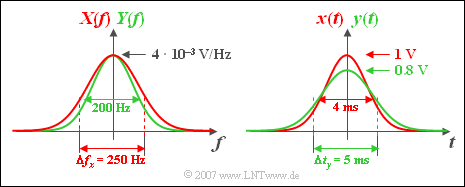
Es soll das Faltungsergebnis zweier Gaußfunktionen ermittelt werden. Wir betrachten einen gaußförmigen Eingangsimpuls ${x(t)}$ mit der Amplitude $x_0 = 1\,\text{ V}$ und der äquivalenten Dauer $\Delta t_x = 4 \,\text{ms}$ sowie eine ebenfalls gaußförmige Impulsantwort ${h(t)}$, welche die äquivalente Dauer $\Delta t_h = 3 \,\text{ms}$ aufweist:
The convolution result of two Gaussian functions is to be determined. We consider
*a Gaussian input pulse ${x(t)}$ with amplitude $x_0 = 1\,\text{V}$ and "equivalent pulse duration" $\Delta t_x = 4 \,\text{ms}$, as well as
*a likewise Gaussian impulse response ${h(t)}$, which has the "equivalent pulse duration" $\Delta t_h = 3 \,\text{ms}$ :
Gesucht ist das Ausgangssignal ${y(t)} = {x(t)} ∗{h(t)}$, wobei der Umweg über die Spektralfunktionen gegangen werden soll.
The output signal ${y(t)} = {x(t)} ∗{h(t)}$ is sought, whereby the diversions via the spectral functions is to be taken.
Line 13:
Line 15:
''Hinweis:''
*Die Aufgabe gehört zum Kapitel [[Signaldarstellung/Faltungssatz_und_Faltungsoperation|Faltungssatz und Faltungsoperation]].
''Hint:''
*This exercise belongs to the chapter [[Signal_Representation/The_Convolution_Theorem_and_Operation|The Convolution Theorem and Operation]].
===Fragebogen===
===Questions===
<quiz display=simple>
<quiz display=simple>
{Geben Sie die Spektralfunktionen ${X(f)}$ und ${H(f)}$ an. Welche Werte ergeben sich für $f = 0$?
{Give the spectral functions ${X(f)}$ and ${H(f)}$ an. Which values result for $f = 0$?
|type="{}"}
|type="{}"}
$X(f = 0)\ = \ $ { 4 3% } $\text{mV/Hz}$
$X(f = 0)\ = \ $ { 4 3% } $\text{mV/Hz}$
Line 28:
Line 31:
{Berechnen Sie die Spektralfunktion ${Y(f)}$ des Ausgangssignals. Wie groß ist der Spektralwert bei $f = 0$?
{Calculate the spectral function ${Y(f)}$ of the output signal. What is the spectral value at $f = 0$?
|type="{}"}
|type="{}"}
$Y(f = 0)\ = \ $ { 4 3% } $\text{mV/Hz}$
$Y(f = 0)\ = \ $ { 4 3% } $\text{mV/Hz}$
{Berechnen Sie den Ausgangsimpuls ${y(t)}$. Welche Werte ergeben sich für die Amplitude $y_0 = y(t = 0)$ und die äquivalente Impulsdauer $\Delta t_y$?
{Calculate the output pulse ${y(t)}$. What values result for the amplitude $y_0 = y(t = 0)$ and the equivalent pulse duration $\Delta t_y$?
|type="{}"}
|type="{}"}
$y_0\ = \ $ { 0.8 3% } $\text{V}$
$y_0\ = \ $ { 0.8 3% } $\text{V}$
Line 42:
Line 45:
</quiz>
</quiz>
===Musterlösung===
===Solution===
{{ML-Kopf}}
{{ML-Kopf}}
'''(1)''' Durch Fouriertransformation erhält man:
'''(1)''' By Fourier transformation one obtains:
*Der Maximalwert des Signals ${y(t)}$ liegt ebenfalls bei $t = 0$ und beträgt $y_0 \hspace{0.15cm}\underline{= 0.8 \text{ V} }$.
*The maximum value of the signal ${y(t)}$ is also at $t = 0$ and is $y_0 \hspace{0.15cm}\underline{= 0.8 \text{ V} }$.
*Die äquivalente Impulsdauer ergibt sich zu $\Delta t_y \hspace{0.15cm}\underline{= 5 \text{ ms}}$ (siehe obiges Bild, rechte Skizze).
*The equivalent pulse duration results in $\Delta t_y \hspace{0.15cm}\underline{= 5 \text{ ms}}$ (see above graphic, right sketch).
*Das bedeutet: Das Gaußfilter ${H(f)}$ bewirkt, dass der Ausgangsimpuls ${y(t)}$ kleiner und breiter als der Eingangsimpuls ${x(t)}$ ist.
*This means: The Gaussian ${H(f)}$ causes the output pulse ${y(t)}$ to be smaller and wider than the input pulse ${x(t)}$ .
*Die Impulsform bleibt weiterhin gaußförmig.
*The pulse shape remains Gaussian. Because: '''Gaussian convoluted with Gaussian always results in Gaussian!'''
{{ML-Fuß}}
{{ML-Fuß}}
__NOEDITSECTION__
__NOEDITSECTION__
[[Category:Aufgaben zu Signaldarstellung|^3. Aperiodische Signale - Impulse^]]
[[Category:Signal Representation: Exercises|^3.4 The Convolution Theorem^]]
[[de:Aufgaben:Aufgabe 3.9Z: Gauß gefaltet mit Gauß]]