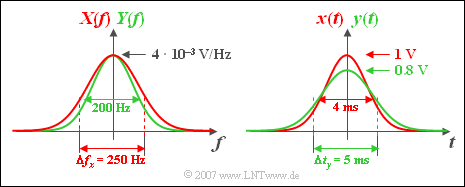
The convolution result of two Gaussian functions is to be determined. We consider a Gaussian input impulse ${x(t)}$ with amplitude $x_0 = 1\,\text{V}$ and equivalent duration $\Delta t_x = 4 \,\text{ms}$ as well as a likewise Gaussian impulse response ${h(t)}$, which has the equivalent duration $\Delta t_h = 3 \,\text{ms}$ :
The convolution result of two Gaussian functions is to be determined. We consider
*a Gaussian input pulse ${x(t)}$ with amplitude $x_0 = 1\,\text{V}$ and "equivalent pulse duration" $\Delta t_x = 4 \,\text{ms}$, as well as
*a likewise Gaussian impulse response ${h(t)}$, which has the "equivalent pulse duration" $\Delta t_h = 3 \,\text{ms}$ :
The output signal ${y(t)} = {x(t)} ∗{h(t)}$ is sought, whereby the diversions via the spectral functions is to be taken.
The output signal ${y(t)} = {x(t)} ∗{h(t)}$ is sought, whereby the diversions via the spectral functions is to be taken.
Line 23:
Line 25:
<quiz display=simple>
<quiz display=simple>
{Give the spectral functions ${X(f)}$ and ${H(f)}$ an. Which values result for $f = 0$?
{Give the spectral functions ${X(f)}$ and ${H(f)}$ an. Which values result for $f = 0$?
|type="{}"}
|type="{}"}
$X(f = 0)\ = \ $ { 4 3% } $\text{mV/Hz}$
$X(f = 0)\ = \ $ { 4 3% } $\text{mV/Hz}$
Line 29:
Line 31:
{Calculate the spectral function ${Y(f)}$ of the output signal. What is the spectral value at $f = 0$?
{Calculate the spectral function ${Y(f)}$ of the output signal. What is the spectral value at $f = 0$?
|type="{}"}
|type="{}"}
$Y(f = 0)\ = \ $ { 4 3% } $\text{mV/Hz}$
$Y(f = 0)\ = \ $ { 4 3% } $\text{mV/Hz}$
{Calculate the output pulse ${y(t)}$. What values result for the amplitude $y_0 = y(t = 0)$ and the equivalent pulse duration $\Delta t_y$?
{Calculate the output pulse ${y(t)}$. What values result for the amplitude $y_0 = y(t = 0)$ and the equivalent pulse duration $\Delta t_y$?
*The maximum value of the signal ${y(t)}$ is also at $t = 0$ and is $y_0 \hspace{0.15cm}\underline{= 0.8 \text{ V} }$.
*The maximum value of the signal ${y(t)}$ is also at $t = 0$ and is $y_0 \hspace{0.15cm}\underline{= 0.8 \text{ V} }$.
*The equivalent pulse duration results in $\Delta t_y \hspace{0.15cm}\underline{= 5 \text{ ms}}$ (see above picture, right sketch).
*The equivalent pulse duration results in $\Delta t_y \hspace{0.15cm}\underline{= 5 \text{ ms}}$ (see above graphic, right sketch).
*This means: The Gaussian ${H(f)}$ causes the output pulse ${y(t)}$ to be smaller and wider than the input pulse ${x(t)}$ .
*This means: The Gaussian ${H(f)}$ causes the output pulse ${y(t)}$ to be smaller and wider than the input pulse ${x(t)}$ .
*The pulse shape remains Gaussian because: '''Gaussian convoluted with Gaussian always results in Gaussian!'''
*The pulse shape remains Gaussian. Because: '''Gaussian convoluted with Gaussian always results in Gaussian!'''
{{ML-Fuß}}
{{ML-Fuß}}
Line 76:
Line 77:
__NOEDITSECTION__
__NOEDITSECTION__
[[Category:Signal Representation: Exercises|^3.4 The Convolution Theorem^]]
[[Category:Signal Representation: Exercises|^3.4 The Convolution Theorem^]]
[[de:Aufgaben:Aufgabe 3.9Z: Gauß gefaltet mit Gauß]]