Wir betrachten hier ein Binärsignal $b(t)$ und ein Quarternärsignal $q(t)$, wobei gilt:
We consider here a binay signal $b(t)$ and a quaternary signal $q(t)$.
*Die beiden Signale sind rechteckförmig, und die Dauer der einzelnen Rechtecke beträgt jeweils $T$ (Symboldauer).
*The two signals are rectangular in shape. The duration of each rectangle is $T$ (symbol duration).
*Die durch die Impulshöhen der einzelnen Rechteckimpulse dargestellten Symbole $($mit Stufenzahl $M = 2$ bzw. $M = 4)$ sind statistisch unabhängig.
*The symbols represented by the pulse heights of the individual rectangular pulses $($with step number $M = 2$ or $M = 4)$ are statistically independent.
*Wegen der bipolaren Signalkonstellation sind beide Signale gleichsignalfrei, wenn die Symbolwahrscheinlichkeiten geeignet (symmetrisch) gewählt werden.
*Because of the bipolar signal constellation, both signals have no DC component if the symbol probabilities are chosen appropriately (symmetrically).
*Aufgrund der letztgenannten Eigenschaft folgt für die Wahrscheinlichkeiten der Binärsymbole:
*Because of the latter property, it follows for the probabilities of the binary symbols:
{Wie groß ist der AKF–Wert bei $\tau = T$ ? Begründen Sie, warum die AKF–Werte für $|\tau| > T$ genauso groß sind. Skizzieren Sie den AKF–Verlauf.
{What is the magnitude of the ACF value when $\tau = T$ ? Justify why the ACF values for $|\tau| > T$ are of the same size. Sketch the ACF diagram.
|type="{}"}
|type="{}"}
$\varphi_q(\tau = T) \ = \ $ { 0. } $\ \rm V^2$
$\varphi_q(\tau = T) \ = \ $ { 0. } $\ \rm V^2$
{Mit welchen Amplitudenwerten $(\pm b_0)$ hat das Binärsignal $b(t)$ genau die gleiche AKF?
{With which amplitude values $(\pm b_0)$ does the binary signal $b(t)$ have exactly the same ACF?
|type="{}"}
|type="{}"}
$b_0\ = \ $ { 1.915 3% } $\ \rm V$
$b_0\ = \ $ { 1.915 3% } $\ \rm V$
{Welche der folgenden Beschreibungsgrößen eines stochastischen Prozesses lassen sich aus der AKF ermitteln?
{Which of the following descriptive quantities of a stochastic process can be determined from the ACF?
|type="[]"}
|type="[]"}
+ Periodendauer.
+ Period duration.
- Wahrscheinlichkeitsdichtefunktion.
- Probability density function.
+ Linearer Mittelwert.
+ Linear mean value.
+ Varianz.
+ Variance.
- Moment 3. Ordnung.
- 3rd order moment.
-Phasenbeziehungen.
- Phase relations.
Line 56:
Line 52:
</quiz>
</quiz>
===Musterlösung===
===Solution===
{{ML-Kopf}}
{{ML-Kopf}}
'''(1)''' Der AKF-Wert an der Stelle $\tau = 0$ entspricht der mittleren Signalleistung, also dem quadratischen Mittelwert von $q(t)$. Für diesen gilt:
'''(1)''' The ACF value at the point $\tau = 0$ corresponds to the mean signal power, i.e. the variance of $q(t)$. For this holds:
'''(2)''' The individual symbols were assumed to be statistically independent.
*Therefore, and because of the lack of a DC component, for any integer value of $\nu$, the following applies here:
'''(2)''' Die einzelnen Symbole wurden als statistisch unabhängig vorausgesetzt. Deshalb und wegen des fehlenden Gleichanteils gilt hier für jeden ganzzahligen Wert von $\nu$:
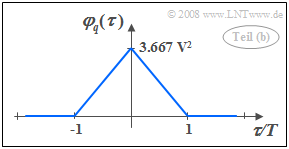
*Thus, the ACF we are looking for has the shape sketched on the right.
*In the range $-T \le \tau \le +T$ the ACF is sectionwise linear, i.e. triangular, due to the rectangular pulse shape.
*Somit hat die gesuchte AKF den rechts skizzierten Verlauf.
*Im Bereich $-T \le \tau \le +T$ ist die AKF aufgrund der rechteckförmigen Impulsform abschnittsweise linear, also dreieckförmig.
<br clear=all>
<br clear=all>
'''(3)''' Die AKF $\varphi_b(\tau)$ des Binärsignals ist aufgrund der statistisch unabhängigen Symbole im Bereich $| \tau| > T$ ebenfalls identisch $0$, und für $-T \le \tau \le +T$ ergibt sich ebenfalls eine Dreiecksform. Für den quadratischen Mittelwert erhält man:
'''(3)''' The ACF $\varphi_b(\tau)$ of the binary signal is also identically zero due to the statistically independent symbols in the range $| \tau| > T$.
*For $-T \le \tau \le +T$ itnalso results in a triangular shape.
*For the second moment, one obtains:
:$$\varphi_b (\tau = 0) = b_{\rm 0}^{\rm 2}.$$
:$$\varphi_b (\tau = 0) = b_{\rm 0}^{\rm 2}.$$
Mit $b_0\hspace{0.15cm}\underline{= 1.915\, \rm V}$ sind die beiden Autokorrelationsfunktionen $\varphi_q(\tau)$ und $\varphi_b(\tau)$ identisch.
*With $b_0\hspace{0.15cm}\underline{= 1.915\, \rm V}$ the two auto-correlation functions $\varphi_q(\tau)$ and $\varphi_b(\tau)$ are identical.
'''(4)''' Correct are <u>the proposed solutions 1, 3, and 4</u>.
'''(4)''' Richtig sind <u>die Lösungsvorschläge 1, 3 und 4</u>. Aus der Autokorrelationsfunktion lassen sich tatsächlich ermitteln:
From the autocorrelation function we can actually determine:
*die Periodendauer $T_0$: diese ist für die Mustersignale und die AKF gleich;
*The period $T_0$: this is the same for the pattern signals and the ACF;
* der lineare Mittelwert: Wurzel aus dem Endwert der AKF für $\tau \to \infty$; und
* the linear mean: root of the final value of the ACF for $\tau \to \infty$;
* die Varianz: Differenz der AKF-Werte von $\tau = 0$ und $\tau \to \infty$.
* the variance: difference of the ACF values of $\tau = 0$ and $\tau \to \infty$.
Nicht ermittelt werden können:
Cannot be determined:
* die Wahrscheinlichkeitsdichtefunktion: trotz $\varphi_q(\tau) =\varphi_b(\tau)$ ist $f_q(q) \ne f_b(b)$;
* The probability density function $\rm (PDF)$: <br> despite $\varphi_q(\tau) =\varphi_b(\tau)$ ⇒ $f_q(q) \ne f_b(b)$;
* die Momente höherer Ordnung: für deren Berechnung benötigt man die WDF; sowie
* the moments of higher order: <br> for their calculation one needs the PDF;
* alle Phasenbeziehungen und Symmetrieeigenschaften.
* all phase relations and symmetry properties are not recognizable from the ACF.
{{ML-Fuß}}
{{ML-Fuß}}
Line 91:
Line 94:
[[Category:Aufgaben zu Stochastische Signaltheorie|^4.4 Autokorrelationsfunktion (AKF)^]]
[[Category:Theory of Stochastic Signals: Exercises|^4.4 Auto-Correlation Function^]]
We consider here a binay signal $b(t)$ and a quaternary signal $q(t)$.
The two signals are rectangular in shape. The duration of each rectangle is $T$ (symbol duration).
The symbols represented by the pulse heights of the individual rectangular pulses $($with step number $M = 2$ or $M = 4)$ are statistically independent.
Because of the bipolar signal constellation, both signals have no DC component if the symbol probabilities are chosen appropriately (symmetrically).
Because of the latter property, it follows for the probabilities of the binary symbols:
(1) The ACF value at the point $\tau = 0$ corresponds to the mean signal power, i.e. the variance of $q(t)$. For this holds:
Triangular auto-correlation function