Aufgaben:Exercise 2.13: Inverse Burrows-Wheeler Transformation: Difference between revisions
No edit summary |
Fix interlanguage link: resolve redirect chain |
||
| (10 intermediate revisions by 4 users not shown) | |||
| Line 1: | Line 1: | ||
{{quiz-Header|Buchseite= | {{quiz-Header|Buchseite=Information_Theory/Further_Source_Coding_Methods | ||
}} | }} | ||
[[File:EN_Inf_A_2_14.png|right|frame| | [[File:EN_Inf_A_2_14.png|right|frame|BWT result to be analyzed]] | ||
The "Burrows–Wheeler Transformation" – abbreviated $\rm BWT$ – causes a blockwise sorting of the characters of a text with the aim of preparing the text for efficient data compression with the help of run-length coding or entropy coding. | |||
* First, an $N×N$ | * First, an $N×N$ matrix is generated from a block of length $N$, with each row of this first matrix resulting from the preceding row by cyclic left shift. | ||
* Then the matrix is sorted lexicographically (without special characters: alphabetically) . The result of the BWT is the last row of the new BWT matrix, the so-called $\text{L | * Then the matrix is sorted lexicographically (without special characters: alphabetically) . The result of the BWT is the last row of the new BWT matrix, the so-called $\text{L column}$ (from "Last"). | ||
* Further, this task refers to the $\text{F | * Further, this task refers to the $\text{F column}$ (from "First", first row of the BWT matrix), which is needed for the inverse Burrows–Wheeler Transformation ⇒ reconstruction of the original text from the L column. | ||
* For the inverse BWT, the so-called | * For the inverse BWT, the so-called "primary index" $I$ is also required. This indicates the row of the BWT matrix in which the algorithm must be started. | ||
The graphic shows the result of a BWT, more precisely its L | The graphic shows the result of a BWT, more precisely its L column. The original text is to be reconstructed from this according to the description in the theory section [[Information_Theory/Further_Source_Coding_Methods#Burrows.E2.80.93Wheeler_transformation|Burrows–Wheeler Transformation]], | ||
* | *in subtask '''(2)''' with the primary index $I = 7$, | ||
* | *in subtask '''(3)''' $I = 0$ is to be assumed. | ||
| Line 25: | Line 25: | ||
Hints: | <u>Hints:</u> | ||
*The exercise belongs to the chapter [[Information_Theory/ | *The exercise belongs to the chapter [[Information_Theory/Further_Source_Coding_Methods|Further Source Coding Methods]]. | ||
*In particular, reference is made to the | *In particular, reference is made to the section [[Information_Theory/Further_Source_Coding_Methods#Burrows.E2.80.93Wheeler_transformation|Burrows–Wheeler Transformation]]. | ||
| Line 36: | Line 33: | ||
<quiz display=simple> | <quiz display=simple> | ||
{What is the $\text{F | {What is the $\text{F column}$ associated with the given $\text{L column}$ ? | ||
|type="()"} | |type="()"} | ||
- $\rm SEINMEINDEIN$, | - $\rm SEINMEINDEIN$, | ||
| Line 50: | Line 47: | ||
{What happens if the reconstruction $\text{(BWT | {What happens if the reconstruction $\text{(inverse BWT transformation})$ starts from the wrong primary index $I = 0$ ? | ||
|type="[]"} | |type="[]"} | ||
- | - $\rm MEINDEINSEIN$, | ||
+ | + $\rm DEINSEINMEIN$, | ||
- $\rm NIESNIEDNIEM$. | |||
Why is the Burrows–Wheeler | {Why is the Burrows–Wheeler transformation better suited than the original with regard to a later data compression? | ||
|type="[]"} | |type="[]"} | ||
- It results in more favourable character frequencies. | - It results in more favourable character frequencies. | ||
| Line 68: | Line 66: | ||
===Solution=== | ===Solution=== | ||
{{ML-Kopf}} | {{ML-Kopf}} | ||
'''(1)''' <u> | '''(1)''' The <u>solution suggestion 3</u> is correct: | ||
*The first column of the BWT matrix is also called the F | *The first column of the BWT matrix is also called the "F column" and the last column the "L column" (from "First" or "Last"). | ||
*Only the L | *Only the "L column" is passed on to the next coding level. | ||
*The F | *The "F column", which is also needed for the reverse transformation, results from the "L column" by lexicographically sorting. | ||
:[[File:Inf_Z_2_14b_v2.png|right|frame|Inverse BWT with $I = 7$ (left) or $I = 0$ (right)]] | |||
:[[File: | |||
'''(2)''' The <u>solution suggestion 1</u> is correct: <b>MEINDEINSEIN</b>, as can be seen from the left-hand representation of the following diagram. <br>Note that the top line represents the line number $I = 0$ in each case. For explanation: | |||
* Start the decoding with the line $I = 7$ of the "F column". <br>The content is $\rm M$. | |||
* Search for the corresponding $\rm M$ in the "L column" and find it in line number "1". | |||
* From line 1 of the "L column" one goes horizontally to the "F column" and finds the symbol $\rm E$. | |||
* Similarly, one finds the third output symbol $\rm I$ in line 4 of the "F column". | |||
* The decoding algorithm ends with the output symbol $\rm N$ in the third last row. | |||
'''(3)''' Correct is the <u>proposed solution 2</u>: | |||
'''(3)''' Correct is the <u>proposed solution 2</u>: $\rm DEINSEINMEIN$, as shown in the graph on the right. | |||
<br clear=all> | <br clear=all> | ||
'''(4)''' Correct is the <u>suggested solution 3</u>: | '''(4)''' Correct is the <u>suggested solution 3</u>: | ||
*In BWT, four characters here are equal to their predecessors, in the original none. | *In BWT, four characters here are equal to their predecessors, in the original none. | ||
*In the | *In the "F column", even more characters would be the same as their respective predecessors (6 in total) due to the lexicographical sorting, but this sorting cannot be reversed without loss. | ||
*Solution suggestion 1 is | *Solution suggestion 1 is wrong too: <br>The original and BWT contain exactly the same characters $($three times $\rm E$, three times $\rm I$, three times $\rm N$ and one each of $\rm D$, $\rm M$ and $\rm S)$. | ||
{{ML-Fuß}} | {{ML-Fuß}} | ||
| Line 96: | Line 96: | ||
[[Category:Information Theory: Exercises|^2.4 Further Source Coding Methods^]] | [[Category:Information Theory: Exercises|^2.4 Further Source Coding Methods^]] | ||
[[de:Aufgaben:Aufgabe 2.13: Burrows-Wheeler-Rücktransformation]] | |||
Latest revision as of 17:54, 16 March 2026

The "Burrows–Wheeler Transformation" – abbreviated $\rm BWT$ – causes a blockwise sorting of the characters of a text with the aim of preparing the text for efficient data compression with the help of run-length coding or entropy coding.
- First, an $N×N$ matrix is generated from a block of length $N$, with each row of this first matrix resulting from the preceding row by cyclic left shift.
- Then the matrix is sorted lexicographically (without special characters: alphabetically) . The result of the BWT is the last row of the new BWT matrix, the so-called $\text{L column}$ (from "Last").
- Further, this task refers to the $\text{F column}$ (from "First", first row of the BWT matrix), which is needed for the inverse Burrows–Wheeler Transformation ⇒ reconstruction of the original text from the L column.
- For the inverse BWT, the so-called "primary index" $I$ is also required. This indicates the row of the BWT matrix in which the algorithm must be started.
The graphic shows the result of a BWT, more precisely its L column. The original text is to be reconstructed from this according to the description in the theory section Burrows–Wheeler Transformation,
- in subtask (2) with the primary index $I = 7$,
- in subtask (3) $I = 0$ is to be assumed.
Hints:
- The exercise belongs to the chapter Further Source Coding Methods.
- In particular, reference is made to the section Burrows–Wheeler Transformation.
Questions
Solution
- The first column of the BWT matrix is also called the "F column" and the last column the "L column" (from "First" or "Last").
- Only the "L column" is passed on to the next coding level.
- The "F column", which is also needed for the reverse transformation, results from the "L column" by lexicographically sorting.
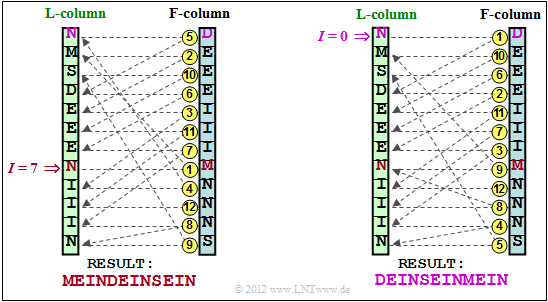
Inverse BWT with $I = 7$ (left) or $I = 0$ (right)

(2) The solution suggestion 1 is correct: MEINDEINSEIN, as can be seen from the left-hand representation of the following diagram.
Note that the top line represents the line number $I = 0$ in each case. For explanation:
- Start the decoding with the line $I = 7$ of the "F column".
The content is $\rm M$. - Search for the corresponding $\rm M$ in the "L column" and find it in line number "1".
- From line 1 of the "L column" one goes horizontally to the "F column" and finds the symbol $\rm E$.
- Similarly, one finds the third output symbol $\rm I$ in line 4 of the "F column".
- The decoding algorithm ends with the output symbol $\rm N$ in the third last row.
(3) Correct is the proposed solution 2: $\rm DEINSEINMEIN$, as shown in the graph on the right.
(4) Correct is the suggested solution 3:
- In BWT, four characters here are equal to their predecessors, in the original none.
- In the "F column", even more characters would be the same as their respective predecessors (6 in total) due to the lexicographical sorting, but this sorting cannot be reversed without loss.
- Solution suggestion 1 is wrong too:
The original and BWT contain exactly the same characters $($three times $\rm E$, three times $\rm I$, three times $\rm N$ and one each of $\rm D$, $\rm M$ and $\rm S)$.
