Die zu berechnende Spektralfunktion $X(f)$ wird komplex sein und kann daher
The spectral function $X(f)$ to be calculated will be complex and therefore can be represented
*nach Real– und Imaginärteil, aber auch
*by real and imaginary part, but also
*nach Betrag und Phase
*by magnitude and phase.
dargestellt werden. Verwenden Sie die Notation:
:$$X( f ) = \left| {X( f )} \right| \cdot {\rm e}^{ - {\rm j} \hspace{0.05cm}\cdot \hspace{0.05cm} \varphi( f )} .$$
Line 30:
Line 27:
''Hint:''
*This exercise belongs to the chapter [[Signal_Representation/Fourier_Transform_and_Its_Inverse|Fourier Transform and its Inverse]].
*Use the notation:
''Hinweis:''
*Die Aufgabe gehört zum Kapitel [[Signaldarstellung/Fouriertransformation_und_-rücktransformation|Fouriertransformation und –rücktransformation]].
:$$X( f ) = \left| {X( f )} \right| \cdot {\rm e}^{ - {\rm j} \hspace{0.05cm}\cdot \hspace{0.05cm} \varphi( f )} .$$
===Fragebogen===
===Questions===
<quiz display=simple>
<quiz display=simple>
{Berechnen Sie die Spektralfunktion $X(f)$. Welcher Spektralwert ergibt sich bei der Frequenz $f = 0$?
{Calculate the spectral function $X(f)$. What spectral value results at the frequency $f = 0$?
{Wie lauten der Real– und der Imaginärteil von $X(f)$ unter Verwendung von $f_0 = 1/(2\pi T)$. Welche Werte ergeben sich bei $f = f_0$?
{What are the real and imaginary parts of $X(f)$ using $f_0 = 1/(2\pi T)$. What are the values when $f = f_0$?
{Berechnen Sie die Phasenfunktion $\varphi(f)$. Welche Werte ergeben sich hierfür bei der Frequenz $f = f_0$ und bei sehr großen Frequenzen?
{Calculate the phase function $\varphi(f)$. What values result for this at the frequency $f = f_0$ and at very high frequencies?
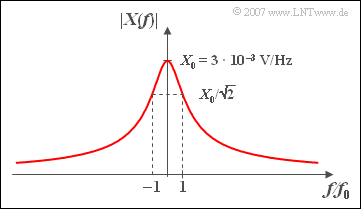
'''(3)''' The magnitude of a complex-valued function, which is a quotient, is equal to the quotient of the magnitudes of the numerator and denominator.
[[File:P_ID548__Sig_A_3_1_c_neu.png|right|frame|Magnitude spectrum of the exponential pulse]]
[[File:P_ID548__Sig_A_3_1_c_neu.png|right|frame|Betragsspektrum des Exponentialimpulses]]
*Thus one obtains:
'''(3)''' Der Betrag einer komplexwertigen Funktion, die als Quotient vorliegt, ist gleich dem Quotienten der Beträge von Zähler und Nenner.
* Für sehr große Werte von $f$ nähert sich die Phasenfunktion dem Wert $\arctan(\infty) = \pi /2 \hspace{0.15 cm}\underline{ \approx 1.571}$ an.
*For very large values of $f$ the phase function approaches $\varphi ( f \to \infty ) =\arctan(\infty) = \pi /2 \hspace{0.15 cm}\underline{ \approx 1.571}$.
*Beide Angaben sind im Bogenmaß („Radian”) zu verstehen.
*Both specifications are to be understood in radians.
{{ML-Fuß}}
{{ML-Fuß}}
__NOEDITSECTION__
__NOEDITSECTION__
[[Category:Aufgaben zu Signaldarstellung|^3. Aperiodische Signale - Impulse^]]
[[Category:Signal Representation: Exercises|^3.1 Fourier Transform and Its Inverse^]]
[[de:Aufgaben:Aufgabe 3.1: Spektrum des Exponentialimpulses]]
For $f = f_0$ this gives $\varphi ( f_0 ) =\arctan(1)= \pi /4 \hspace{0.15 cm}\underline{\approx 0.785}$.
For very large values of $f$ the phase function approaches $\varphi ( f \to \infty ) =\arctan(\infty) = \pi /2 \hspace{0.15 cm}\underline{ \approx 1.571}$.
Both specifications are to be understood in radians.