Let the pulse amplitude be $A = 1\, \text{V}$, the time parameter $T = 1 \text{ ms}$. For all times $|\hspace{0.05cm} t \hspace{0.05cm} | > T$ ist ${x(t)} = 0$.
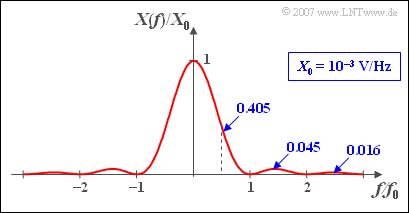
Let the pulse amplitude be $A = 1\, \text{V}$ and the time parameter $T = 1 \text{ ms}$. For all times $|\hspace{0.05cm} t \hspace{0.05cm} | > T$ ⇒ ${x(t)} = 0$.
To calculate the spectral function ${X(f)}$ you can exploit the following properties:
To calculate the spectral function ${X(f)}$ you can exploit the following properties:
* The time function is even and thus the spectral function is real:
* The time function is even and thus the spectral function is real:
*This exercise belongs to the chapter [[Signal_Representation/Fourier_Transform_and_Its_Inverse|Fourier Transform and Its Inverse]].
*This exercise belongs to the chapter [[Signal_Representation/Fourier_Transform_and_Its_Inverse|Fourier Transform and its Inverse]].
*Further information on this topic can be found in the learning video [[Kontinuierliche_und_diskrete_Spektren_(Lernvideo)|Continuous and discrete spectra]].
*Further information on this topic can be found in the (German language) learning video [[Kontinuierliche_und_diskrete_Spektren_(Lernvideo)|Kontinuierliche und diskrete Spektren]] ⇒ "Continuous and discrete spectra".
*You can use the following formulas to solve this task:
*You can use the following formulas to solve this task:
{Give the spectral function ${X(f)}$ using the slit function $\text{si}(x) = \sin(x)/x$ . What value results for $f = 0$?
{Give the spectral function ${X(f)}$ using the "slitting function" $\text{si}(x) = \sin(x)/x$. What value results for $f = 0$?
|type="{}"}
|type="{}"}
$X(f = 0) \ = \ $ { 1 3% } $\text{mV/Hz}$
$X(f = 0) \ = \ $ { 1 3% } $\text{mV/Hz}$
{At what frequency $f = f_0$ does the spectrum ${X(f)}$ have the first zero?
{At what frequency $f = f_0$ does the spectrum ${X(f)}$ have the first zero?
|type="{}"}
|type="{}"}
$f_0 \ = \ $ { 1 3% } $\text{kHz}$
$f_0 \ = \ $ { 1 3% } $\text{kHz}$
Line 58:
Line 58:
===Solution===
===Solution===
{{ML-Kopf}}
{{ML-Kopf}}
'''(1)''' Taking advantage of the above symmetry properties, the abbreviation $\omega = 2\pi f$ holds:
'''(1)''' We use the abbreviation $\omega = 2\pi f$. Then taking advantage of the above symmetry properties:
*At frequency $f = 1/(2T) = 500 \,\text{Hz}$ the argument of the cosine function is equal to $\pi$ and the cosine function itself is equal to $-1$. It follows:
*At frequency $f = 1/(2T) = 500 \,\text{Hz}$ the argument of the cosine function is equal to $\pi$ and the cosine function itself is equal to $-1$. It follows:
'''(2)''' With the trigonometric transformation ${1}/{2} \cdot (1 - \cos (2 \alpha)) = \sin^2(\alpha)$ one obtains for the spectral function:
'''(2)''' With the trigonometric transformation ${1}/{2} \cdot (1 - \cos (2 \alpha)) = \sin^2(\alpha)$ one obtains for the spectral function:
Let the pulse amplitude be $A = 1\, \text{V}$ and the time parameter $T = 1 \text{ ms}$. For all times $|\hspace{0.05cm} t \hspace{0.05cm} | > T$ ⇒ ${x(t)} = 0$.
To calculate the spectral function ${X(f)}$ you can exploit the following properties:
The time function is even and thus the spectral function is real:
Further information on this topic can be found in the (German language) learning video Kontinuierliche und diskrete Spektren ⇒ "Continuous and discrete spectra".
You can use the following formulas to solve this task:
At frequency $f = 1/(2T) = 500 \,\text{Hz}$ the argument of the cosine function is equal to $\pi$ and the cosine function itself is equal to $-1$. It follows: