Die Seite wurde neu angelegt: „ {{quiz-Header|Buchseite=Signaldarstellung/Fouriertransformation und -rücktransformation }} right| Betrachtet wird ein d…“
Die Impulsamplitude sei $A = 1 \text{V}$, der Zeitparameter $T = 1 \text{ms}$. Für alle Zeiten $| t | > T$ ist $\text{x(t)} = 0$.
Let the pulse amplitude be $A = 1\, \text{V}$ and the time parameter $T = 1 \text{ ms}$. For all times $|\hspace{0.05cm} t \hspace{0.05cm} | > T$ ⇒ ${x(t)} = 0$.
Zur Berechnung der Spektralfunktionen $\text{X(f)}$ können Sie folgende Eigenschaften ausnutzen:
To calculate the spectral function ${X(f)}$ you can exploit the following properties:
:* Die Zeitfunktion ist gerade und damit die Spektralfunktion reell:
* The time function is even and thus the spectral function is real:
<b>Hinweis:</b> Diese Aufgabe bezieht sich auf die theoretischen Grundlagen von [http://en.lntwww.de/Signaldarstellung/Fouriertransformation_und_-rücktransformation Kapitel 3.1]. Zur Lösung dieser Aufgabe können Sie auf die folgenden Formeln zurückgreifen:
*This exercise belongs to the chapter [[Signal_Representation/Fourier_Transform_and_Its_Inverse|Fourier Transform and its Inverse]].
*Further information on this topic can be found in the (German language) learning video [[Kontinuierliche_und_diskrete_Spektren_(Lernvideo)|Kontinuierliche und diskrete Spektren]] ⇒ "Continuous and discrete spectra".
*You can use the following formulas to solve this task:
{Geben Sie die Spektralfunktion $\text{X(f)}$ unter Verwendung der Spaltfunktion $si(x) = sin(x)/x$ an. Welcher Wert ergibt sich bei der Frequenz $f = 0$?
{Give the spectral function ${X(f)}$ using the "slitting function" $\text{si}(x) = \sin(x)/x$. What value results for $f = 0$?
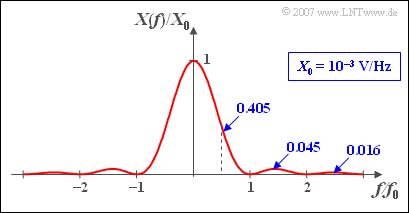
Bei der Frequenz $f = 1/(2T) = 500 \text{Hz}$ ist das Argument der Cosinusfunktion gleich $\pi$ und damit die Cosinusfunktion selbst gleich $–1$. Daraus folgt:
*At frequency $f = 1/(2T) = 500 \,\text{Hz}$ the argument of the cosine function is equal to $\pi$ and the cosine function itself is equal to $-1$. It follows:
'''(2)''' With the trigonometric transformation ${1}/{2} \cdot (1 - \cos (2 \alpha)) = \sin^2(\alpha)$ one obtains for the spectral function:
:$$X(f) = A \cdot T \cdot \frac{\sin^2(\pi f T)}{\pi^2 \cdot {f^2 \cdot T^2}} = A \cdot T \cdot {{{\rm si}^2(\pi f T)}}.$$
:$$X(f) = A \cdot T \cdot \frac{\sin^2(\pi f T)}{\pi^2 \cdot {f^2 \cdot T^2}} = A \cdot T \cdot {{{\rm si}^2(\pi f T)}}.$$
Bei der Frequenz $f = 0$ ist die si-Funktion gleich $1$. Daraus folgt:
*At the frequency $f = 0$ the $\rm si$-function is equal to $1$. From this follows:
:$$X( {f = 0} ) = A \cdot T \hspace{0.15 cm}\underline{= 10^{ - 3} \;{\rm V/Hz}}.$$
:$$X( {f = 0} ) = A \cdot T \hspace{0.15 cm}\underline{= 1\,{\rm mV/Hz}}.$$
'''(3)''' The first zero occurs when the argument of the $\rm si$-function is equal to $\pi$.
*From this follows: $f_0 \cdot T = 1$ bzw. $f_0 = 1/T \hspace{0.15 cm}\underline{= 1 \ \text{kHz}}$.
'''3.''' Die erste Nullstelle tritt auf, wenn das Argument der si-Funktion gleich $\pi$ ist. Daraus folgt $f_0 \cdot T = 1$ bzw. $f_0 = 1/T \underline{= 1 \text{kHz}}$.
'''(4)''' The <u>first statement</u> is correct:
*The spectrum ${X(f)}$ is equal to ${\rm si}^2(n \cdot \pi) = 0$ at multiples of $f_0$ $(f = n \cdot f_0)$.
*The second statement is false: At no frequency $f$ holds: ${X(f)} < 0$ (see sketch).
'''4.''' Die Spektralfunktion $\text{X(f)}$ ist bei Vielfachen von $f_0$ ($f = n \cdot f_0$) gleich $si^2(n \cdot \pi) = 0$. Die erste Aussage trifft also zu im Gegensatz zur zweiten: Bei keiner Frequenz $f$ ist $\text{X(f)} < 0$ (siehe Skizze).
[[File:P_ID497__Sig_Z_3_1_d_neu.png|center|]]
{{ML-Fuß}}
{{ML-Fuß}}
__NOEDITSECTION__
__NOEDITSECTION__
[[Category:Aufgaben zu Signaldarstellung|^3. Aperiodische Signale - Impulse^]]
[[Category:Signal Representation: Exercises|^3.1 Fourier Transform and Its Inverse^]]
[[de:Aufgaben:Aufgabe 3.1Z: Spektrum des Dreieckimpulses]]
Let the pulse amplitude be $A = 1\, \text{V}$ and the time parameter $T = 1 \text{ ms}$. For all times $|\hspace{0.05cm} t \hspace{0.05cm} | > T$ ⇒ ${x(t)} = 0$.
To calculate the spectral function ${X(f)}$ you can exploit the following properties:
The time function is even and thus the spectral function is real:
Further information on this topic can be found in the (German language) learning video Kontinuierliche und diskrete Spektren ⇒ "Continuous and discrete spectra".
You can use the following formulas to solve this task:
At frequency $f = 1/(2T) = 500 \,\text{Hz}$ the argument of the cosine function is equal to $\pi$ and the cosine function itself is equal to $-1$. It follows: