:Wir betrachten eine 2D–Zufallsgröße (<i>x</i>, <i>y</i>), deren Komponenten sich jeweils als Linearkombinationen zweier Zufallsgrößen <i>u</i> und <i>υ</i> ergeben:
We consider a two-dimensional random variable $(x,\hspace{0.08cm} y)$ whose components arise as linear combinations of two random variables $u$ and $v$:
:$$x=2u-2v+1,$$
:$$x=2u-2v+1,$$
:$$y=u+3v.$$
:$$y=u+3v.$$
:Die beiden statistisch unabhängigen Zufallsgrößen <i>u</i> und <i>υ</i> sind jeweils gleichverteilt zwischen 0 und 1.
Further, note:
*The two statistically independent random variables $u$ and $v$ are each uniformly distributed between $0$ and $1$.
*In the figure you can see the joint PDF. Within the parallelogram drawn in blue holds:
:$$f_{xy}(x,\hspace{0.08cm} y) = H = {\rm const.}$$
*Outside the parallelogram no values are possible: $f_{xy}(x,\hspace{0.08cm} y) = 0$.
:In der Abbildung sehen Sie die 2D–WDF. Innerhalb des blau eingezeichneten Parallelogramms gilt:
:$$f_{xy}(x, y) = H.$$
:Außerhalb sind keine Werte möglich.
:<b>Hinweis:</b> Diese Aufgabe bezieht sich auf die theoretischen Grundlagen von Kapitel 4.3, insbesondere auf die Seite Korrelationsgerade. Gehen Sie - wenn möglich - von den zwei angegebenen Gleichungen aus und nutzen Sie die Informationen der obigen Skizze vorwiegend nur zur Kontrolle Ihrer Ergebnisse.
Hints:
*The exercise belongs to the chapter [[Theory_of_Stochastic_Signals/Linear_Combinations_of_Random_Variables|Linear Combinations of Random Variables]].
*Reference is also made to the page [[Theory_of_Stochastic_Signals/Two-Dimensional_Random_Variables#Regression_line|Regression line]].
*We also refer here to the interactive applet [[Applets:Korrelationskoeffizient_%26_Regressionsgerade|Correlation coefficient and regression line]]
*Assume - if possible - the given equations. Use the information of the above sketch mainly only to check your results.
===Fragebogen===
===Questions===
<quiz display=simple>
<quiz display=simple>
{Wie groß ist die Höhe <i>H</i> der 2D–WDF innerhalb des Parallelogramms?
{What is the height $H$ of the joint PDF within the parallelogram?
|type="{}"}
|type="{}"}
$H$ = { 0.125 3% }
$H \ = \ $ { 0.125 3% }
{Welche Werte von <i>u</i> und <i>υ</i> liegen dem Eckpunkt (–1, 3) zugrunde?
{Calculate the correlation coefficient $\rho_{xy}$.
|type="{}"}
|type="{}"}
$\rho_\text{xy}$ = { 0.447 3% }
$\rho_{xy}\ = \ $ { -0.457--0.437 }
{Wie lautet die Korrelationsgerade <i>y</i> = <i>K</i>(<i>x</i>)? Bei welchem Punkt <i>y</i><sub>0</sub> schneidet diese die <i>y</i>-Achse?
{What is the regression line $\rm (RL)$? At what point $y_0$ does it intersect the $y$–axis?
|type="{}"}
|type="{}"}
$y_0$ = { 2.5 3% }
$y_0\ = \ $ { 2.5 3% }
{Berechnen Sie die Randwahrscheinlichkeitsdichtefunktion <i>f<sub>x</sub></i>(<i>x</i>). Wie groß ist die Wahrscheinlichkeit, dass die Zufallsgröße <i>x</i> negativ ist.
{Calculate the marginal probability density function $f_x(x)$. What is the probability that the random variable $x$ is negative?
|type="{}"}
|type="{}"}
$Pr(x < 0)$ = { 0.125 3% }
${\rm Pr}(x < 0)\ = \ $ { 0.125 3% }
{Berechnen Sie die Randwahrscheinlichkeitsdichtefunktion <i>f<sub>y</sub></i>(<i>y</i>). Wie groß ist die Wahrscheinlichkeit, dass die Zufallsgröße <i>y</i> größer als 3 ist?
{Calculate the marginal probability density function $f_y(y)$. What is the probability that the random variablee $y >3$?
|type="{}"}
|type="{}"}
$Pr(y > 3)$ = { 0.167 3% }
${\rm Pr}(y > 3)\ = \ $ { 0.167 3% }
</quiz>
</quiz>
===Musterlösung===
===Solution===
{{ML-Kopf}}
{{ML-Kopf}}
:<b>1.</b> Die Fläche des Parallelogramms kann aus zwei gleich großen Dreiecken zusammengesetzt werden. Die Fläche des Dreiecks (1,0)(1,4)(–1,3) ergibt 0.5 · 4 · 2 = 4. Somit ist die Gesamtfläche <i>F</i> = 8. Da das WDF-Volumen stets 1 ist, gilt <u><i>H</i> = 1/<i>F</i> = 0.125</u>.
'''(1)''' The area of the parallelogram can be composed of two triangles of equal size.
*The area of the triangle $(1,0)\ (1,4)\ (-1,3)$ gives $0.5 · 4 · 2 = 4$.
*The total area is double: $F = 8$.
*Since the PDF volume is always $1$ , then $H= 1/F\hspace{0.15cm}\underline{ = 0.125}$.
'''(2)''' The minimum value of $x$ is obtained for $\underline{ u=0}$ and $\underline{ v=1}$.
*From the above equations, the results $x= -1$ and $y= +3$ follow.
:<b>2.</b> Der minimale Wert von <i>x</i> ergibt sich für <u><i>u</i> = 0</u> und <u><i>υ</i> = 1</u>. Daraus folgen aus obigen Gleichungen die Ergebnisse <i>x</i> = –1 und <i>y</i> = 3.
:<b>3.</b> Die im Theorieteil angegebene Gleichung gilt allgemein, d. h. für jede beliebige WDF der beiden statistisch unabhängigen Größen <i>u</i> und <i>υ</i>, so lange diese gleiche Streuungen aufweisen.
'''(3)''' The equation given in the theory section is valid in general, i.e., for any PDF of the two statistically independent variables $u$ and $v$, as long as they have equal standard deviations $(\sigma_u = \sigma_v)$.
:Aus den linearen Mittelwerten <i>m<sub>u</sub></i> = <i>m<sub>υ</sub></i> = 0.5 und den in der Aufgabenstellung angegebenen Gleichungen erhält man <i>m<sub>x</sub></i> = 1 und <i>m<sub>y</sub></i> = 2.
:Die Varianzen von <i>u</i> und <i>υ</i> betragen jeweils 1/12. Daraus folgt:
*From the linear means $m_u = m_v = 0.5$ and the equations given in the problem statement, we obtain $m_x = 1$ and $m_y = 2$.
*The variances of $u$ and $v$ are respectively $\sigma_u^2 = \sigma_v^2 =1/12$. It follows:
*From this follows with $x=0$ the value $y_0=\hspace{0.15cm}\underline{ = 2.5}$
:Daraus folgt der Wert <u><i>y</i><sub>0</sub> = 2.5</u>.
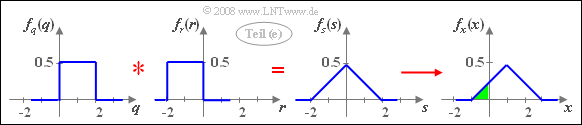
:<b>5.</b> Mit den Hilfsgrößen <i>q</i> = 2<i>u</i>, <i>r</i> = –2<i>υ</i> und <i>s</i> = <i>x</i> – 1 gilt der Zusammenhang: <i>s</i> = <i>q</i> + <i>r</i>. Da <i>u</i> und <i>υ</i> jeweils zwischen 0 und 1 gleichverteilt sind, besitzt <i>q</i> eine Gleichverteilung im Bereich von 0 bis 2 und <i>r</i> eine Gleichverteilung zwischen –2 und 0.
:Da zudem <i>q</i> und <i>r</i> nicht statistisch voneinander abhängen, gilt für die WDF der Summe:
'''(5)''' With the auxiliary quantities $q= 2u$, $r= -2v$ and $s= x-1$: $s= q+r$.
[[File:P_ID414__Sto_A_4_8_e.png|right|frame|Triangular PDF $f_x(x)$]]
*Since $u$ and $v$ are each uniformly distributed between $0$ and $1$, $q$ has a uniform distribution in the range from $0$ to $2$ and $r$ is uniformly distributed between $-2$ and $0$.
*In addition, since $q$ and $r$ are not statistically dependent on each other, the PDF of the sum is:
:$$f_s(s) = f_q(q) \star f_r(r).$$
:$$f_s(s) = f_q(q) \star f_r(r).$$
*The addition $x = s+1$ leads to a shift of the triangular–PDF by $1$ to the right.
*For the sought probability (highlighted in green in the graphic) therefore holds:
:Die Addition <i>x</i> = <i>s</i> + 1 führt zu einer Verschiebung der Dreieck–WDF um 1 nach rechts. Für die gesuchte Wahrscheinlichkeit (im folgenden Bild grün hinterlegt) gilt deshalb: <u>Pr(<i>x</i> < 0) = 0.125</u>.
[[File:P_ID414__Sto_A_4_8_e.png|midle|]]
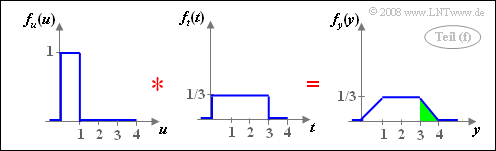
:<b>6.</b> Analog zur Musterlösung für die Teilaufgabe e) gilt mit <i>t</i> = 3<i>υ</i>:
[[File: P_ID415__Sto_A_4_8_f.png|right|frame|Trapezoidal PDF $f_y(y)$]]
'''(6)''' Analogous to the solution for the subtask '''(5)''' holds with $t = 3v$:
:$$f_y(y) = f_u(u) \star f_t(t).$$
:$$f_y(y) = f_u(u) \star f_t(t).$$
:Die Faltung zwischen zwei unterschiedlich breiten Rechteckfunktionen ergibt ein Trapez. Für die gesuchte Wahrscheinlichkeit erhält man <u>Pr(<i>y</i> > 3) = 1/6</u>. Diese ist im nachfolgenden Bild grün hinterlegt.
*The convolution between two rectangles of different widths results in a trapezoid. For the probability we are looking for, we get:
We consider a two-dimensional random variable $(x,\hspace{0.08cm} y)$ whose components arise as linear combinations of two random variables $u$ and $v$:
$$x=2u-2v+1,$$
$$y=u+3v.$$
Further, note:
The two statistically independent random variables $u$ and $v$ are each uniformly distributed between $0$ and $1$.
In the figure you can see the joint PDF. Within the parallelogram drawn in blue holds:
$$f_{xy}(x,\hspace{0.08cm} y) = H = {\rm const.}$$
Outside the parallelogram no values are possible: $f_{xy}(x,\hspace{0.08cm} y) = 0$.
(1) The area of the parallelogram can be composed of two triangles of equal size.
The area of the triangle $(1,0)\ (1,4)\ (-1,3)$ gives $0.5 · 4 · 2 = 4$.
The total area is double: $F = 8$.
Since the PDF volume is always $1$ , then $H= 1/F\hspace{0.15cm}\underline{ = 0.125}$.
(2) The minimum value of $x$ is obtained for $\underline{ u=0}$ and $\underline{ v=1}$.
From the above equations, the results $x= -1$ and $y= +3$ follow.
(3) The equation given in the theory section is valid in general, i.e., for any PDF of the two statistically independent variables $u$ and $v$, as long as they have equal standard deviations $(\sigma_u = \sigma_v)$.
With $A = 2$, $B = -2$, $D = 1$ and $E = 3$ we obtain:
From this follows with $x=0$ the value $y_0=\hspace{0.15cm}\underline{ = 2.5}$
(5) With the auxiliary quantities $q= 2u$, $r= -2v$ and $s= x-1$: $s= q+r$.
Triangular PDF $f_x(x)$
Since $u$ and $v$ are each uniformly distributed between $0$ and $1$, $q$ has a uniform distribution in the range from $0$ to $2$ and $r$ is uniformly distributed between $-2$ and $0$.
In addition, since $q$ and $r$ are not statistically dependent on each other, the PDF of the sum is:
$$f_s(s) = f_q(q) \star f_r(r).$$
The addition $x = s+1$ leads to a shift of the triangular–PDF by $1$ to the right.
For the sought probability (highlighted in green in the graphic) therefore holds: