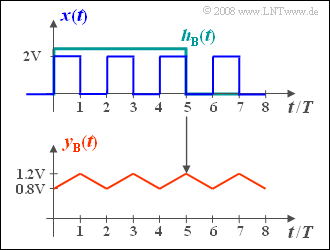
Die Seite wurde neu angelegt: „ {{quiz-Header|Buchseite=Lineare zeitinvariante Systeme/Systembeschreibung im Zeitbereich}} Datei:P_ID834__LZI_Z_1_4.png |right|Periodisches Rechtecksignal…“
[[File:P_ID834__LZI_Z_1_4.png |right|Periodisches Rechtecksignal und Rechteckfilter (Aufgabe Z1.4)]]
[[File:P_ID834__LZI_Z_1_4.png |right|frame|Periodic rectangular signal and <br>filter with rectangular impulse response]]
Wir betrachten das periodische Rechtecksignal $x(t)$ gemäß obiger Skizze, dessen Periodendauer $T_0 = 2T$ ist. Dieses Signal besitzt Spektralanteile bei der Grundfrequenz $f_0 = 1/T_0 = 1/(2T)$ und allen ungeradzahligen Vielfachen davon, d.h. bei $3f_0, 5f_0,$ usw. Zusätzlich gibt es einen Gleichanteil.
We consider the periodic rectangular signal $x(t)$ , whose periodic duration is $T_0 = 2T$ , according to the sketch above.
Dazu betrachten wir zwei Filter A und B mit jeweils rechteckförmiger Impulsantwort $h_{\rm A}(t)$ mit Dauer $6T$ bzw. $h_{\rm B}(t)$ mit der Dauer $5T$. Die Höhen der beiden Impulsantworten sind so gewählt, dass die Flächen der Rechtecke jeweils 1 ergeben.
*This signal has spectral components at the fundamental frequency $f_0 = 1/T_0 = 1/(2T)$ and at all odd multiples thereof, that is, at $3f_0$, $5f_0,$ and so on. In addition, there is a direct component.
'''Hinweis:''' Die Aufgabe bezieht sich auf den Theorieteil von [[Lineare_zeitinvariante_Systeme/Systembeschreibung_im_Zeitbereich|Kapitel 1.2]]. Informationen zur Faltung finden Sie im [[Signaldarstellung/Faltungssatz_und_Faltungsoperation|Kapitel 3.4]] des Buches „Signaldarstellung”.
*For this purpose, we consider two filters $\rm A$ and $\rm B$ each with rectangular impulse response $h_{\rm A}(t)$ with duration $6T$ and $h_{\rm B}(t)$ with duration $5T$, respectively.
*The heights of the two impulse responses are such that the areas of the rectangles each add up to $1$ .
===Fragebogen===
''Please note:''
*The exercise belongs to the chapter [[Linear_and_Time_Invariant_Systems/System_Description_in_Time_Domain|System Description in Time Domain]].
*For information on convolution, see the chapter [[Signal_Representation/The_Convolution_Theorem_and_Operation|convolution theorem and operation]] in the book "Signal Representation”.
*We also refer you to the interactive applet [[Applets:Zur_Verdeutlichung_der_grafischen_Faltung|Zur Verdeutlichung der graphischen Faltung]].
===Questions===
<quiz display=simple>
<quiz display=simple>
{Multiple-Choice Frage
{Compute the output signal $y_{\rm A}(t)$ of the filter $\rm A$, in particular the values at $t = 0$ and $t = T$.
|type="[]"}
|type="{}"}
- Falsch
$y_{\rm A}(t = 0) \ =\ $ { 1 3% } $\rm V$
+ Richtig
$y_{\rm A}(t = T) \ =\ $ { 1 3% } $\rm V$
{Give the absolute value function $|H_{\rm A}(f)|$ . What value is obtained at frequency $f = f_0$? <br>Interpret the result of the subtask '''(1)'''.
|type="{}"}
$|H_{\rm A}(f = f_0)| \ =\ $ { 0. }
{Input-Box Frage
{Compute the output signal $y_{\rm B}(t)$ of the filter $\rm B$, in particular the values at $t = 0$ and $t = T$.
|type="{}"}
|type="{}"}
$\alpha$ = { 0.3 }
$y_{\rm B}(t = 0) \ =\ $ { 0.8 3% } $\rm V$
$y_{\rm B}(t = T) \ =\ $ { 1.2 3% } $\rm V$
{What is the absolute value function $|H_{\rm B}(f)|$, especially at frequencies $f = f_0$ and $f = 3 · f_0$? <br>Use this to interpret the result of the subtask '''(3)'''.
|type="{}"}
$|H_{\rm B}(f = f_0)| \ =\ $ { 0.127 5% }
$|H_{\rm B}(f = 3f_0)| \ =\ $ { 0.042 5% }
</quiz>
</quiz>
===Musterlösung===
===Solution===
{{ML-Kopf}}
{{ML-Kopf}}
'''1.'''
'''(1)''' The output signal is the result of the convolution operation between $x(t)$ and $h_{\rm A}(t)$:
*It can be seen that this equation gives the same result $y_{\rm A}(t) \rm \underline{\: = 1V}$ for all $t$ .
'''6.'''
'''7.'''
'''(2)''' The magnitude of the frequency response is $|H_{\rm A}(f)| = |{\rm si}(\pi \cdot f \cdot 6T)|.$ This has zeros at an interval of $1/(6T)$ .
*So, there are also zeros at $f_0$, $3f_0$, $5f_0$ etc., respectively.
*The spectral components of the rectangular signal at $f_0, 3f_0,$ etc., although now no longer suppressed, are increasingly attenuated as the frequency increases, in such a way that the rectangular curve is converted into a periodic triangular signal. The direct component $(1 \hspace{0.05cm} \rm V)$ remains unchanged here, too.
*Thus, both filters provide the average value of the input signal. For the signal $x(t)$ at hand the filter $\rm A$ is more suitable than the filter $\rm B$ for the determination of the mean value, because for the former the length of the impulse response is a multiple of the period $T_0 = 2T$ .
*If this condition – as with the filter $\rm B$ – is not fulfilled, an error signal (triangular in this example) is still superimposed on the mean value.
{{ML-Fuß}}
{{ML-Fuß}}
[[Category:Aufgaben zu Lineare zeitinvariante Systeme|^Kapitelx^]]
[[Category:Linear and Time-Invariant Systems: Exercises|^1.2 System Description in Time Domain^]]
[[de:Aufgaben:Aufgabe 1.4Z: Alles rechteckförmig]]
Periodic rectangular signal and filter with rectangular impulse response
We consider the periodic rectangular signal $x(t)$ , whose periodic duration is $T_0 = 2T$ , according to the sketch above.
This signal has spectral components at the fundamental frequency $f_0 = 1/T_0 = 1/(2T)$ and at all odd multiples thereof, that is, at $3f_0$, $5f_0,$ and so on. In addition, there is a direct component.
For this purpose, we consider two filters $\rm A$ and $\rm B$ each with rectangular impulse response $h_{\rm A}(t)$ with duration $6T$ and $h_{\rm B}(t)$ with duration $5T$, respectively.
The heights of the two impulse responses are such that the areas of the rectangles each add up to $1$ .
The spectral components of the rectangular signal at $f_0, 3f_0,$ etc., although now no longer suppressed, are increasingly attenuated as the frequency increases, in such a way that the rectangular curve is converted into a periodic triangular signal. The direct component $(1 \hspace{0.05cm} \rm V)$ remains unchanged here, too.
Thus, both filters provide the average value of the input signal. For the signal $x(t)$ at hand the filter $\rm A$ is more suitable than the filter $\rm B$ for the determination of the mean value, because for the former the length of the impulse response is a multiple of the period $T_0 = 2T$ .
If this condition – as with the filter $\rm B$ – is not fulfilled, an error signal (triangular in this example) is still superimposed on the mean value.