Die Seite wurde neu angelegt: „ {{quiz-Header|Buchseite=Stochastische Signaltheorie/*Kapitel* }} right| :Gegeben seien hier die drei Zufallsgrößen <i>x</i…“
[[File:P_ID619__Sto_A_3_4.png|right|frame|Rectangular and trapezoidal PDF]]
:Gegeben seien hier die drei Zufallsgrößen <i>x</i>, <i>y</i> und <i>z</i> durch ihre jeweiligen Wahrscheinlichkeitsdichtefunktionen:
Given here are three random variables $x$, $y$ and $z$, mostly by their respective probability density functions:
:*Über die Zufallsgröße <i>x</i> ist nichts weiter bekannt: Diese kann sowohl eine diskrete als auch eine kontinuierliche Zufallsgröße sein und eine beliebige WDF <i>f<sub>x</sub></i>(<i>x</i>) besitzen. Der Mittelwert ist allgemein gleich <i>m<sub>x</sub></i>.
*Nothing else is known about the random variable $x$: This can be both a discrete or a continuous random variable, and can have any PDF $f_x(x)$ The mean is generally equal $m_x$.
*The continuous random variable $y$ can take values in the range between $1$ to $3$ with equal probability. Mean: $m_y = 2.$
*The random variable $z$ has the following characteristic function:
:Besides, the qualitative course of the WDF $f_z(z)$ according to the blue sketch is assumed to be known. To be determined are the PDF parameters $a$, $b$, $c$ of this PDF.
:*Die Zufallsgröße <i>y</i> kann nur Werte im Bereich von 1 bis 3 mit gleicher Wahrscheinlichkeit annehmen ⇒ Mittelwert <i>m<sub>y</sub></i> = 2.
:*Die Zufallsgröße <i>z</i> besitzt die folgende charakteristische Funktion:
:Daneben wird noch der qualitative Verlauf der WDF <i>f<sub>z</sub></i>(<i>z</i>) entsprechend der blauen Skizze als bekannt vorausgesetzt. Zu bestimmen sind die WDF-Parameter <i>a</i>, <i>b</i> und <i>c</i>.
:<b>Hinweis:</b> Diese Aufgabe bezieht sich auf Kapitel 3.3 - Seite 5.
:Die charakteristische Funktion einer zwischen ±<i>a</i> gleichverteilten Zufallsgröße <i>z</i> lautet:
*This exercise belongs to the chapter [[Theory_of_Stochastic_Signals/Expected_Values_and_Moments|Expected values and moments]].
*Reference is made to the section [[Theory_of_Stochastic_Signals/Expected_Values_and_Moments#Characteristic_function|Charakteristic funcion]] .
*The characteristic function of a between $\pm a$ uniformly distributed random variable $z$ is:
{Welche Aussagen sind bezüglich der charakteristischen Funktion <i>C<sub>x</sub></i>(<i>Ω</i>) stets – also bei beliebiger WDF – gültig?
{Which statements are valid with respect to the characteristic function $C_x ( {\it \Omega} )$ always – that is, at any PDF ?
|type="[]"}
|type="[]"}
- <i>C<sub>x</sub></i>(<i>Ω</i>) ist die Fouriertransformierte von <i>f<sub>x</sub></i>(<i>x</i>).
- $C_x ( {\it \Omega} )$ is the Fourier transform of $f_x(x)$.
+ Der Realteil von <i>C<sub>x</sub></i>(<i>Ω</i>) ist eine gerade Funktion in <i>Ω</i>.
+ The real part of $C_x ( {\it \Omega} )$ is an even function in ${\it \Omega}$.
+ Der Imaginärteil von <i>C<sub>x</sub></i>(<i>Ω</i>) ist eine ungerade Funktion in <i>Ω</i>.
+ The imaginary part of $C_x ( {\it \Omega} )$ is an odd function in ${\it \Omega}$.
+ Der Wert an der Stelle <i>Ω</i> = 0 ist stets 1.
+ The value at location ${\it \Omega} = 0$ is always $C_x ( {\it \Omega} ) = 1$.
- Bei mittelwertfreier Zufallsgröße (<i>m<sub>x</sub></i> = 0) ist <i>C<sub>x</sub></i>(<i>Ω</i>) stets reell.
- For a zero mean random variable $(m_x = 0)$ ⇒ $C_x ( {\it \Omega} )$ is always real.
{Berechnen Sie die charakteristische Funktion <i>C<sub>y</sub></i>(<i>Ω</i>). Wie groß sind Real- und Imaginärteil bei <i>Ω</i> = π /2?
{Calculate the characteristic function $C_y( {\it \Omega} )$. What are the real and imaginary parts at ${\it \Omega} = \pi/2$?
{Bestimmen Sie die Kenngrößen <i>a</i>, <i>b</i> und <i>c</i> der WDF <i>f<sub>z</sub></i> (<i>z</i>):
{Determine the characteristic parameters $a$, $b$ and $c$ of the PDF $f_z(z)$.
|type="{}"}
|type="{}"}
$a$ = { 1 3% }
$a \ = \ $ { 1 3% }
$b$ = { 5 3% }
$b \ = \ $ { 5 3% }
$c$ = { 0.167 3% }
$c \ = \ $ { 0.167 3% }
</quiz>
</quiz>
===Musterlösung===
===Solutions===
{{ML-Kopf}}
{{ML-Kopf}}
:<b>1.</b> <i>C<sub>x</sub></i>(<i>Ω</i>) ist nicht die Fouriertransformierte zu <i>f<sub>x</sub></i>(<i>x</i>), sondern die Fourierrücktransformierte:
'''(1)''' Correct are <u>the proposed solutions 2, 3 and 4</u>:
*The last alternative does not always hold: A two-point distributed random variable $x \in \{-1, +3\}$ with probabilities $0.75$ and $0.25$ is zero mean $(m_x = 0)$, but has still a complex characteristic function.
:Auch bei dieser ist der Realteil stets gerade und der Imaginärteil ungerade. Für <i>Ω</i> = 0 gilt:
:Die letzte Alternative trifft nicht immer zu: Eine zweipunktverteilte Zufallsgröße <i>x</i> ∈ {–1; +3} mit den Wahrscheinlichkeiten 0.75 und 0.25 ist zwar mittelwertfrei (<i>m<sub>x</sub></i> = 0), besitzt aber trotzdem eine komplexe charakteristische Funktion. Richtig sind somit <u>die Lösungsvorschläge 2, 3 und 4</u>.
'''(2)''' According to the general definition:
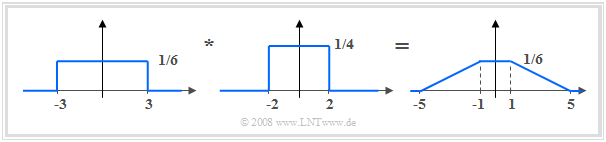
:<b>3.</b> Aus der angegebenen Korrespondenz kann abgelesen werden, dass si(3Ω) auf eine zwischen ±3 gleichverteilte Zufallsgröße zurückgeht und si(2Ω) die Transformierte einer Gleichverteilung zwischen ±2 angibt. In der charakteristischen Funktion sind diese beiden Anteile multiplikativ verknüpft. Damit ist die resultierende WDF <i>f<sub>z</sub></i>(<i>z</i>) die Faltung dieser beiden Rechteckfunktionen:
'''(3)''' From the given correspondence it can be read that ${\rm si}(3 {\it \Omega} )$ is due to an between $\pm 3$ equally distributed random variable and ${\rm si}(2 {\it \Omega} )$ gives the transform of a uniform distribution between $\pm 2$.
[[File:P_ID620__Sto_A_3_4_c_neu.png|center|]]
[[File:P_ID620__Sto_A_3_4_c_neu.png|right|frame|Construction of the trapezoidal PDF]]
:Die drei WDF-Parameter lauten somit:
*In the characteristic function, these two proportions are multiplicatively linked.
Given here are three random variables $x$, $y$ and $z$, mostly by their respective probability density functions:
Nothing else is known about the random variable $x$: This can be both a discrete or a continuous random variable, and can have any PDF $f_x(x)$ The mean is generally equal $m_x$.
The continuous random variable $y$ can take values in the range between $1$ to $3$ with equal probability. Mean: $m_y = 2.$
The random variable $z$ has the following characteristic function:
Besides, the qualitative course of the WDF $f_z(z)$ according to the blue sketch is assumed to be known. To be determined are the PDF parameters $a$, $b$, $c$ of this PDF.
The last alternative does not always hold: A two-point distributed random variable $x \in \{-1, +3\}$ with probabilities $0.75$ and $0.25$ is zero mean $(m_x = 0)$, but has still a complex characteristic function.
(3) From the given correspondence it can be read that ${\rm si}(3 {\it \Omega} )$ is due to an between $\pm 3$ equally distributed random variable and ${\rm si}(2 {\it \Omega} )$ gives the transform of a uniform distribution between $\pm 2$.
Construction of the trapezoidal PDF
In the characteristic function, these two proportions are multiplicatively linked.
Thus, the resulting PDF $f_z(z)$ is the convolution of these two rectangular functions.