Ein „getakteter” Zufallsgenerator liefert eine Folge $\langle x_\nu \rangle$ von binären Zufallszahlen.
*Es wird nun vorausgesetzt, dass die Binärzahlen $0$ und $1$ mit gleichen Wahrscheinlichkeiten auftreten und dass die einzelnen Zufallszahlen nicht statistisch voneinander abhängen.
*Die Zufallszahlen $ x_\nu \in \{0, 1\}$ werden in die erste Speicherstelle eines Schieberegisters eingetragen und mit jeden Takt um eine Stelle nach unten verschoben.
[[File:P_ID254__Sto_A_4_3Tab.png|right|frame|Table for moment calculation]]
A "clocked" random number generator returns a sequence $\langle x_\nu \rangle$ of binary random numbers.
*It is assumed that the binary numbers $0$ and $1$ occur with equal probabilities and that the individual random numbers do not depend on each other.
*The random numbers $ x_\nu \in \{0, 1\}$ are entered into the first memory location of a shift register and shifted down one digit with each clock pulse.
Aus den Inhalten des dreistelligen Schieberegisters werden zwei neue Zufallsfolgen $\langle a_\nu \rangle$ und $\langle m_\nu \rangle$ gebildet. Hierbei bezeichnet:
* $a_\nu$ die <i>algebraische Summe</i>:
Two new random sequences $\langle a_\nu \rangle$ and $\langle m_\nu \rangle$ are formed from the contents of the three-digit shift register. Here denotes:
* the "algebraic sum" $a_\nu$:
:$$a_\nu=x_\nu+x_{\nu-1}+x_{\nu-2},$$
:$$a_\nu=x_\nu+x_{\nu-1}+x_{\nu-2},$$
*$m_\nu$ die <i>Modulo-2-Summe</i>:
*the "modulo–2 sum" $m_\nu$:
:$$m_\nu=x_\nu\oplus x_{\nu-1}\oplus x_{\nu-2}.$$
:$$m_\nu=x_\nu\oplus x_{\nu-1}\oplus x_{\nu-2}.$$
Dieser Sachverhalt ist in der nachfolgenden Tabelle nochmals dargestellt:
[[File:P_ID254__Sto_A_4_3Tab.png|left|frame|Tabelle zur Momentenberechnung]]
<br><br><br><br><br><br>
Hints:
*This exercise belongs to the chapter [[Theory_of_Stochastic_Signals/Two-Dimensional_Random_Variables|Two-Dimensional Random Variables]].
*Use the following table for moment calculation.
<br clear=all>
<br clear=all>
===Questions===
<quiz display=simple>
{Calculate the probabilities of the random variable $m_\nu$. What is the probability that the modulo-2 sum is equal to $0$ ?
|type="{}"}
${\rm Pr}(m_\nu = 0) \ = \ $ { 0.5 3% }
''Hinweis:''
*Die Aufgabe gehört zum Kapitel [[Stochastische_Signaltheorie/Zweidimensionale_Zufallsgrößen|Zweidimensionale Zufallsgrößen]].
{Are there statistical dependencies within the sequence $\langle m_\nu \rangle$?
|type="()"}
+ The sequence elements $m_\nu$ are statistically independent.
- There are statistical bindings within the sequence $\langle m_\nu \rangle$.
{Determine the 2D–PDF $f_{xm}(x_\nu, m_\nu)$. Based on the result, evaluate the following statements.
|type="[]"}
- The random variables $x_\nu$ and $m_\nu$ are statistically dependent.
+ The random variables $x_\nu$ and $m_\nu$ are statistically independent.
- The random variables $x_\nu$ and $m_\nu$ are correlated.
+ The random variables $x_\nu$ and $m_\nu$ are uncorrelated.
===Fragebogen===
<quiz display=simple>
{Do statistical dependencies exist within the sequence $\langle a_\nu \rangle$ ?
{Berechnen Sie die Wahrscheinlichkeiten der Zufallsgröße $m_\nu$. Wie groß ist die Wahrscheinlichkeit, dass die Modulo-2-Summe gleich $0$ ist?
|type="()"}
|type="{}"}
- The sequence elements $a_\nu$ are statistically independent.
${\rm Pr}(m_\nu = 0) \ = $ { 0.5 3% }
+ There are statistical bindings within the sequence $\langle a_\nu \rangle$.
{Bestehen statistiche Abhängigkeiten innerhalb der Folge $\langle m_\nu \rangle$?
{Determine the 2D–PDF $f_{am}(a_\nu, m_\nu)$ and the correlation coefficient $\rho_{am}$. Which of the following statements are true?
|type="[]"}
|type="[]"}
+ Die Folgenelemente $m_\nu$ sind statistisch unabhängig.
+ The random variables $a_\nu$ and $m_\nu$ are statistically dependent.
- Es bestehen statistische Bindungen innerhalb der Folge $\langle m_\nu \rangle$.
- The random variables $a_\nu$ and $m_\nu$ are statistically independent.
- The random variables $a_\nu$ and $m_\nu$ are correlated.
+ The random variables $a_\nu$ and $m_\nu$ are uncorrelated.
{Ermitteln Sie die Verbund-WDF $f_{xm}(x_\nu, m_\nu)$. Bewerten Sie aufgrund des Resultats die folgenden Aussagen (zutreffend oder nicht).
|type="[]"}
- Die Zufallsgrößen $x_\nu$ und $m_\nu$ sind statistisch abhängig.
+ Die Zufallsgrößen $x_\nu$ und $m_\nu$ sind statistisch unabhängig.
- Die Zufallsgrößen $x_\nu$ und $m_\nu$ sind korreliert.
+ Die Zufallsgrößen $x_\nu$ und $m_\nu$ sind unkorreliert.
</quiz>
===Solution===
{{ML-Kopf}}
'''(1)''' It can be seen from the table in the information section that for the modulo–2 sum, the two values $0$ and $1$ have equal probability:
{Bestehen innerhalb der Folge $\langle a_\nu \rangle$ statistische Abhängigkeiten?
|type="[]"}
- Die Folgenelemente $a_\nu$ sind statistisch unabhängig.
+ Es bestehen statistische Bindungen innerhalb der Folge $\langle a_\nu \rangle$.
{Ermitteln Sie die 2D-WDF $f_{am}(a_\nu, m_\nu)$ und den Korrelationskoeffizienten $\rho_{am}$. Welche der folgenden Aussagen treffen zu?
'''(2)''' The table shows that for each preassignment ⇒ $( x_{\nu-1}, x_{\nu-2}) = (0,0), (0,1), (1,0), (1,1)$, the values $m_\nu = 0$ and $m_\nu = 1$ resp. are equally likely.
'''(3)''' Correct are <u>the second and the last suggested solutions</u>.
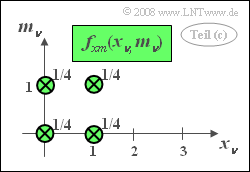
*The 2D–PDF consists of four Dirac delta functions, each with weight $1/4$.
*One obtains this result, for example, by evaluating the table in the data section.
*Since $f_{xm}(x_\nu, m_\nu)=f_{x}(x_\nu) \cdot f_{m}(m_\nu)$, the quantities $x_\nu$ and $m_\nu$ are statistically independent.
*Statistically independent random variables, however, are also linearly statistically independent, so they are certainly uncorrelated.
===Musterlösung===
{{ML-Kopf}}
'''(1)''' Aus der Tabelle auf der Angabenseite ist ersichtlich, dass bei der Modulo-2-Summe die beiden Werte $0$ und $1$ mit gleicher Wahrscheinlichkeit auftreten: ${\rm Pr}(m_\nu = 0) = {\rm Pr}(m_\nu = 1)\hspace{0.15cm}\underline{=0.5}$
'''(2)''' Die Tabelle zeigt, dass bei jeder Vorbelegung ⇒ $( x_{\nu-1}, x_{\nu-2}) = (0,0), (0,1), (1,0), (1,1)$ die Werte $m_\nu = 0$ bzw. $m_\nu = 1$ mit gleicher Wahrscheinlichkeit auftreten. Anders ausgedrückt:
Dies entspricht genau der Definition der <u>statistischen Unabhängigkeit</u>.
[[File:P_ID224__Sto_A_4_3_c.png|right|2D-WDF zwischen <i>x</i> und <i>m</i>]]
'''(4)''' Within the sequence $\langle a_\nu \rangle$ of algebraic sum there are statistical bindings ⇒ <u>Answer 2</u>.
'''(3)''' Richtig sind <u>der zweite und der letzte Lösungsvorschlag</u>.
*You can see this because the unconditional probability is $ {\rm Pr}( a_{\nu} = 0) =1/8$,
*Die 2D–WDF besteht aus vier Diracfunktionen, jeweils mit dem Gewicht $1/4$. Man erhält dieses Ergebnis beispielsweise durch Auswertung der Tabelle auf der Angabenseite.
*Da $f_{xm}(x_\nu, m_\nu)$ gleich dem Produkt $f_{x}(x_\nu) \cdot f_{m}(m_\nu)$ ist, sind die Größen $x_\nu$ und $m_\nu$ statistisch unabhängig.
*Statistisch unabhängige Zufallsgrößen sind aber natürlich auch linear statistisch unabhängig, also mit Sicherheit unkorreliert.
'''(4)''' Innerhalb der Folge $\langle a_\nu \rangle$ der algebraischen Summe gibt es statistische Bindungen ⇒ <u>Vorschlag 2</u>. Man erkennt dies daran, dass die unbedingte Wahrscheinlichkeit $ {\rm Pr}( a_{\nu} = 0) =1/8$ ist , während zum Beispiel ${\rm Pr}(a_{\nu} = 0\hspace{0.05cm}|\hspace{0.05cm}a_{\nu-1} = 3) =0$ ist.
[[File:P_ID225__Sto_A_4_3_e.png|right|2D-WDF zwischen <i>a</i> und <i>m</i>]]
'''(5)''' Richtig sind <u>der erste und der letzte Lösungsvorschlag</u>:
'''(5)''' Correct are <u>the first and the last suggested solutions</u>:
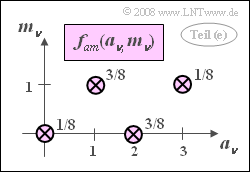
*Wie bei der Teilaufgabe (3) erhält man wieder vier Diracfunktionen, diesmal aber nicht mit jeweils gleichem Impulsgewicht $1/4$.
*As in the subtask '''(3)''' there are again four Dirac delta functions, but this time not with equal Dirac weights $1/4$.
*Die zweidimensionale WDF lässt sich somit nicht als Produkt der zwei Randwahrscheinlichkeitsdichten schreiben. Das bedeutet aber, dass statistische Bindungen zwischen $a_\nu$ und $m_\nu$ bestehen müssen.
*The two-dimensional PDF thus cannot be written as a product of the two marginal probability densities.
*Für den gemeinsamen Erwartungswert erhält man:
*But this means that statistical bindings must exist between $a_\nu$ and $m_\nu$.
Algebraic & modulo–2 sumTable for moment calculation
A "clocked" random number generator returns a sequence $\langle x_\nu \rangle$ of binary random numbers.
It is assumed that the binary numbers $0$ and $1$ occur with equal probabilities and that the individual random numbers do not depend on each other.
The random numbers $ x_\nu \in \{0, 1\}$ are entered into the first memory location of a shift register and shifted down one digit with each clock pulse.
Two new random sequences $\langle a_\nu \rangle$ and $\langle m_\nu \rangle$ are formed from the contents of the three-digit shift register. Here denotes:
(2) The table shows that for each preassignment ⇒ $( x_{\nu-1}, x_{\nu-2}) = (0,0), (0,1), (1,0), (1,1)$, the values $m_\nu = 0$ and $m_\nu = 1$ resp. are equally likely.