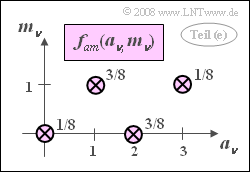
[[File:P_ID254__Sto_A_4_3Tab.png|right|frame|Table for moment calculation]]
[[File:P_ID254__Sto_A_4_3Tab.png|right|frame|Table for moment calculation]]
Line 66:
Line 66:
===Solution===
===Solution===
{{ML-Kopf}}
{{ML-Kopf}}
'''(1)''' It can be seen from the table on the information page that for the modulo–2 sum, the two values $0$ and $1$ have equal probability:
'''(1)''' It can be seen from the table in the information section that for the modulo–2 sum, the two values $0$ and $1$ have equal probability:
'''(3)''' Correct are <u>the second and the last suggested solutions</u>.
'''(3)''' Correct are <u>the second and the last suggested solutions</u>.
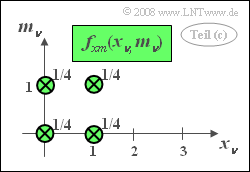
*The 2D–PDF consists of four Dirac delta functions, each with weight $1/4$.
*The 2D–PDF consists of four Dirac delta functions, each with weight $1/4$.
*One obtains this result, for example, by evaluating the table on the data page.
*One obtains this result, for example, by evaluating the table in the data section.
*Since $f_{xm}(x_\nu, m_\nu)=f_{x}(x_\nu) \cdot f_{m}(m_\nu)$, the quantities $x_\nu$ and $m_\nu$ are statistically independent.
*Since $f_{xm}(x_\nu, m_\nu)=f_{x}(x_\nu) \cdot f_{m}(m_\nu)$, the quantities $x_\nu$ and $m_\nu$ are statistically independent.
*Statistically independent random variables, however, are also linearly statistically independent, so they are certainly uncorrelated.
*Statistically independent random variables, however, are also linearly statistically independent, so they are certainly uncorrelated.
Line 109:
Line 109:
[[Category:Theory of Stochastic Signals: Exercises|^4.1 Two-Dimensional Random Variables^]]
[[Category:Theory of Stochastic Signals: Exercises|^4.1 Two-Dimensional Random Variables^]]
[[de:Aufgaben:Aufgabe 4.3: Algebraische und Modulo-Summe]]
Algebraic & modulo–2 sumTable for moment calculation
A "clocked" random number generator returns a sequence $\langle x_\nu \rangle$ of binary random numbers.
It is assumed that the binary numbers $0$ and $1$ occur with equal probabilities and that the individual random numbers do not depend on each other.
The random numbers $ x_\nu \in \{0, 1\}$ are entered into the first memory location of a shift register and shifted down one digit with each clock pulse.
Two new random sequences $\langle a_\nu \rangle$ and $\langle m_\nu \rangle$ are formed from the contents of the three-digit shift register. Here denotes:
(2) The table shows that for each preassignment ⇒ $( x_{\nu-1}, x_{\nu-2}) = (0,0), (0,1), (1,0), (1,1)$, the values $m_\nu = 0$ and $m_\nu = 1$ resp. are equally likely.