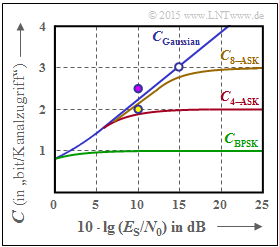
Die beiden weiteren Kurvenverläufe <i>C</i><sub>rot</sub> und <i>C</i><sub>braun</sub> sollen in den Teilaufgaben (c) und (d) analysiert und möglichen Modulationsverfahren zugeordnet werden.
The two other curves $C_\text{red}$ and $C_\text{brown}$ should be analyzed and assigned to possible modulation schemes in subtasks '''(3)''' and '''(4)'''.
''Hinweise:''
*Die Aufgabe gehört zum Kapitel [[Informationstheorie/AWGN–Kanalkapazität_bei_wertkontinuierlichem_Eingang|AWGN–Kanalkapazität bei wertkontinuierlichem Eingang]].
*Bezug genommen wird insbesondere auf die Seite [[Informationstheorie/AWGN–Kanalkapazität_bei_wertdiskretem_Eingang#Die_Kanalkapazit.C3.A4t_.7FUNIQ-MathJax112-QINU.7F_als_Funktion_von_.7FUNIQ-MathJax113-QINU.7F|Die Kanalkapazität <i>C</i> als Funktion von <i>E</i><sub>B</sub>/<i>N</i><sub>0</sub>]].
*Da die Ergebnisse in „bit” angegeben werden sollen, wird in den Gleichungen „log” ⇒ „log<sub>2</sub>” verwendet.
*Die im Fragebogen genannten Modulationsverfahren werden anhand ihrer Signalraumkonstellation beschrieben:
*In der Literatur wird manchmal die BPSK auch mit 2–ASK bezeichnet ⇒ <i>x</i> ∈ <i>X</i> = (+1, –1).
*Dagegen verstehen wir in unserem Lerntutorial ''LNTwww'' als ASK den unipolaren Fall <i>x</i> ∈ <i>X</i> = (0, 1).
*Nach unserer Nomenklatur gilt deshalb: <i>C</i><sub>ASK</sub> < <i>C</i><sub>BPSK</sub>.
Dieser Sachverhalt hat aber keinen Einfluss auf die Lösung der vorliegenden Aufgabe.
Hints:
*The task belongs to the chapter [[Information_Theory/AWGN–Kanalkapazität_bei_wertdiskretem_Eingang|AWGN channel capacity with discrete value input]].
*Reference is made in particular to the page [[Information_Theory/AWGN_Channel_Capacity_for_Discrete-Valued_Input#The_channel_capacity_.7F.27.22.60UNIQ-MathJax81-QINU.60.22.27.7F_as_a_function_of_.7F.27.22.60UNIQ-MathJax82-QINU.60.22.27.7F|Channel capacity $C$ as a function of $E_{\rm S}/{N_0}$]].
*Since the results are to be given in "bit" ⇒ "log" ⇒ "log<sub>2</sub>" is used in the equations.
*The modulation methods mentioned in the questions are described in terms of their signal space constellation <br>(see lower graph).
===Fragebogen===
[[File:EN_Inf_A_4_9_Zusatz.png|right|frame|Proposed signal space constellations]]
'''Notes on nomenclature:'''
*In the literature, "BPSK" is sometimes also referred to as "2–ASK":
:$$x ∈ X = \{+1,\ -1\}.$$
*In contrast, in our learning tutorial we understand as "ASK" the unipolar case:
:$$x ∈ X = \{0,\ 1 \}.$$
*Therefore, according to our nomenclature:
:$$C_\text{ASK} < C_\text{BPSK}$$
But: This fact is irrelevant for the solution of the present problem.
===Questions===
<quiz display=simple>
<quiz display=simple>
{Welche Gleichung liegt der Shannon–Grenzkurve <i>C</i><sub>Gauß</sub> zugrunde?
'''(1)''' Richtig ist der <u>Vorschlag 2</u>, wie die Rechnung für 10 · lg (<i>E</i><sub>S</sub>/<i>N</i><sub>0</sub>) = 15 dB ⇒ <i>E</i><sub>S</sub>/<i>N</i><sub>0</sub> = 31.62 zeigt:
'''(1)''' <u>Proposition 2</u> is correct, as shown by the calculation for $10 \cdot \lg (E_{\rm S}/{N_0}) = 15 \ \rm dB$ ⇒ $E_{\rm S}/{N_0} = 31.62$:
Der Lösungsvorschlag 3 entspricht dabei dem Fall ''Zweier unabhängiger Gaußkanäle'' mit jeweils halber Sendeleistung pro Kanal.
*The proposed solution 3 corresponds to the case of "two independent Gaussian channels" with half transmission power per channel.
'''(2)''' Richtig sind die <u>Lösungsvorschläge 1, 2 und 4</u>:
*Würde man <i>E</i><sub>S</sub> durch <i>E</i><sub>B</sub> ersetzen, so wäre auch die Aussage 3 richtig.
*Für <i>E</i><sub>B</sub>/<i>N</i><sub>0</sub> < ln 2 gilt nämlich <i>C</i><sub>Gauß</sub> ≡ 0 und damit auch <i>C</i><sub>BPSK</sub> ≡ 0.
'''(3)''' Richtig sind die <u>Aussagen 2, 3 und 5</u>:
'''(2)''' <u>Proposed solutions 1, 2 and 4</u> are correct:
*Der rote Kurvenzug (<i>C</i><sub>rot</sub>) liegt stets oberhalb von <i>C</i><sub>BPSK</sub>, aber unterhalb von <i>C</i><sub>braun</sub> und der Shannon–Grenzkurve <i>C</i><sub>Gauß</sub>.
*If one would replace $E_{\rm S}$ by $E_{\rm B}$, then the statement 3 would be also correct.
*Diese Aussagen gelten auch, wenn für gewisse <i>E</i><sub>S</sub>/<i>N</i><sub>0</sub>–Werte Kurven innerhalb der Zeichengenauigkeit nicht zu unterscheiden sind.
*For $E_{\rm B}/{N_0} < \ln (2)$ ⇒ $C_{\rm Gaussian} ≡ 0$ is valid, and therefore also $C_{\rm BPSK} ≡ 0$.
*Aus dem Grenzwert <i>C</i><sub>rot</sub> = 2 bit/Kanalzugriff für <i>E</i><sub>S</sub>/<i>N</i><sub>0</sub> → ∞ kann auf den Symbolumfang <i>M<sub>X</sub></i> = 4 geschlossen werden.
*Die rote Kurve beschreibt also die 4–ASK. <i>M<sub>X</sub></i> = 2 würde für die BPSK gelten.
*Die 4–QAM führt genau zum gleichen Endwert „2 bit/Kanalzugriff”. Für kleine <i>E</i><sub>S</sub>/<i>N</i><sub>0</sub>–Werte liegt aber die Kanalkapazität <i>C</i><sub>4–QAM</sub> oberhalb der roten Kurve, da <i>C</i><sub>rot</sub> von der Gauß–Grenzkurve <i>C</i><sub>2</sub> begrenzt wird, <i>C</i><sub>4–QAM</sub> aber von <i>C</i><sub>3</sub>.
Die Bezeichnungen <i>C</i><sub>2</sub> und <i>C</i><sub>3</sub> beziehen sich hierbei auf die Teilaufgabe (1).
'''(3)''' <u>Statements 2, 3 and 5</u> are correct:
*The red curve $(C_{\rm red})$ is always above $C_{\rm BPSK}$, but below $C_{\rm brown}$ and Shannon's boundary curve $(C_{\rm Gaussian})$.
*The statements also hold if (for certain $E_{\rm S}/{N_0}$ values) curves are indistinguishable within the drawing precision.
*From the limit $C_{\rm red}= 2 \ \rm bit/use$ for $E_{\rm S}/{N_0} → ∞$, the symbol set size $M_X = |X| = 4$.
*Thus, the red curve describes "4–ASK". $M_X = |X| = 2$ would apply to the "BPSK".
*The "4–QAM" leads exactly to the same final value "2 bit/use". For small $E_{\rm S}/{N_0}$ values, however, the channel capacity $C_{\rm 4–QAM}$ is above the red curve, since $C_{\rm red}$ is bounded by the Gaussian boundary curve $(C_2)$, but $C_{\rm 4–QAM}$ is bounded by $C_3$. The designations $C_2$ and $C_3$ here refer to subtask '''(1)''
[[File:P_ID2954__Inf_A_4_9e.png|right|frame|Kanalkapazitätsgrenzen für <br>BPSK, 4–ASK und 8–ASK]]
[[File:EN_Inf_A_4_9e_v2.png|right|frame|Channel capacity limits for <br>BPSK, 4–ASK and 8–ASK]]
'''(4)''' Richtig sind die <u>Lösungsvorschläge 1, 2 und 5</u>:
<br><br>
*Aus dem braunen Kurvenverlauf erkennt man die Richtigkeit der beiden ersten Aussagen.
'''(4)''' <u>Proposed solutions 1, 2 and 5</u> are correct:
*Die 8–PSK mit I– und Q–Komponente – also mit <i>K</i> = 2 Dimensionen – wird für kleine <i>E</i><sub>S</sub>/<i>N</i><sub>0</sub>–Werte etwas oberhalb der braunen Kurve liegen die Antwort 3 ist falsch.
*From the brown curve, one can see the correctness of the first two statements.
*The "8–PSK" with I– and Q–components – i.e. with $K = 2$ dimensions – lies slightly above the brown curve for small $E_{\rm S}/{N_0}$ values ⇒ the answer 3 is incorrect.
In der Grafik sind auch die beiden 8–ASK–Systeme gemäß den Vorschlägen 4 und 5 als Punkte eingezeichnet.
In the graph, the two "8–ASK"nbsp; systems are also drawn as dots according to propositions 4 and 5.
* Der violette Punkt liegt über der Kurve <i>C</i><sub>8–ASK</Sub>. Das heißt: 10 · lg (<i>E</i><sub>S</sub>/<i>N</i><sub>0</sub>) = 10 dB und <i>R</i> = 2.5 reichen nicht aus, um die 8–ASK fehlerfrei decodieren zu können ⇒ <i>R</i> > <i>C</i> ⇒ das Kanalcodierungstheorem wird nicht erfüllt ⇒ die Antwort 4 ist falsch.
* The purple dot is above the $C_{\rm 8–ASK}$ curve ⇒ $R = 2.5$ and $10 \cdot \lg (E_{\rm S}/{N_0}) = 10 \ \rm dB$ are not enough to decode the "8–ASK" without errors ⇒ $R > C_{\rm 8–ASK}$ ⇒ channel coding theorem is not satisfied ⇒ answer 4 is wrong.
* Reduziert man aber die Coderate gemäß dem gelben Punkt bei gleichem 10 · lg (<i>E</i><sub>S</sub>/<i>N</i><sub>0</sub>) = 10 dB auf <i>R</i> = 2 < <i>C</i><sub>8–ASK</Sub>, so wird das Kanalcodierungstheorem erfüllt ⇒ Antwort 5 ist richtig.
* However, if we reduce the code rate to $R = 2 < C_{\rm 8–ASK}$ for the same $10 \cdot \lg (E_{\rm S}/{N_0}) = 10 \ \rm dB$ according to the yellow dot, the channel coding theorem is satisfied ⇒ answer 5 is correct.
{{ML-Fuß}}
{{ML-Fuß}}
Line 105:
Line 111:
[[Category:Aufgaben zu Informationstheorie|^4.3 AWGN & wertdiskreter Eingang^]]
[[Category:Information Theory: Exercises|^4.3 AWGN and Value-Discrete Input^]]
The proposed solution 3 corresponds to the case of "two independent Gaussian channels" with half transmission power per channel.
(2)Proposed solutions 1, 2 and 4 are correct:
If one would replace $E_{\rm S}$ by $E_{\rm B}$, then the statement 3 would be also correct.
For $E_{\rm B}/{N_0} < \ln (2)$ ⇒ $C_{\rm Gaussian} ≡ 0$ is valid, and therefore also $C_{\rm BPSK} ≡ 0$.
(3)Statements 2, 3 and 5 are correct:
The red curve $(C_{\rm red})$ is always above $C_{\rm BPSK}$, but below $C_{\rm brown}$ and Shannon's boundary curve $(C_{\rm Gaussian})$.
The statements also hold if (for certain $E_{\rm S}/{N_0}$ values) curves are indistinguishable within the drawing precision.
From the limit $C_{\rm red}= 2 \ \rm bit/use$ for $E_{\rm S}/{N_0} → ∞$, the symbol set size $M_X = |X| = 4$.
Thus, the red curve describes "4–ASK". $M_X = |X| = 2$ would apply to the "BPSK".
The "4–QAM" leads exactly to the same final value "2 bit/use". For small $E_{\rm S}/{N_0}$ values, however, the channel capacity $C_{\rm 4–QAM}$ is above the red curve, since $C_{\rm red}$ is bounded by the Gaussian boundary curve $(C_2)$, but $C_{\rm 4–QAM}$ is bounded by $C_3$. The designations $C_2$ and $C_3$ here refer to subtask '(1)
Channel capacity limits for BPSK, 4–ASK and 8–ASK
(4)Proposed solutions 1, 2 and 5 are correct:
From the brown curve, one can see the correctness of the first two statements.
The "8–PSK" with I– and Q–components – i.e. with $K = 2$ dimensions – lies slightly above the brown curve for small $E_{\rm S}/{N_0}$ values ⇒ the answer 3 is incorrect.
In the graph, the two "8–ASK"nbsp; systems are also drawn as dots according to propositions 4 and 5.
The purple dot is above the $C_{\rm 8–ASK}$ curve ⇒ $R = 2.5$ and $10 \cdot \lg (E_{\rm S}/{N_0}) = 10 \ \rm dB$ are not enough to decode the "8–ASK" without errors ⇒ $R > C_{\rm 8–ASK}$ ⇒ channel coding theorem is not satisfied ⇒ answer 4 is wrong.
However, if we reduce the code rate to $R = 2 < C_{\rm 8–ASK}$ for the same $10 \cdot \lg (E_{\rm S}/{N_0}) = 10 \ \rm dB$ according to the yellow dot, the channel coding theorem is satisfied ⇒ answer 5 is correct.