*The task belongs to the chapter [[Information_Theory/AWGN–Kanalkapazität_bei_wertdiskretem_Eingang|AWGN channel capacity with discrete value input]].
*The task belongs to the chapter [[Information_Theory/AWGN–Kanalkapazität_bei_wertdiskretem_Eingang|AWGN channel capacity with discrete value input]].
*Reference is made in particular to the page [[Information_Theory/AWGN–Kanalkapazität_bei_wertdiskretem_Eingang#The_channel_capacity_.7F.27.22.60UNIQ-MathJax81-QINU.60.22.27.7F_as_a_function_of_.7F.27.22.60UNIQ-MathJax82-QINU.60.22.27.7F|Channel capacity $C$ as a function of $E_{\rm S}/{N_0}$]].
*Reference is made in particular to the page [[Information_Theory/AWGN_Channel_Capacity_for_Discrete-Valued_Input#The_channel_capacity_.7F.27.22.60UNIQ-MathJax81-QINU.60.22.27.7F_as_a_function_of_.7F.27.22.60UNIQ-MathJax82-QINU.60.22.27.7F|Channel capacity $C$ as a function of $E_{\rm S}/{N_0}$]].
*Since the results are to be given in "bit" ⇒ "log" ⇒ "log<sub>2</sub>" is used in the equations.
*Since the results are to be given in "bit" ⇒ "log" ⇒ "log<sub>2</sub>" is used in the equations.
*The modulation methods mentioned in the questions are described in terms of their signal space constellation <br>(see lower graph).
*The modulation methods mentioned in the questions are described in terms of their signal space constellation <br>(see lower graph).
Line 74:
Line 74:
===Solution===
===Solution===
{{ML-Kopf}}
{{ML-Kopf}}
'''(1)''' <u>Proposition 2</u> is correct, as shown by the calculation for $10 \cdot \lg (E_{\rm S}/{N_0}) = 15 \ \rm dB$ ⇒ $E_{\rm S}/{N_0} = 31.62$ zeigt:
'''(1)''' <u>Proposition 2</u> is correct, as shown by the calculation for $10 \cdot \lg (E_{\rm S}/{N_0}) = 15 \ \rm dB$ ⇒ $E_{\rm S}/{N_0} = 31.62$:
*The proposed solution 3 corresponds to the case of ''two independent Gaussian channels'' with half transmit power per channel.
*The proposed solution 3 corresponds to the case of "two independent Gaussian channels" with half transmission power per channel.
'''(2)''' <u>Proposed solutions 1, 2 and 4</u> are correct:
'''(2)''' <u>Proposed solutions 1, 2 and 4</u> are correct:
*If one would replace $E_{\rm S}$ by $E_{\rm B}$, then the statement 3 would be also correct.
*If one would replace $E_{\rm S}$ by $E_{\rm B}$ , then also the statement 3 would be correct.
*For $E_{\rm B}/{N_0} < \ln (2)$ ⇒ $C_{\rm Gaussian} ≡ 0$ is valid, and therefore also $C_{\rm BPSK} ≡ 0$.
*For $E_{\rm B}/{N_0} < \ln (2)$ $C_{\rm Gauß} ≡ 0$ is valid and therefore also $C_{\rm BPSK} ≡ 0$ .
'''(3)''' <u>Statements 2, 3 and 5</u> are correct::
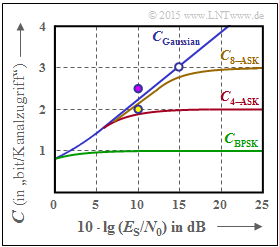
*The red curve $C_{\rm red}$ is always above $C_{\rm BPSK}$ , but below $C_{\rm brown}$ and the Shannon boundary curve $C_{\rm Gauß}$.
*The statements also hold if for certain $E_{\rm S}/{N_0}$ values curves are indistinguishable within the character precision.
*From the limit $C_{\rm red}= 2 \ \rm bit/channel use$ for $E_{\rm S}/{N_0} → ∞$ , the symbol range $M_X = |X| = 4$.
*Thus, the red curve describes the 4–ASK. $M_X = |X| = 2$ would apply to the BPSK.
*The 4–QAM leads exactly to the same final value "2 bit/channel use". For small $E_{\rm S}/{N_0}$ values, however, the channel capacity $C_{\rm 4–QAM}$ is above the red curve, since $C_{\rm red}$ is bounded by the Gaussian boundary curve $C_2$ , but $C_{\rm 4–QAM}$ is bounded by $C_3$.
The designations $C_2$ and $C_3$ here refer to subtask '''(1)'''.
'''(3)''' <u>Statements 2, 3 and 5</u> are correct:
*The red curve $(C_{\rm red})$ is always above $C_{\rm BPSK}$, but below $C_{\rm brown}$ and Shannon's boundary curve $(C_{\rm Gaussian})$.
*The statements also hold if (for certain $E_{\rm S}/{N_0}$ values) curves are indistinguishable within the drawing precision.
*From the limit $C_{\rm red}= 2 \ \rm bit/use$ for $E_{\rm S}/{N_0} → ∞$, the symbol set size $M_X = |X| = 4$.
*Thus, the red curve describes "4–ASK". $M_X = |X| = 2$ would apply to the "BPSK".
*The "4–QAM" leads exactly to the same final value "2 bit/use". For small $E_{\rm S}/{N_0}$ values, however, the channel capacity $C_{\rm 4–QAM}$ is above the red curve, since $C_{\rm red}$ is bounded by the Gaussian boundary curve $(C_2)$, but $C_{\rm 4–QAM}$ is bounded by $C_3$. The designations $C_2$ and $C_3$ here refer to subtask '''(1)''
[[File:EN_Inf_A_4_9e_v2.png|right|frame|Channel capacity limits for <br>BPSK, 4–ASK and 8–ASK]]
[[File:EN_Inf_A_4_9e_v2.png|right|frame|Channel capacity limits for <br>BPSK, 4–ASK and 8–ASK]]
'''(4)''' <u>Proposed solutions 1, 2 and 5</u> are correct:
<br><br>
*From the brown curve, one can see the correctness of the first two statements.
'''(4)''' <u>Proposed solutions 1, 2 and 5</u> are correct:
*The 8–PSK with I– and Q–components – i.e. with $K = 2$ dimensions – lies slightly above the brown curve for small $E_{\rm S}/{N_0}$ values ⇒ the answer 3 is incorrect.
*From the brown curve, one can see the correctness of the first two statements.
*The "8–PSK" with I– and Q–components – i.e. with $K = 2$ dimensions – lies slightly above the brown curve for small $E_{\rm S}/{N_0}$ values ⇒ the answer 3 is incorrect.
In the graph, the two 8–ASK–systems are also drawn as dots according to propositions 4 and 5.
In the graph, the two "8–ASK"nbsp; systems are also drawn as dots according to propositions 4 and 5.
* The purple dot is above the $C_{\rm 8–ASK}$ curve ⇒ $R = 2.5$ and $10 \cdot \lg (E_{\rm S}/{N_0}) = 10 \ \rm dB$ are not enough to decode the 8–ASK without errors ⇒ $R > C$ ⇒ the channel coding theorem is not satisfied ⇒ answer 4 is wrong.
* The purple dot is above the $C_{\rm 8–ASK}$ curve ⇒ $R = 2.5$ and $10 \cdot \lg (E_{\rm S}/{N_0}) = 10 \ \rm dB$ are not enough to decode the "8–ASK" without errors ⇒ $R > C_{\rm 8–ASK}$ ⇒ channel coding theorem is not satisfied ⇒ answer 4 is wrong.
* However, if we reduce the code rate to $R = 2 < C_{\rm 8–ASK}$ according to the yellow dot for the same $10 \cdot \lg (E_{\rm S}/{N_0}) = 10 \ \rm dB$, the channel coding theorem is satisfied ⇒ Answer 5 is correct.
* However, if we reduce the code rate to $R = 2 < C_{\rm 8–ASK}$ for the same $10 \cdot \lg (E_{\rm S}/{N_0}) = 10 \ \rm dB$ according to the yellow dot, the channel coding theorem is satisfied ⇒ answer 5 is correct.
{{ML-Fuß}}
{{ML-Fuß}}
Line 119:
Line 112:
[[Category:Information Theory: Exercises|^4.3 AWGN and Value-Discrete Input^]]
[[Category:Information Theory: Exercises|^4.3 AWGN and Value-Discrete Input^]]
The proposed solution 3 corresponds to the case of "two independent Gaussian channels" with half transmission power per channel.
(2)Proposed solutions 1, 2 and 4 are correct:
If one would replace $E_{\rm S}$ by $E_{\rm B}$, then the statement 3 would be also correct.
For $E_{\rm B}/{N_0} < \ln (2)$ ⇒ $C_{\rm Gaussian} ≡ 0$ is valid, and therefore also $C_{\rm BPSK} ≡ 0$.
(3)Statements 2, 3 and 5 are correct:
The red curve $(C_{\rm red})$ is always above $C_{\rm BPSK}$, but below $C_{\rm brown}$ and Shannon's boundary curve $(C_{\rm Gaussian})$.
The statements also hold if (for certain $E_{\rm S}/{N_0}$ values) curves are indistinguishable within the drawing precision.
From the limit $C_{\rm red}= 2 \ \rm bit/use$ for $E_{\rm S}/{N_0} → ∞$, the symbol set size $M_X = |X| = 4$.
Thus, the red curve describes "4–ASK". $M_X = |X| = 2$ would apply to the "BPSK".
The "4–QAM" leads exactly to the same final value "2 bit/use". For small $E_{\rm S}/{N_0}$ values, however, the channel capacity $C_{\rm 4–QAM}$ is above the red curve, since $C_{\rm red}$ is bounded by the Gaussian boundary curve $(C_2)$, but $C_{\rm 4–QAM}$ is bounded by $C_3$. The designations $C_2$ and $C_3$ here refer to subtask '(1)
Channel capacity limits for BPSK, 4–ASK and 8–ASK
(4)Proposed solutions 1, 2 and 5 are correct:
From the brown curve, one can see the correctness of the first two statements.
The "8–PSK" with I– and Q–components – i.e. with $K = 2$ dimensions – lies slightly above the brown curve for small $E_{\rm S}/{N_0}$ values ⇒ the answer 3 is incorrect.
In the graph, the two "8–ASK"nbsp; systems are also drawn as dots according to propositions 4 and 5.
The purple dot is above the $C_{\rm 8–ASK}$ curve ⇒ $R = 2.5$ and $10 \cdot \lg (E_{\rm S}/{N_0}) = 10 \ \rm dB$ are not enough to decode the "8–ASK" without errors ⇒ $R > C_{\rm 8–ASK}$ ⇒ channel coding theorem is not satisfied ⇒ answer 4 is wrong.
However, if we reduce the code rate to $R = 2 < C_{\rm 8–ASK}$ for the same $10 \cdot \lg (E_{\rm S}/{N_0}) = 10 \ \rm dB$ according to the yellow dot, the channel coding theorem is satisfied ⇒ answer 5 is correct.