Zur Messung akustischer Echos in Räumen – zum Beispiel bedingt durch Reflexionen an einer Wand – kann die nebenstehende Anordnung verwendet werden.
To measure acoustic echoes in rooms – for example caused by reflections at a wall – the adjacent setup can be used:
*Der Rauschgenerator erzeugt ein „im relevanten Frequenzbereich Weißes Rauschen” $x(t)$ mit der Rauschleistungsdichte $N_0 = 10^{-6} \hspace{0.08cm} \rm W/Hz$.
*The noise generator produces a "white noise in the relevant frequency range" $x(t)$ with power density $N_0 = 10^{-6} \hspace{0.08cm} \rm W/Hz$.
*Dieses ist bandbegrenzt auf $B_x = 20 \hspace{0.08cm} \rm kHz$ und wird auf einen Lautsprecher gegeben.
*This is bandlimited to $B_x = 20 \hspace{0.08cm} \rm kHz$ and is given to a loudspeaker.
*Die gesamte Messeinrichtung ist für den Widerstandswert $R = 50 \hspace{0.08cm} \rm \Omega$ ausgelegt.
*The entire measurement setup is designed for the resistance value $R = 50 \hspace{0.08cm} \rm \Omega$.
Das vom Mikrofon aufgenommene Signal ist im allgemeinsten Fall wie folgt beschreibbar:
In the most general case, the signal recorded by the microphone can be described as follows:
:$$y(t) = \sum_{\mu = 1}^M \alpha_\mu \cdot x ( t - t_\mu ) .$$
:$$y(t) = \sum_{\mu = 1}^M \alpha_\mu \cdot x ( t - t_\mu ) .$$
Hierbei bezeichnen $\alpha_\mu$ Dämpfungsfaktoren und $t_\mu$ Laufzeiten.
Here the $\alpha_\mu$ denote damping factors and $t_\mu$ delay times.
Hints:
''Hinweise:''
*The exercise belongs to the chapter [[Theory_of_Stochastic_Signals/Cross-Correlation_Function_and_Cross_Power_Density|Cross-Correlation Function and Cross Power-Spectral Density]].
*Die Aufgabe gehört zum Kapitel [[Stochastische_Signaltheorie/Kreuzkorrelationsfunktion_und_Kreuzleistungsdichte|Kreuzkorrelationsfunktion und Kreuzleistungsdichte]].
*Benutzen Sie für numerische Berechnungen die Parameterwerte
*Use for numerical calculations the parameter values.
{Geben Sie die AKF $\varphi_x(\tau)$ am Sender an. Wie lautet diese umgerechnet auf den Widerstand $R = 50 \hspace{0.08cm} \rm \Omega$? <br>Wie groß ist der Effektivwert $\sigma_x$?
{Apply the $\rm ACF$ $\varphi_x(\tau)$ at the transmitter. What means this converted to the resistor $R = 50 \hspace{0.08cm} \rm \Omega$ ? What is the rms value $\sigma_x$ ?
|type="{}"}
|type="{}"}
$\sigma_x \ = \ $ { 1 3% } $\ \rm V$
$\sigma_x \ = \ $ { 1 3% } $\ \rm V$
{Berechnen Sie die Kreuzkorrelationsfunktion (KKF) $\varphi_{xy}(\tau)$ zwischen Sende– und Empfangssignal. <br>Welche Werte ergeben sich für $\tau = 0$, $\tau = t_1 = 200 \hspace{0.08cm} \rm ms$ und $\tau = t_2 = 250 \hspace{0.08cm} \rm ms$?
{Calculate the cross-correlation function $\rm (CCF)$ $\varphi_{xy}(\tau)$ between transmitted and received signal. <br>What values result for $\tau = 0$, $\tau = t_1 = 200 \hspace{0.08cm} \rm ms$ and $\tau = t_2 = 250 \hspace{0.08cm} \rm ms$ ?
{Welche der folgenden Aussagen sind zutreffend, wenn Sie anstelle der in '''(1)''' berechneten AKF die Näherung $\varphi_{xy}(\tau) \approx N_0/2 \cdot \delta(\tau)$ verwenden?
{Which of the following statements are true if you use the approximation $\varphi_{x}(\tau) \approx N_0/2 \cdot \delta(\tau)$ instead of the ACF calculated in '''(1)'''?
|type="[]"}
|type="[]"}
+ Das Rauschen ist nun „echt” weiß – also nicht bandbegrenzt.
+ The noise is now "true white" – so it is not bandlimited.
- Die Rauschleistung wird gegenüber der Teilaufgabe '''(1)''' vermindert.
- The noise power is reduced compared to subtask '''(1)'''.
+ Die Kreuzkorrelationsfunktion ist die Summe gewichteter und verschobener Diracs.
+ The cross-correlation function is the sum of weighted and shifted Dirac delta functions.
- Das Kreuzleistungsdichtespektrum ist wie in der Teilaufgabe '''(3)''' berechnet.
- The cross power-spectral density is calculated as in subtask '''(3)'''.
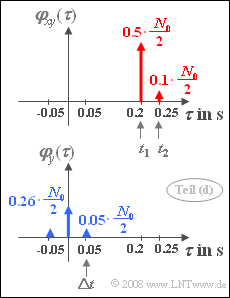
{Berechnen Sie unter Verwendung der Näherung $\varphi_{xy}(\tau) \approx N_0/2 \cdot \delta(\tau)$ die AKF $\varphi_y(\tau)$. <br>Welche Gewichte ergeben sich für $\tau = 0$ und $\tau = \Delta t = t_2 - t_1$?
{Calculate the $\rm ACF$ $\varphi_y(\tau)$ using the approximation $\varphi_{xy}(\tau) \approx N_0/2 \cdot \delta(\tau)$. What weights result for $\tau = 0$ and $\tau = \Delta t = t_2 - t_1$?
'''(1)''' Das zweiseitige Leistungsdichtespektrum ${\it \Phi}_{x}(f)$ ist im Bereich $\pm B_x$ konstant gleich $N_0/2$. Dessen Fouriertransformierte ergibt die AKF:
'''(1)''' The two-sided power-spectral density ${\it \Phi}_{x}(f)$ is constantly equal $N_0/2$ in the range $\pm B_x$.
Die si-Funktion weist äquidistante Nulldurchgänge bei allen Vielfachen von $1/(2B_x) = 25 \hspace{0.05cm} \mu s$ auf, jeweils bezogen auf deren Mittellagen bei $t_1 = 200 \hspace{0.05cm} ms$ bzw. $t_2 = 250 \hspace{0.05cm} ms$. Daraus ergeben sich die KKF-Werte zu:
*The sinc–function exhibits equidistant zero crossings at all multiples of $1/(2B_x) = 25 \hspace{0.08cm} µ \rm s$, related to the centers at $t_1 = 200 \hspace{0.08cm} {\rm ms}$ and $t_2 = 250 \hspace{0.08cm} {\rm ms}$. This results in the CCF values:
'''(3)''' Das Kreuzleistungsdichtespektrum (KLDS) ist die Fouriertransformierte der KKF, ebenso wie das Leistungsdichtespektrum (LDS) die Fouriertransformierte der AKF angibt. Für dieses gilt:
'''(3)''' The cross power-spectral density is the Fourier transform of the CCF, just as the power-spectral density $\rm (PSD)$ gives the Fourier transform of the ACF. It holds:
*Outside of the range $|f| \le B_x$ the power-spectral density ${\it \Phi}_{x}(f)$ – and correspondingly the cross power-spectral density ${\it \Phi}_{xy}(f)$ – is identically zero.
*In contrast, inside this interval holds ${\it \Phi}_{x}(f) = N_0/2$. It follows in this range:
[[File:P_ID450__Sto_Z_4_14_d.png|right|frame|ACF and CCF with white noise]]
Außerhalb des Bereichs $|f| \le B_x$ ist das LDS ${\it \Phi}_{x}(f)$ - und dementsprechend auch das KLDS ${\it \Phi}_{xy}(f)$ - identisch $0$. Innerhalb dieses Intervalls gilt dagegen ${\it \Phi}_{x}(f) = N_0/2$. Daraus folgt in diesem Bereich:
*In the frequency domain, no difference is detectable for $|f| \le B_x$ compared to subtask '''(3)''' .
*But since "true white noise" is now present, here the cross power-spectral density is not limited to this range.
'''(4)''' Richtig sind demnach <u>die Lösungsvorschläge 1 und 3</u>:
*Die Fouriertransformierte einer diracförmigen AKF führt zu einem für alle Frequenzen $f$ konstanten LDS, das heißt tatsächlich zu „ echt Weißem Rauschen”. Dieses besitzt eine unendlich große Leistung, und für die KKF kann dann entsprechend der oberen Grafik geschrieben werden:
*Im Frequenzbereich ist für $|f| \le B_x$ tatsächlich kein Unterschied gegenüber Teilaufgabe (3) feststellbar. Da nun aber echt weißes Rauschen vorliegt, ist aber hier das KLDS nicht auf diesen Bereich beschränkt.
'''(5)''' Für die AKF des echobehafteten Signals gilt: $\varphi_{y} (\tau) = \overline {y(t) \hspace{0.05cm}\cdot \hspace{0.05cm}y(t+\tau)}$. Diese AKF $\varphi_{y} (\tau)$ lässt sich demzufolge als die folgende Summe darstellen:
'''(5)''' For the ACF of the echoed signal, $\varphi_{y} (\tau) = \overline {y(t) \hspace{0.05cm}\cdot \hspace{0.05cm}y(t+\tau)}$.
The sinc–function exhibits equidistant zero crossings at all multiples of $1/(2B_x) = 25 \hspace{0.08cm} µ \rm s$, related to the centers at $t_1 = 200 \hspace{0.08cm} {\rm ms}$ and $t_2 = 250 \hspace{0.08cm} {\rm ms}$. This results in the CCF values:
(3) The cross power-spectral density is the Fourier transform of the CCF, just as the power-spectral density $\rm (PSD)$ gives the Fourier transform of the ACF. It holds:
Outside of the range $|f| \le B_x$ the power-spectral density ${\it \Phi}_{x}(f)$ – and correspondingly the cross power-spectral density ${\it \Phi}_{xy}(f)$ – is identically zero.
In contrast, inside this interval holds ${\it \Phi}_{x}(f) = N_0/2$. It follows in this range: