To measure acoustic echoes in rooms – for example caused by reflections at a wall – the adjacent setup can be used.
To measure acoustic echoes in rooms – for example caused by reflections at a wall – the adjacent setup can be used:
*The noise generator produces a "white noise in the relevant frequency range" $x(t)$ with power density $N_0 = 10^{-6} \hspace{0.08cm} \rm W/Hz$.
*The noise generator produces a "white noise in the relevant frequency range" $x(t)$ with power density $N_0 = 10^{-6} \hspace{0.08cm} \rm W/Hz$.
*This is bandlimited to $B_x = 20 \hspace{0.08cm} \rm kHz$ and is given to a loudspeaker.
*This is bandlimited to $B_x = 20 \hspace{0.08cm} \rm kHz$ and is given to a loudspeaker.
*The entire measurement setup is designed for the resistance value $R = 50 \hspace{0.08cm} \rm \Omega$ .
*The entire measurement setup is designed for the resistance value $R = 50 \hspace{0.08cm} \rm \Omega$.
In the most general case, the signal recorded by the microphone can be described as follows:
In the most general case, the signal recorded by the microphone can be described as follows:
:$$y(t) = \sum_{\mu = 1}^M \alpha_\mu \cdot x ( t - t_\mu ) .$$
:$$y(t) = \sum_{\mu = 1}^M \alpha_\mu \cdot x ( t - t_\mu ) .$$
Here denote $\alpha_\mu$ damping factors and $t_\mu$ travel times.
Here the $\alpha_\mu$ denote damping factors and $t_\mu$ delay times.
Line 23:
Line 19:
Hints:
Hints:
*The exercise belongs to the chapter [[Theory_of_Stochastic_Signals/Cross-Correlation_Function_and_Cross_Power_Density|Cross-Correlation Function and Cross Power Density]].
*The exercise belongs to the chapter [[Theory_of_Stochastic_Signals/Cross-Correlation_Function_and_Cross_Power_Density|Cross-Correlation Function and Cross Power-Spectral Density]].
*Use for numerical calculations the parameter values.
*Use for numerical calculations the parameter values.
Line 35:
Line 31:
<quiz display=simple>
<quiz display=simple>
{Apply the ACF $\varphi_x(\tau)$ at the transmitter. What is this converted to the resistor $R = 50 \hspace{0.08cm} \rm \Omega$ ? What is the rms value $\sigma_x$ ?
{Apply the $\rm ACF$ $\varphi_x(\tau)$ at the transmitter. What means this converted to the resistor $R = 50 \hspace{0.08cm} \rm \Omega$ ? What is the rms value $\sigma_x$ ?
|type="{}"}
|type="{}"}
$\sigma_x \ = \ $ { 1 3% } $\ \rm V$
$\sigma_x \ = \ $ { 1 3% } $\ \rm V$
{Calculate the cross-correlation function (CCF) $\varphi_{xy}(\tau)$ between transmit– and receive signal. <br>What values result for $\tau = 0$, $\tau = t_1 = 200 \hspace{0.08cm} \rm ms$ und $\tau = t_2 = 250 \hspace{0.08cm} \rm ms$ ?
{Calculate the cross-correlation function $\rm (CCF)$ $\varphi_{xy}(\tau)$ between transmitted and received signal. <br>What values result for $\tau = 0$, $\tau = t_1 = 200 \hspace{0.08cm} \rm ms$ and $\tau = t_2 = 250 \hspace{0.08cm} \rm ms$ ?
|type="{}"}
|type="{}"}
$\varphi_{xy}(\tau= 0) \ = \ $ { 0. } $\ \rm V^2$
$\varphi_{xy}(\tau= 0) \ = \ $ { 0. } $\ \rm V^2$
Line 47:
Line 43:
{Calculate the cross power spectral density ${\it \Phi}_{xy}(f)$. What value is obtained at frequency $f = 0$?
{Calculate the cross power-spectral density ${\it \Phi}_{xy}(f)$. What value is obtained at frequency $f = 0$?
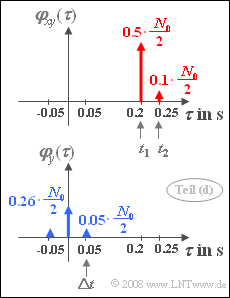
{Which of the following statements are true if you use the approximation $\varphi_{xy}(\tau) \approx N_0/2 \cdot \delta(\tau)$ instead of the ACF calculated in '''(1)''''?
{Which of the following statements are true if you use the approximation $\varphi_{x}(\tau) \approx N_0/2 \cdot \delta(\tau)$ instead of the ACF calculated in '''(1)'''?
|type="[]"}
|type="[]"}
+ The noise is now "true" white – so it is not bandlimited.
+ The noise is now "true white" – so it is not bandlimited.
- The noise power is reduced compared to the sub-task '''(1)''' .
- The noise power is reduced compared to subtask '''(1)'''.
+ The cross-correlation function is the sum of weighted and shifted diracs.
+ The cross-correlation function is the sum of weighted and shifted Dirac delta functions.
- The cross power spectral density is calculated as in subtask '''(3)''' .
- The cross power-spectral density is calculated as in subtask '''(3)'''.
{Calculate using the approximation $\varphi_{xy}(\tau) \approx N_0/2 \cdot \delta(\tau)$ the ACF $\varphi_y(\tau)$. What weights result forür $\tau = 0$ and $\tau = \delta t = t_2 - t_1$ ?
{Calculate the $\rm ACF$ $\varphi_y(\tau)$ using the approximation $\varphi_{xy}(\tau) \approx N_0/2 \cdot \delta(\tau)$. What weights result for $\tau = 0$ and $\tau = \Delta t = t_2 - t_1$?
'''(1)''' The two-sided power spectral density spectrum ${\it \Phi}_{x}(f)$ is constantly equal $N_0/2$ in the range $\pm B_x$ .
'''(1)''' The two-sided power-spectral density ${\it \Phi}_{x}(f)$ is constantly equal $N_0/2$ in the range $\pm B_x$.
*The si function exhibits equidistant zero crossings at multiples of $1/(2B_x) = 25 \hspace{0.08cm} µ \rm s$ respectively, related to the centers at $t_1 = 200 \hspace{0.08cm} {\rm ms}$ and $t_2 = 250 \hspace{0.08cm} {\rm ms}$.
*The sinc–function exhibits equidistant zero crossings at all multiples of $1/(2B_x) = 25 \hspace{0.08cm} µ \rm s$, related to the centers at $t_1 = 200 \hspace{0.08cm} {\rm ms}$ and $t_2 = 250 \hspace{0.08cm} {\rm ms}$. This results in the CCF values:
'''(3)''' The cross power spectral density is the Fourier transform of the CCF, just as the power spectral density spectrum (PSD) gives the Fourier transform of the ACF. For this holds:
'''(3)''' The cross power-spectral density is the Fourier transform of the CCF, just as the power-spectral density $\rm (PSD)$ gives the Fourier transform of the ACF. It holds:
*Outside the range $|f| \le B_x$ the PSD ${\it \Phi}_{x}(f)$ – and correspondingly the KPSD ${\it \Phi}_{xy}(f)$ – is identically zero.
*Outside of the range $|f| \le B_x$ the power-spectral density ${\it \Phi}_{x}(f)$ – and correspondingly the cross power-spectral density ${\it \Phi}_{xy}(f)$ – is identically zero.
*In contrast, inside this interval holds ${\it \Phi}_{x}(f) = N_0/2$. It follows in this range:
*In contrast, inside this interval holds ${\it \Phi}_{x}(f) = N_0/2$. It follows in this range:
[[File:P_ID450__Sto_Z_4_14_d.png|right|frame|ACF and CCF in white noise]]
[[File:P_ID450__Sto_Z_4_14_d.png|right|frame|ACF and CCF with white noise]]
The sinc–function exhibits equidistant zero crossings at all multiples of $1/(2B_x) = 25 \hspace{0.08cm} µ \rm s$, related to the centers at $t_1 = 200 \hspace{0.08cm} {\rm ms}$ and $t_2 = 250 \hspace{0.08cm} {\rm ms}$. This results in the CCF values:
(3) The cross power-spectral density is the Fourier transform of the CCF, just as the power-spectral density $\rm (PSD)$ gives the Fourier transform of the ACF. It holds:
Outside of the range $|f| \le B_x$ the power-spectral density ${\it \Phi}_{x}(f)$ – and correspondingly the cross power-spectral density ${\it \Phi}_{xy}(f)$ – is identically zero.
In contrast, inside this interval holds ${\it \Phi}_{x}(f) = N_0/2$. It follows in this range: