Although the description of Gaussian random variables using vectors and matrices is actually only necessary and makes sense for more than $N = 2$ dimensions, here we restrict ourselves to the special case of two-dimensional random variables for simplicity.
Although the description of Gaussian random variables using vectors and matrices is actually only necessary and makes sense for more than $N = 2$ dimensions, here we restrict ourselves to the special case of two-dimensional random variables for simplicity.
In the graph above, the general correlation matrix $\mathbf{K_x}$ of the 2D–random variable $\mathbf{x} = (x_1, x_2)^{\rm T}$ is given, where $\sigma_1^2$ and $\sigma_2^2$ describe the variances of the individual components. $\rho$ denotes the correlation coefficient between the two components.
The random variables $\mathbf{y}$ and $\mathbf{z}$ give two special cases of $\mathbf{x}$ whose process parameters are to be determined from the correlation matrices $\mathbf{K_y}$ and $\mathbf{K_z}$ respectively.
In the graph above, the general correlation matrix $\mathbf{K_x}$ of the two-dimensional random variable $\mathbf{x} = (x_1, x_2)^{\rm T}$ is given, where $\sigma_1^2$ and $\sigma_2^2$ describe the variances of the individual components. $\rho$ denotes the correlation coefficient between the two components.
The random variables $\mathbf{y}$ and $\mathbf{z}$ give two special cases of $\mathbf{x}$ whose process parameters are to be determined from the correlation matrices $\mathbf{K_y}$ and $\mathbf{K_z}$ respectively.
Line 21:
Line 17:
Hints:
Hints:
*The exercise belongs to the chapter [[Theory_of_Stochastic_Signals/Generalization_to_N-Dimensional_Random_Variables|Generalization to N-Dimensional Random Variables]].
*The exercise belongs to the chapter [[Theory_of_Stochastic_Signals/Generalization_to_N-Dimensional_Random_Variables|Generalization to N-Dimensional Random Variables]].
*Some basics on the application of vectors and matrices can be found on the pages [[Theory_of_Stochastic_Signals/Generalization_to_N-Dimensional_Random_Variables#Basics_of_matrix_operations:_Determinant_of_a_matrix|Determinant of a Matrix]] and [[Theory_of_Stochastic_Signals/Generalization_to_N-Dimensional_Random_Variables#Basics_of_matrix_operations:_Inverse_of_a_matrix|Inverse of a Matrix]] .
*Some basics on the application of vectors and matrices can be found on the pages [[Theory_of_Stochastic_Signals/Generalization_to_N-Dimensional_Random_Variables#Basics_of_matrix_operations:_Determinant_of_a_matrix|Determinant of a Matrix]] and [[Theory_of_Stochastic_Signals/Generalization_to_N-Dimensional_Random_Variables#Basics_of_matrix_operations:_Inverse_of_a_matrix|Inverse of a Matrix]] .
* According to the page [[Theory_of_Stochastic_Signals/Two-Dimensional_Gaussian_Random_Variables#Contour_lines_for_correlated_random_variables|Contour lines for correlated random variables]] the angle $\alpha$ between the old and the new system is given by the following equation:
* According to the page [[Theory_of_Stochastic_Signals/Two-Dimensional_Gaussian_Random_Variables#Contour_lines_for_correlated_random_variables|"Contour lines for correlated random variables"]] the angle $\alpha$ between the old and the new system is given by the following equation:
**A $2×2$-covariance matrix has two real eigenvalues $\lambda_1$ and $\lambda_2$.
**A $2×2$-covariance matrix has two real eigenvalues $\lambda_1$ and $\lambda_2$.
**These two eigenvalues determine two eigenvectors $\xi_1$ and $\xi_2$.
**These two eigenvalues determine two eigenvectors $\xi_1$ and $\xi_2$.
Line 38:
Line 33:
|type="[]"}
|type="[]"}
+ $\mathbf{K_y}$ describes all possible two-dimensional random variables with $\sigma_1 = \sigma_2 = \sigma$.
+ $\mathbf{K_y}$ describes all possible two-dimensional random variables with $\sigma_1 = \sigma_2 = \sigma$.
+ The value range of the parameter $\rho$ is $-1 \le \rho \le +1$.
+ The value range of the parameter $\rho$ is $-1 \le \rho \le +1$.
- The value range of the parameter $\rho$ is $0 < \rho < 1$.
- The value range of the parameter $\rho$ is $0 < \rho < 1$.
Line 48:
Line 43:
{Give the eigenvalues of $\mathbf{K_y}$ under the condition $\sigma = 1$ and $0 < \rho < 1$ What values result for $\rho = 0.5 $, assuming $\lambda_1 \ge \lambda_2$ ?
{Give the eigenvalues of $\mathbf{K_y}$ under the condition $\sigma = 1$ and $0 < \rho < 1$ What values result for $\rho = 0.5 $, assuming $\lambda_1 \ge \lambda_2$?
{Calculate the corresponding eigenvectors $\mathbf{\eta_1}$ and $\mathbf{\eta_2}$. Which of the following statements are true?
{Calculate the corresponding eigenvectors $\mathbf{\eta_1}$ and $\mathbf{\eta_2}$. Which of the following statements are true?
|type="[]"}
|type="[]"}
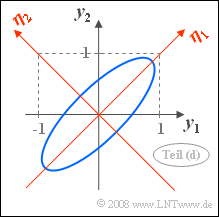
+ $\mathbf{\eta_1}$ and $\mathbf{\eta_2}$ lie in the direction of the ellipse principal axes.
+ $\mathbf{\eta_1}$ and $\mathbf{\eta_2}$ lie in the direction of the ellipse main axes.
+ The new coordinates are rotated by $45^\circ$ .
+ The new coordinates are rotated by $45^\circ$.
- The scatterings with respect to the new system are $\lambda_1$ and $\lambda_2$.
- The standard deviations with respect to the new system are $\lambda_1$ and $\lambda_2$.
{What are the characteristics of the random variable specified by $\mathbf{K_z}$ $\mathbf{z}$?
{What are the characteristics of the random variable $\mathbf{z}$ specified by $\mathbf{K_z}$?
|type="{}"}
|type="{}"}
$\sigma_1 = \ $ { 2 3% }
$\sigma_1 = \ $ { 2 3% }
Line 84:
Line 79:
===Solution===
===Solution===
{{ML-Kopf}}
{{ML-Kopf}}
'''(1)''' Correct are <u>proposed solutions 1 and 2</u>:
'''(1)''' Correct are the <u>proposed solutions 1 and 2</u>:
*$\mathbf{K_y}$ is indeed the most general correlation matrix of a 2D random variable with $\sigma_1 = \sigma_2 = \sigma$.
*$\mathbf{K_y}$ is indeed the most general correlation matrix of a two-dimensional random variable with $\sigma_1 = \sigma_2 = \sigma$.
*The parameter $\rho$ specifies the correlation coefficient. This can take all values between $\pm 1$ including these marginal values.
*The parameter $\rho$ specifies the correlation coefficient. This can take all values between $\pm 1$ including these marginal values.
Line 91:
Line 86:
'''(2)''' In this case, the governing equation is:
'''(2)''' In this case, the governing equation is:
'''(4)''' The eigenvectors are obtained by substituting the eigenvalues $\lambda_1$ and $\lambda_2$ into the correlation matrix:
'''(4)''' Correct are <u>the proposed solutions 1 and 2</u>.
*The coordinate system defined by $\mathbf{\eta_1}$ and $\mathbf{\eta_2}$ is actually in the direction of the principal axes of the original system.
*The coordinate system defined by $\mathbf{\eta_1}$ and $\mathbf{\eta_2}$ is actually in the direction of the main axes of the original system.
*With $\sigma_1 = \sigma_2$ almost always results $($exception: $\rho= 0)$ the angle of rotation $\alpha = 45^\circ$.
*With $\sigma_1 = \sigma_2$ almost always results $($exception: $\rho= 0)$ the rotation angle $\alpha = 45^\circ$.
*This also follows from the equation given in the theory section:
*This also follows from the equation given in the theory section:
*The eigenvalues $\lambda_1$ and $\lambda_2$ do not denote the standard deviations with respect to the new axes, but the variances.
Although the description of Gaussian random variables using vectors and matrices is actually only necessary and makes sense for more than $N = 2$ dimensions, here we restrict ourselves to the special case of two-dimensional random variables for simplicity.
In the graph above, the general correlation matrix $\mathbf{K_x}$ of the two-dimensional random variable $\mathbf{x} = (x_1, x_2)^{\rm T}$ is given, where $\sigma_1^2$ and $\sigma_2^2$ describe the variances of the individual components. $\rho$ denotes the correlation coefficient between the two components.
The random variables $\mathbf{y}$ and $\mathbf{z}$ give two special cases of $\mathbf{x}$ whose process parameters are to be determined from the correlation matrices $\mathbf{K_y}$ and $\mathbf{K_z}$ respectively.