[[File:P_ID245__Sto_Z_4_1.jpg|right|Dr. Angela Merkel und Dr. Edmund Stoiber im Jahr 2002]]
[[File:P_ID245__Sto_Z_4_1.jpg|right|frame|Chancellor candidates – breakfast in 2002]]
Frau M. und Herr S. treffen sich ja bekanntlich öfter einmal zu einem gemeinsamen Frühstück. Beide versprechen, an einem bestimmten Tag zwischen 8 Uhr und 9 Uhr zu einem solchen Treffen zu kommen. Weiter vereinbaren sie, dass jeder von ihnen in diesem Zeitraum (und nur in diesem) auf „Gut Glück” eintrifft und bis zu einer Viertelstunde auf den Anderen wartet.
Ms. M. and Mr. S. are known to meet often for a joint breakfast:
*Both promise to come to such a meeting on a certain day between 8 am and 9 am.
*Further, they agree that each of them will arrive in this period (and only in this period) on "good luck" <br>and wait up to fifteen minutes for the other.
''Hinweise:''
*Die Aufgabe gehört zum Kapitel [[Stochastische_Signaltheorie/Zweidimensionale_Zufallsgrößen|Zweidimensionale Zufallsgrößen]].
*Verwenden Sie bei den nachfolgenden Fragen als Zeitangabe die Minute der Ankunftszeit: „Minute = 0” steht für 8 Uhr, „Minute = 60” für 9 Uhr.
*Die Aufgabe entstand vor der Bundestagswahl 2002, als sowohl Angela Merkel als auch Edmund Stoiber Kanzlerkandidat(in) der CDU/CSU werden wollten. Bei einem gemeinsamen Frühstück in Wolfratshausen verzichtete Frau Merkel. Die spätere Wahl gewann Gerhard Schröder.
===Fragebogen===
Hints:
*The exercise belongs to the chapter [[Theory_of_Stochastic_Signals/Two-Dimensional_Random_Variables|Two-Dimensional Random Variables]].
*Use the minute of arrival time as the time in the following questions: <br>"Minute = 0" stands for 8 o'clock, "Minute = 60" for 9 o'clock.
*The exercise arose before the 2002 German Bundestag elections, when both Dr. Angela Merkel and Dr. Edmund Stoiber wanted to become the CDU/CSU's candidate for chancellor.
*At a joint breakfast in Wolfratshausen, Ms. Merkel renounced. The later election was won by Gerhard Schröder (SPD).
===Questions===
<quiz display=simple>
<quiz display=simple>
{Wie groß ist die Wahrscheinlichkeit $p_1$, dass sich die beiden treffen, wenn Herr S. um 8 Uhr 30 ankommt? Begründen Sie Ihre Antwort.
{What is the probability $p_1$ that the two will meet when Mr. S. arrives at 8:30? Give reasons for your answer.
|type="{}"}
|type="{}"}
$p_1 \ = $ { 50 1% } $\ \%$
$p_1 \ = \ $ { 50 1% } $\ \%$
{Welche Ankunftszeit sollte Frau M. wählen, wenn sie Herrn S. eigentlich nicht treffen möchte, sich aber trotzdem an die getroffene Vereinbarung halten will? Wie groß ist dann die Wahrscheinlichkeit $p_2$, dass sich Frau M. und Herr S. treffen werden?
{Which arrival time should Ms. M. choose if she does not actually want to meet Mr. S., but still wants to keep to the agreement made? <br>What is the probability $p_2$ that Ms. M. and Mr. S. will meet?
|type="{}"}
|type="{}"}
$p_2 \ = $ { 25 1% } $\ \%$
$p_2 \ = \ $ { 25 1% } $\ \%$
{Welche Ankunftszeit sollte Frau M. wählen, wenn sie nicht nur ein Treffen möglichst vermeiden, sondern die Wartezeit minimieren möchte?
{Which arrival time should Ms. M. choose if she not only wants to avoid a meeting as much as possible, but also wants to minimize the waiting time?
|type="{}"}
|type="{}"}
$\rm Minute$ = { 60 }
$\rm minute \ = \ ${ 60 }
{Wie groß ist die Wahrscheinlichkeit $p_4$ für ein Zusammentreffen generell, das heißt, wenn beide tatsächlich auf „Gut Glück” erscheinen?
{What is the probability $p_4$ for a meeting in general, that is, if both actually appear on "good luck"?
|type="{}"}
|type="{}"}
$p_4 \ = $ { 43.75 1% } $\ \%$
$p_4 \ = \ $ { 43.75 1% } $\ \%$
Line 40:
Line 46:
</quiz>
</quiz>
===Musterlösung===
===Solution===
{{ML-Kopf}}
{{ML-Kopf}}
'''(1)''' Kommt Herr S. um 8 Uhr 30, so trifft er Frau M., wenn diese zwischen 8 Uhr 15 und 8 Uhr 45 ankommt. Damit ist die Wahrscheinlichkeit
'''(1)''' If Mr. S. arrives at 8:30, he will meet Ms. M. if she arrives between 8:15 and 8:45. Thus the probability:
$$p_1 = \text{Pr(Herr S. trifft Frau M.)}\hspace{0.15cm}\underline{=50\%}.$$
:$$p_1 = \text{Pr(Mr. S. meets Ms. M.)}\hspace{0.15cm}\underline{=50\%}.$$
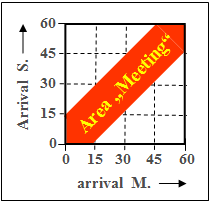
[[File:EN_Sto_Z_4_1_d_neu.png|right|frame|"Favorable area" for meeting]]
'''(2)''' If Ms. M. arrives at 8 a.m., she meets Mr. S. only if he arrives before 8:15.
*If Ms. M. arrives at 9 a.m., Mr. S. must arrive after 8:45 a.m. so that they can meet.
*The probability of meeting is the same in both cases:
:$$p_2 = \big[\text{Min Pr(Mr. S. meets Ms. M.)}\big]\hspace{0.15cm}\underline{=25\%}.$$
'''(3)''' Of the two arrival times calculated in '''(2)''', 9 o'clock $(\underline{\text{Minute = 60}})$ is more favorable, <br> since she – if Mr. S. is not there – can leave immediately.
[[File:P_ID246__Sto_Z_4_1_d.png|right|Günstiger Bereich für Zusammentreffen]]
'''(2)''' Kommt Frau M. um 8 Uhr, so trifft sie Herrn S. nur dann, wenn dieser vor 8 Uhr 15 kommt. Erscheint Frau M. um 9 Uhr, dann muss Herr S. nach 8 Uhr 45 angekommen sein, damit sich beide treffen können. Die Wahrscheinlichkeit für ein Zusammentreffen ist in beiden Fällen:
$$p_1 = \text{Min[Pr(Herr S. trifft Frau M.)]}\hspace{0.15cm}\underline{=25\%}.$$
'''(3)''' Von den beiden unter (2) berechneten Ankunftszeiten ist 9 Uhr ($\underline{\text{Minute = 60}}$) günstiger, da sie – falls Herr S. nicht da ist – sofort wieder gehen kann.
'''(4)''' Die Wahrscheinlichkeit $p_4$ ergibt sich als das Verhältnis der roten Fläche in der Grafik zur Gesamtfläche $1$. Mit den Dreiecksflächen erhält man:
'''(4)''' The probability $p_4$ is given as the ratio of the red area in the graph to the total area $1$.
Ms. M. and Mr. S. are known to meet often for a joint breakfast:
Both promise to come to such a meeting on a certain day between 8 am and 9 am.
Further, they agree that each of them will arrive in this period (and only in this period) on "good luck" and wait up to fifteen minutes for the other.
Use the minute of arrival time as the time in the following questions: "Minute = 0" stands for 8 o'clock, "Minute = 60" for 9 o'clock.
The exercise arose before the 2002 German Bundestag elections, when both Dr. Angela Merkel and Dr. Edmund Stoiber wanted to become the CDU/CSU's candidate for chancellor.
At a joint breakfast in Wolfratshausen, Ms. Merkel renounced. The later election was won by Gerhard Schröder (SPD).
(1) If Mr. S. arrives at 8:30, he will meet Ms. M. if she arrives between 8:15 and 8:45. Thus the probability:
$$p_1 = \text{Pr(Mr. S. meets Ms. M.)}\hspace{0.15cm}\underline{=50\%}.$$
"Favorable area" for meeting
(2) If Ms. M. arrives at 8 a.m., she meets Mr. S. only if he arrives before 8:15.
If Ms. M. arrives at 9 a.m., Mr. S. must arrive after 8:45 a.m. so that they can meet.
The probability of meeting is the same in both cases:
$$p_2 = \big[\text{Min Pr(Mr. S. meets Ms. M.)}\big]\hspace{0.15cm}\underline{=25\%}.$$
(3) Of the two arrival times calculated in (2), 9 o'clock $(\underline{\text{Minute = 60}})$ is more favorable, since she – if Mr. S. is not there – can leave immediately.
(4) The probability $p_4$ is given as the ratio of the red area in the graph to the total area $1$.