Aufgaben:Exercise 4.7Z: Generation of a Joint PDF: Difference between revisions

From LNTwww
Mwiki-lnt (talk | contribs)
m Textersetzung - „\*\s*Sollte die Eingabe des Zahlenwertes „0” erforderlich sein, so geben Sie bitte „0\.” ein.“ durch „ “
Fix interlanguage link: resolve redirect chain
 
(16 intermediate revisions by 4 users not shown)
Line 1: Line 1:


{{quiz-Header|Buchseite=Stochastische Signaltheorie/Linearkombinationen von Zufallsgrößen
{{quiz-Header|Buchseite=Theory_of_Stochastic_Signals/Linear_Combinations_of_Random_Variables
}}
}}


[[File:P_ID423__Sto_Z_4_7.png|right|Vorgaben zur Erzeugung einer 2D-Zufallsgröße]]
[[File:P_ID423__Sto_Z_4_7.png|right|frame|Requirements for the generation of a <br>two-dimensional random variable]]
Ausgehend von statistisch unabhängigen Größen $u$ und $v$ die beide zwischen $-1$ und $+1$ gleichverteilt sind und somit jeweils die Varianz $\sigma^2 = 2/3$ besitzen, soll eine 2D-Zufallsgröße $(x, y)$ generiert werden, wobei für die Komponenten gilt:
Given statistically independent quantities&nbsp; $u$&nbsp; and&nbsp; $v$,
:$$x = A \cdot u + B \cdot  v + C,$$
*both of which are uniformly distributed between&nbsp; $-1$&nbsp; and&nbsp; $+1$,&nbsp; and
:$$y= D \cdot u + E \cdot  v + F.$$
*thus each have variance&nbsp; $\sigma^2 = 2/3$,&nbsp;


Die zu erzeugende 2D&ndash;Zufallsgröße $(x, y)$ soll die folgenden statistischen Eigenschaften aufweisen:
* Die Varianzen seien $\sigma_x^2 = 4$ und $\sigma_y^2 = 10$.
* Die Zufallsgröße $x$ sei mittelwertfrei $(m_x =0)$.
* Für den Mittelwert von $y$ gelte $m_y = 1$.
* Der Korrelationskoeffizient zwischen $x$ und $y$ betrage $\rho_{xy} = \sqrt{0.9} = 0.949.$
* Die Zufallsgröße $x$ besitze eine dreieckförmige WDF  $f_x(x)$ entsprechend der oberen Grafik.
* Die Zufallsgröße $y$ besitze eine trapezförmige WDF  $f_y(y)$ entsprechend der unteren Grafik.


generate a two-dimensional random variable&nbsp; $(x,\hspace{0.08cm} y)$&nbsp; where for the components:
:$$x = A \cdot u + B \cdot v + C,$$
:$$y= D \cdot u + E \cdot v + F.$$


''Hinweise:''
The two-dimensional random variable&nbsp; $(x,\hspace{0.08cm} y)$&nbsp; to be generated should have the following statistical properties:
*Die Aufgabe gehört zum  Kapitel [[Stochastische_Signaltheorie/Linearkombinationen_von_Zufallsgrößen|Linearkombinationen von Zufallsgrößen]].
* Let the variances be&nbsp; $\sigma_x^2 = 4$&nbsp; and&nbsp; $\sigma_y^2 = 10$.
*Insbesondere wird Bezug genommen auf die Seite [[Stochastische_Signaltheorie/Linearkombinationen_von_Zufallsgrößen#Erzeugung_korrelierter_Zufallsgr.C3.B6.C3.9Fen|Erzeugung korrelierter Zufallsgrößen]].
* Let the random variable&nbsp; $x$&nbsp; be mean-free&nbsp; $(m_x =0)$.
*Um Mehrdeutigkeiten zu vermeiden wird festgelegt, dass alle Koeffizienten $A$, ... , $F$ nicht negativ sein sollen.
* For the mean of&nbsp; $y$&nbsp; let&nbsp; $m_y = 1$&nbsp; hold.
* The correlation coefficient between&nbsp; $x$&nbsp; and&nbsp; $y$&nbsp; is&nbsp; $\rho_{xy} = \sqrt{0.9} = 0.949.$
* The random variable&nbsp; $x$&nbsp; possess a triangular PDF $f_x(x)$&nbsp; corresponding to the above graph.
* The random variable&nbsp; $y$&nbsp; has a trapezoidal PDF $f_y(y)$&nbsp; according to the lower graph.


Hints:
*The exercise belongs to the chapter&nbsp; [[Theory_of_Stochastic_Signals/Linear_Combinations_of_Random_Variables|Linear Combinations of Random Variables]].
*In particular,&nbsp; reference is made to the page&nbsp; [[Theory_of_Stochastic_Signals/Linear_Combinations_of_Random_Variables#Generation_of_correlated_random_variables|Generation of correlated random variables]].
*To avoid ambiguity,&nbsp; it is specified that all coefficients&nbsp; $A$, ... , $F$&nbsp; should be non-negative.


===Fragebogen===
===Questions===


<quiz display=simple>
{Bestimmen Sie die Koeffizienten $C$ und $F$.
{Determine the coefficients&nbsp; $C$&nbsp; and&nbsp; $F$.
|type="{}"}
|type="{}"}
$C \ = $ { 0. }
$C \ = \ $ { 0. }
$F\ = $ { 1 3% }
$F\ = \ $ { 1 3% }


{Bestimmen Sie die Koeffizienten $A$ und $B$.
{Determine the coefficients&nbsp; $A$&nbsp; and&nbsp; $B$.
|type="{}"}
|type="{}"}
$A \ = $ { 1.732 3% }
$A \ = \ $ { 1.732 3% }
$B \ = $ { 1.732 3% }
$B \ = \ $ { 1.732 3% }


{Bestimmen Sie die Koeffizienten $D$ und $E$, wobei $D > E$ gelten soll.
{Determine the coefficients&nbsp; $D$&nbsp; and&nbsp; $E$,&nbsp; where&nbsp; $D > E$&nbsp; should hold.
|type="{}"}
|type="{}"}
$D \ = $ { 3.464 3% }
$D \ = \ $ { 3.464 3% }
$E \ = $ { 1.732 3% }
$E \ = \ $ { 1.732 3% }


{Geben Sie die Maximalwerte f&uuml;r $x$ und $y$ an.
{Specify the maximum values for&nbsp; $x$&nbsp; and&nbsp; $y$.
|type="{}"}
|type="{}"}
$x_\text{max}\ = $ { 3.464 3% }
$x_\text{max}\ = \ $ { 3.464 3% }
$y_\text{max}\ = $ { 6.196 3% }
$y_\text{max}\ = \ $ { 6.196 3% }


</quiz>
</quiz>


===Musterlösung===
===Solution===
{{ML-Kopf}}
{{ML-Kopf}}
'''(1)'''&nbsp; Aufgrund der angegebenen Mittelwerte muss gelten:  
'''(1)'''&nbsp; Given the mean values,&nbsp; it must hold:  
:$$ C = m_x\hspace{0.15cm}\underline{ = 0},$$
:$$ F = m_y\hspace{0.15cm}\underline{ = 1}.$$


'''(2)'''&nbsp; Unter Ber&uuml;cksichtigung von $\sigma^2 = 2/3$ gilt:
:$$\sigma_x^2 =  \sigma^2 \cdot ( A^2 + B^2)= {2}/{3} \cdot ( A^2 + B^2) .$$


Wegen $\sigma_x^2 = 4$ folgt daraus $A^2 + B^2= 6$. Eine dreieckf&ouml;rmige WDF bedeutet, dass $A = \pm B$ gelten muss. Somit erh&auml;lt man, da  negative Koeffizienten  ausgeschlossen wurden:  
'''(2)'''&nbsp; Taking into account&nbsp; $\sigma^2 = 2/3$&nbsp; holds:
:$$ A = B = \sqrt{3}\hspace{0.15cm}\underline{ = 1.732}.$$  
:$$\sigma_x^2 = \sigma^2 \cdot ( A^2 + B^2)= {2}/{3} \cdot ( A^2 + B^2) .$$
 
*Because of&nbsp; $\sigma_x^2 = 4$&nbsp; it follows&nbsp; $A^2 + B^2= 6$.  
*A triangular PDF means that&nbsp; $A = \pm B$&nbsp; must hold.  
*Thus,&nbsp; since negative coefficients have been excluded,&nbsp; we obtain:  
:$$ A = B = \sqrt{3}\hspace{0.15cm}\underline{ = 1.732}.$$


'''(3)'''&nbsp; Mit $ A = B = \sqrt{3}$ entsprechend der letzten Teilaufgabe verbleiben zwei Bestimmungsgleichungen f&uuml;r $D$ und $E$:
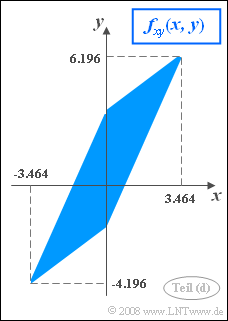
[[File:P_ID424__Sto_Z_4_7_d.png|right|Rautenförmige 2D-WDF]]
[[File:P_ID424__Sto_Z_4_7_d.png|right|frame|Rhombic joint PDF]]
:$$\sigma_y^2 = \sigma^2 \cdot ( D^2 + E^2)= 10 \hspace{0.5cm} \Rightarrow \hspace{0.5cm} D^2 + E^2 = \frac {\sigma_y^2}{\sigma^2} = \frac {10}{2/3} \stackrel{!}{=}15,$$
'''(3)'''&nbsp; With&nbsp; $ A = B = \sqrt{3}$&nbsp; corresponding to the last subtask,&nbsp; two equations of determination remain for&nbsp; $D$&nbsp; and&nbsp; $E$:
:$$\rho_{xy} = \frac{A \cdot D + B \cdot E}{\sqrt{(A^2 + B^2)(D^2 + E^2)}} = \frac{\sqrt{3} \cdot (D + E)}{\sqrt{6 \cdot (D^2 + E^2)}}  \stackrel{!}{=} \sqrt{0.9}.$$
:$$\sigma_y^2 = \sigma^2 \cdot ( D^2 + E^2)= 10 \hspace{0.5cm} \Rightarrow \hspace{0.5cm} D^2 + E^2 = \frac {\sigma_y^2}{\sigma^2} = \frac {10}{2/3} \stackrel{!}{=}15,$$
:$$\rho_{xy} = \frac{A \cdot D + B \cdot E}{\sqrt{(A^2 + B^2)(D^2 + E^2)}} = \frac{\sqrt{3} \cdot (D + E)}{\sqrt{6 \cdot (D^2 + E^2)}}  \stackrel{!}{=} \sqrt{0.9}.$$


Daraus folgt weiter: $D + E = \sqrt{1.8 \cdot ( D^2 + E^2)} = \sqrt{27} = 3 \cdot \sqrt{3}.$ Die Gleichung führt in Verbindung mit $D^2 + E^2 = 15$ und der oben angegebenen Nebenbedingung$(D>E)$ zum Ergebnis:
*From this it further follows:&nbsp; $D + E = \sqrt{1.8 \cdot ( D^2 + E^2)} = \sqrt{27} = 3 \cdot \sqrt{3}.$  
*The equation,&nbsp; in conjunction with&nbsp; $D^2 + E^2 = 15$&nbsp; and the constraint&nbsp; $(D>E)$&nbsp; leads to the result:
:$$ D= 2 \cdot \sqrt{3}\hspace{0.15cm}\underline{ = 3.464}, \hspace{0.5cm}E= \sqrt{3} \hspace{0.15cm}\underline{= 1.732}.$$


'''(4)'''&nbsp; Die Zufallsgr&ouml;&szlig;e $x$ bzw. $y$ nehmen ihre maximalen Werte  an, wenn jeweils $u= 1$ und $v= 1$ gilt:
 
:$$ x_\text{max}= A+B \hspace{0.15cm}\underline{ = 3.464}, \hspace{0.5cm} x_\text{min} = - A - B= -3.464.$$
'''(4)'''&nbsp; The random variables&nbsp; $x$&nbsp; and&nbsp; $y$&nbsp; resp. take their maximum values when&nbsp; $u= +1$ and&nbsp; $v= +1$&nbsp; holds:
:$$ y_\text{max}= D+E+F \hspace{0.15cm}\underline{ = 6.196}, \hspace{0.5cm} y_\text{min} = -D-E+F= -3.464.$$
:$$ x_\text{max}= A+B \hspace{0.15cm}\underline{ = +3.464}, \hspace{0.5cm} x_\text{min} = - A - B= -3.464.$$
:$$ y_\text{max}= D+E+F \hspace{0.15cm}\underline{ = +6.196}, \hspace{0.5cm} y_\text{min} = -D-E+F= -4.196.$$


{{ML-Fuß}}
{{ML-Fuß}}
Line 81: Line 95:


[[Category:Aufgaben zu Stochastische Signaltheorie|^4.3 Linearkombinationen^]]
[[Category:Theory of Stochastic Signals: Exercises|^4.3 Linear Combinations^]]
[[de:Aufgaben:Aufgabe 4.7Z: Erzeugung einer 2D–WDF]]

Latest revision as of 17:53, 16 March 2026

Requirements for the generation of a
two-dimensional random variable

Given statistically independent quantities  $u$  and  $v$,

  • both of which are uniformly distributed between  $-1$  and  $+1$,  and
  • thus each have variance  $\sigma^2 = 2/3$, 


generate a two-dimensional random variable  $(x,\hspace{0.08cm} y)$  where for the components:

$$x = A \cdot u + B \cdot v + C,$$
$$y= D \cdot u + E \cdot v + F.$$

The two-dimensional random variable  $(x,\hspace{0.08cm} y)$  to be generated should have the following statistical properties:

  • Let the variances be  $\sigma_x^2 = 4$  and  $\sigma_y^2 = 10$.
  • Let the random variable  $x$  be mean-free  $(m_x =0)$.
  • For the mean of  $y$  let  $m_y = 1$  hold.
  • The correlation coefficient between  $x$  and  $y$  is  $\rho_{xy} = \sqrt{0.9} = 0.949.$
  • The random variable  $x$  possess a triangular PDF $f_x(x)$  corresponding to the above graph.
  • The random variable  $y$  has a trapezoidal PDF $f_y(y)$  according to the lower graph.


Hints:


Questions

1 Determine the coefficients  $C$  and  $F$.

$C \ = \ $
$F\ = \ $

2 Determine the coefficients  $A$  and  $B$.

$A \ = \ $
$B \ = \ $

3 Determine the coefficients  $D$  and  $E$,  where  $D > E$  should hold.

$D \ = \ $
$E \ = \ $

4 Specify the maximum values for  $x$  and  $y$.

$x_\text{max}\ = \ $
$y_\text{max}\ = \ $


Solution

(1)  Given the mean values,  it must hold:

$$ C = m_x\hspace{0.15cm}\underline{ = 0},$$
$$ F = m_y\hspace{0.15cm}\underline{ = 1}.$$


(2)  Taking into account  $\sigma^2 = 2/3$  holds:

$$\sigma_x^2 = \sigma^2 \cdot ( A^2 + B^2)= {2}/{3} \cdot ( A^2 + B^2) .$$
  • Because of  $\sigma_x^2 = 4$  it follows  $A^2 + B^2= 6$.
  • A triangular PDF means that  $A = \pm B$  must hold.
  • Thus,  since negative coefficients have been excluded,  we obtain:
$$ A = B = \sqrt{3}\hspace{0.15cm}\underline{ = 1.732}.$$


Rhombic joint PDF

(3)  With  $ A = B = \sqrt{3}$  corresponding to the last subtask,  two equations of determination remain for  $D$  and  $E$:

$$\sigma_y^2 = \sigma^2 \cdot ( D^2 + E^2)= 10 \hspace{0.5cm} \Rightarrow \hspace{0.5cm} D^2 + E^2 = \frac {\sigma_y^2}{\sigma^2} = \frac {10}{2/3} \stackrel{!}{=}15,$$
$$\rho_{xy} = \frac{A \cdot D + B \cdot E}{\sqrt{(A^2 + B^2)(D^2 + E^2)}} = \frac{\sqrt{3} \cdot (D + E)}{\sqrt{6 \cdot (D^2 + E^2)}} \stackrel{!}{=} \sqrt{0.9}.$$
  • From this it further follows:  $D + E = \sqrt{1.8 \cdot ( D^2 + E^2)} = \sqrt{27} = 3 \cdot \sqrt{3}.$
  • The equation,  in conjunction with  $D^2 + E^2 = 15$  and the constraint  $(D>E)$  leads to the result:
$$ D= 2 \cdot \sqrt{3}\hspace{0.15cm}\underline{ = 3.464}, \hspace{0.5cm}E= \sqrt{3} \hspace{0.15cm}\underline{= 1.732}.$$


(4)  The random variables  $x$  and  $y$  resp. take their maximum values when  $u= +1$ and  $v= +1$  holds:

$$ x_\text{max}= A+B \hspace{0.15cm}\underline{ = +3.464}, \hspace{0.5cm} x_\text{min} = - A - B= -3.464.$$
$$ y_\text{max}= D+E+F \hspace{0.15cm}\underline{ = +6.196}, \hspace{0.5cm} y_\text{min} = -D-E+F= -4.196.$$