Die zu berechnende Spektralfunktion $X(f)$ wird komplex sein und kann daher
The spectral function $X(f)$ to be calculated will be complex and therefore can be represented
*nach Real– und Imaginärteil, aber auch
*by real and imaginary part, but also
*nach Betrag und Phase
*by magnitude and phase.
dargestellt werden. Verwenden Sie die Notation:
:$$X( f ) = \left| {X( f )} \right| \cdot {\rm e}^{ - {\rm j} \hspace{0.05cm}\cdot \hspace{0.05cm} \varphi( f )} .$$
Line 30:
Line 27:
''Hint:''
*This exercise belongs to the chapter [[Signal_Representation/Fourier_Transform_and_Its_Inverse|Fourier Transform and its Inverse]].
*Use the notation:
''Hinweis:''
*Die Aufgabe gehört zum Kapitel [[Signaldarstellung/Fouriertransformation_und_-rücktransformation|Fouriertransformation und –rücktransformation]].
:$$X( f ) = \left| {X( f )} \right| \cdot {\rm e}^{ - {\rm j} \hspace{0.05cm}\cdot \hspace{0.05cm} \varphi( f )} .$$
===Fragebogen===
===Questions===
<quiz display=simple>
<quiz display=simple>
{Berechnen Sie die Spektralfunktion $X(f)$. Welcher Spektralwert ergibt sich bei der Frequenz $f = 0$?
{Calculate the spectral function $X(f)$. What spectral value results at the frequency $f = 0$?
{Wie lauten der Real– und der Imaginärteil von $X(f)$ unter Verwendung von $f_0 = 1/(2\pi T)$. Welche Werte ergeben sich bei $f = f_0$?
{What are the real and imaginary parts of $X(f)$ using $f_0 = 1/(2\pi T)$. What are the values when $f = f_0$?
{Berechnen Sie die Phasenfunktion $\varphi(f)$. Welche Werte ergeben sich hierfür bei der Frequenz $f = f_0$ und bei sehr großen Frequenzen?
{Calculate the phase function $\varphi(f)$. What values result for this at the frequency $f = f_0$ and at very high frequencies?
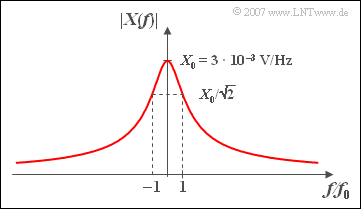
[[File:P_ID548__Sig_A_3_1_c_neu.png|right|frame|Betragsspektrum des Exponentialimpulses]]
'''(3)''' The magnitude of a complex-valued function, which is a quotient, is equal to the quotient of the magnitudes of the numerator and denominator.
'''(3)''' Der Betrag einer komplexwertigen Funktion, die als Quotient vorliegt, ist gleich dem Quotienten der Beträge von Zähler und Nenner. Damit erhält man:
[[File:P_ID548__Sig_A_3_1_c_neu.png|right|frame|Magnitude spectrum of the exponential pulse]]
Für $f = f_0$ ergibt sich $\arctan(1)= \pi /4 \hspace{0.15 cm}\underline{\approx 0.785}$, für sehr große Werte von $f$ nähert sich die Phasenfunktion dem Wert $\arctan(\infty) = \pi /2 \hspace{0.15 cm}\underline{ \approx 1.571}$ an. Beide Angaben sind im Bogenmaß („Radian”) zu verstehen.
*For very large values of $f$ the phase function approaches $\varphi ( f \to \infty ) =\arctan(\infty) = \pi /2 \hspace{0.15 cm}\underline{ \approx 1.571}$.
*Both specifications are to be understood in radians.
{{ML-Fuß}}
{{ML-Fuß}}
__NOEDITSECTION__
__NOEDITSECTION__
[[Category:Aufgaben zu Signaldarstellung|^3. Aperiodische Signale - Impulse^]]
[[Category:Signal Representation: Exercises|^3.1 Fourier Transform and Its Inverse^]]
[[de:Aufgaben:Aufgabe 3.1: Spektrum des Exponentialimpulses]]
For $f = f_0$ this gives $\varphi ( f_0 ) =\arctan(1)= \pi /4 \hspace{0.15 cm}\underline{\approx 0.785}$.
For very large values of $f$ the phase function approaches $\varphi ( f \to \infty ) =\arctan(\infty) = \pi /2 \hspace{0.15 cm}\underline{ \approx 1.571}$.
Both specifications are to be understood in radians.