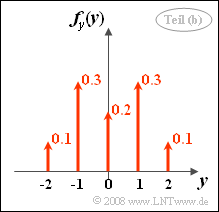
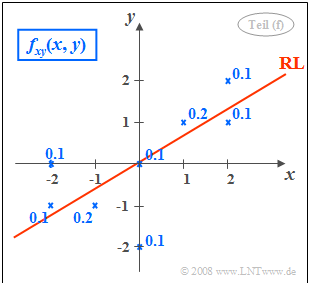
In der Grafik ist die zweidimensionale Wahrscheinlichkeitsdichtefunktion $f_{xy}(x, y)$ der zwei diskreten Zufallsgrößen $x$ und $y$ dargestellt.
The graph shows the two-dimensional probability density function $f_{xy}(x, y)$ of two discrete random variables $x$, $y$.
*Diese 2D–WDF besteht aus acht Diracpunkten, durch Kreuze markiert. Die Zahlenwerte geben die entsprechenden Wahrscheinlichkeiten an.
*This 2D–PDF consists of eight Dirac points, marked by crosses.
*Es ist zu erkennen, dass sowohl $x$ als auch $y$ alle ganzzahligen Werte zwischen den Grenzen $-2$ und $+2$ annehmen können.
*The numerical values indicate the corresponding probabilities.
*Die Varianzen der beiden Zufallsgrößen sind wie folgt gegeben: $\sigma_x^2 = 2$, $\sigma_y^2 = 1.4$.
*It can be seen that both $x$ and $y$ can take all integer values between the limits $-2$ and $+2$.
<br>
*The variances of the two random variables are given as follows: $\sigma_x^2 = 2$, $\sigma_y^2 = 1.4$.
Line 14:
Line 14:
Hints:
*The exercise belongs to the chapter [[Theory_of_Stochastic_Signals/Two-Dimensional_Random_Variables|Two-Dimensional Random Variables]].
''Hinweise:''
*Reference is also made to the chapter [[Theory_of_Stochastic_Signals/Moments_of_a_Discrete_Random_Variable|Moments of a Discrete Random Variable]]
*Die Aufgabe gehört zum Kapitel [[Stochastische_Signaltheorie/Zweidimensionale_Zufallsgrößen|Zweidimensionale Zufallsgrößen]].
*Bezug genommen wird auch auf das Kapitel [[Stochastische_Signaltheorie/Momente_einer_diskreten_Zufallsgröße|Momente einer diskreten Zufallsgröße]]
Line 25:
Line 23:
===Fragebogen===
===Questions===
<quiz display=simple>
<quiz display=simple>
{Welche der folgenden Aussagen trefen hinsichtlich der Zufallsgröße $x$ zu?
{Which of the following statements are true regarding the random variable $x$?
|type="[]"}
|type="[]"}
+ Die Wahrscheinlichkeiten für $-2$, $-1$, $0$, $+1$ und $+2$ sind gleich.
+ The probabilities for $-2$, $-1$, $0$, $+1$ and $+2$ are equal.
+ Die Zufallsgröße $x$ ist mittelwertfrei $(m_x = 0)$.
+ The random variable $x$ is mean-free $(m_x = 0)$.
- Die Wahrscheinlichkeit ${\rm Pr}(x \le 1)$ ist $0.9$.
- The probability ${\rm Pr}(x \le 1)=0.9$.
{Welche der folgenden Aussagen treffen hinsichtlich der Zufallsgröße $y$ zu?
{Which of the following statements are true with respect to the random variable $y$?
|type="[]"}
|type="[]"}
- Die Wahrscheinlichkeiten für $-2$, $-1$, $0$, $+1$ und $+2$ sind gleich.
- The probabilities for $-2$, $-1$, $0$, $+1$ and $+2$ are equal.
+ Die Zufallsgröße $y$ ist mittelwertfrei $(m_y = 0)$.
+ The random variable $y$ is mean-free $(m_y = 0)$.
+ Die Wahrscheinlichkeit ${\rm Pr}(y \le 1)$ ist $0.9$.
+ The probability ${\rm Pr}(y \le 1)=0.9$.
{Berechnen Sie den Wert der zweidimensionalen VTF an der Stelle $(+1, +1)$.
{Calculate the value of the two-dimensional cumulative distribution function $\rm (CDF)$ at location $(+1, +1)$.
|type="{}"}
|type="{}"}
$F_{xy}(+1, +1) \ = \ $ { 0.8 3% }
$F_{xy}(+1, +1) \ = \ $ { 0.8 3% }
{Berechnen Sie die Wahrscheinlichkeit, dass $x \le 1$ gilt, unter der Bedingung, dass gleichzeitig $y \le 1$ ist.
{Calculate the probability that $x \le 1$ holds, conditioned on $y \le 1$ simultaneously.
{Berechnen Sie das gemeinsame Moment $m_{xy}$ der Zufallsgrößen $x$ und $y$.
{Calculate the joint moment $m_{xy}$ of the random variables $x$ and $y$.
|type="{}"}
|type="{}"}
$m_{xy}\ = \ $ { 1.2 3% }
$m_{xy}\ = \ $ { 1.2 3% }
{Berechnen Sie den Korrelationskoeffizienten $\rho_{xy}$ und geben Sie die Gleichung der Korrelationsgeraden $K(x)$ an. Wie groß ist deren Winkel zur $x$-Achse?
{Calculate the correlation coefficient $\rho_{xy}$. Give the equation of the correlation line $K(x)$ What is its angle to the $x$–axis?
{Welche der nachfolgenden Aussagen sind zutreffend?
{Which of the following statements are true?
|type="[]"}
|type="[]"}
- Die Zufallsgrößen $x$ und $y$ sind statistisch unabhängig.
- The random variables $x$ and $y$ are statistically independent.
+ Man erkennt bereits aus der vorgegebenen 2D-WDF, dass $x$ und $y$ statistisch voneinander abhängen.
+ It can already be seen from the given 2D–PDF that $x$ and $y$ are statistically dependent on each other.
+ Aus dem berechneten Korrelationskoeffizienten $\rho_{xy}$ kann man auf die statistische Abhängigkeit zwischen $x$ und $y$ schließen.
+ From the calculated correlation coefficient $\rho_{xy}$ one can conclude the statistical dependence between $x$ and $y$ .
Line 73:
Line 70:
</quiz>
</quiz>
===Musterlösung===
===Solution===
{{ML-Kopf}}
{{ML-Kopf}}
'''(1)''' Richtig sind die <u>beiden ersten Antworten</u>:
'''(1)''' Correct are the <u>first two answers</u>:
*Die Randwahrscheinlichkeitsdichtefunktion $f_{x}(x)$ erhält man aus der 2D–WDF $f_{xy}(x, y)$ durch Integration über $y$.
*The marginal probability density function $f_{x}(x)$ is obtained from the 2D–PDF $f_{xy}(x, y)$ by integration over $y$.
*Für alle möglichen Werte $ x \in \{-2, -1, \ 0, +1, +2\}$ sind die Wahrscheinlichkeiten gleich $0.2$.
*For all possible values $ x \in \{-2, -1, \ 0, +1, +2\}$ the probabilities are equal $0.2$.
*Es gilt ${\rm Pr}(x \le 1)= 0.8$ und der Mittelwert ist $m_x = 0$.
*It holds ${\rm Pr}(x \le 1)= 0.8$. The mean is $m_x = 0$.
*As can be seen from the 2D–PDF on the information page, this probability is ${\rm Pr}\big [(x \le 1)\cap(y\le 1)\big ]\hspace{0.15cm}\underline{=0.8}$.
*Wie aus der 2D–WDF auf der Angabenseite zu ersehen, ist diese Wahrscheinlichkeit ${\rm Pr}\big [(x \le 1)\cap(y\le 1)\big ]\hspace{0.15cm}\underline{=0.8}$.
'''(4)''' Hierfür kann mit dem Satz von Bayes auch geschrieben werden:
'''(4)''' For this, Bayes' theorem can also be used to write:
*Hierbei ist berücksichtigt, dass wegen $m_x = m_y = 0$ die Kovarianz $\mu_{xy}$ gleich dem Moment $m_{xy}$ ist.
*This takes into account that because $m_x = m_y = 0$ the covariance $\mu_{xy}$ is equal to the moment $m_{xy}$ .
*Die Gleichung der Korrelationsgeraden lautet:
*The equation of the correlation line is:
:$$y=\frac{\sigma_y}{\sigma_x}\cdot \rho_{xy}\cdot x = \frac{\mu_{xy}}{\sigma_x^{\rm 2}}\cdot x = \rm 0.6\cdot \it x.$$
:$$y=\frac{\sigma_y}{\sigma_x}\cdot \rho_{xy}\cdot x = \frac{\mu_{xy}}{\sigma_x^{\rm 2}}\cdot x = \rm 0.6\cdot \it x.$$
*Im Bild ist die Gerade $y = K(x)$ eingezeichnet. Der Winkel zwischen Korrelationsgerade und $x$-Achse beträgt
*See sketch on the right. The angle between the regression line $\rm (RL)$ and the $x$-axis is
As can be seen from the 2D–PDF on the information page, this probability is ${\rm Pr}\big [(x \le 1)\cap(y\le 1)\big ]\hspace{0.15cm}\underline{=0.8}$.
(4) For this, Bayes' theorem can also be used to write:
With the results from (2) and (3) it follows $ \rm Pr(\it x \le \rm 1)\hspace{0.05cm} | \hspace{0.05cm} \it y \le \rm 1) = 0.8/0.9 = 8/9 \hspace{0.15cm}\underline{=0.889}$.
(5) According to the definition, the common moment is: