(2 intermediate revisions by the same user not shown)
Line 81:
Line 81:
'''(3)''' For the event $W$, de Morgan's theorem holds:
'''(3)''' For the event $W$, de Morgan's theorem holds:
:$$\overline W = \overline A \cup \overline D \cup (\overline B \cap C) \cup (B \cap \overline C)
:$$\overline W = \overline A \cup \overline D \cup (\overline B \cap C) \cup (B \cap \overline C)\hspace{0.3cm} \Rightarrow \hspace{0.3cm} W = \overline{\overline W} = A \cap D \cap (\overline{\overline B \cap C}) \cap (\overline{B \cap \overline C}).$$
\hspace{0.3cm} \Rightarrow \hspace{0.3cm} W = \overline{\overline W} = A \cap D \cap (\overline{\overline B \cap C}) \cap (\overline{B \cap \overline C}).$$
*Using de Morgan's theorems, it further follows:
*Using de Morgan's theorems, it further follows:
Line 107:
Line 106:
[[Category:Theory of Stochastic Signals: Exercises|^1.2 Set Theory Basics^]]
[[Category:Theory of Stochastic Signals: Exercises|^1.2 Set Theory Basics^]]
(2) The event $V$ consists of the two numbers $4$ (binary 0100) and $6$ (binary 0110) ⇒ The correct solutions are 1 and 3.
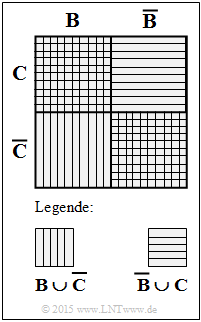
Auxiliary Venn diagram
(3) For the event $W$, de Morgan's theorem holds:
$$\overline W = \overline A \cup \overline D \cup (\overline B \cap C) \cup (B \cap \overline C)\hspace{0.3cm} \Rightarrow \hspace{0.3cm} W = \overline{\overline W} = A \cap D \cap (\overline{\overline B \cap C}) \cap (\overline{B \cap \overline C}).$$
Using de Morgan's theorems, it further follows:
$$ W = A \cap D \cap (B \cup \overline C) \cap (\overline B \cup C).$$
Finally, using the Boolean relation $(B \cup \overline C) \cap (\overline B \cup C) = (B \cap C) \cup (\overline B \cap \overline C)$ we obtain (see sketch):
$$W = (A \cap B \cap C \cap D) \cup (A \cap \overline B \cap \overline C \cap D).$$
Thus, $W$ contains the numbers $15$ and $9$ ⇒ only the proposed solution 1 is correct.
(4) The union of $U$, $V$ and $W$ contains the following numbers: $4, 6, 8, 9, 10, 12, 14, 15$.
Accordingly, the set $P$ as the complement of this union is:
$$P = {\{1, 2, 3, 5, 7, 11, 13\}}.$$
These are exactly the prime numbers which can be represented with four bits ⇒ Proposed solution 2.