Die Seite wurde neu angelegt: „ {{quiz-Header|Buchseite=*Buch*/*Kapitel* }} 250px|right|* ===Fragebogen=== <quiz display=simple> {Multiple-Choice Frage |type="[]"} - Falsch +…“
The range between the frequencies $f_1$ and $f_2 > f_1$ is not relevant for the solution of this task.
The corner frequencies $f_1$ and $f_2$ are to be determined in such a way that the output signal $y(t)$ of the low-pass filter exactly matches the signal $x(t)$ .
''Hints:''
*This task belongs to the chapter [[Signal_Representation/Time_Discrete_Signal_Representation|Discrete-Time Signal Representation]].
*There is an interactive applet for the topic dealt with here: [[Applets:Sampling_of_Analog_Signals_and_Signal_Reconstruction|Sampling of Analog Signals and Signal Reconstruction]]
===Questions===
<quiz display=simple>
<quiz display=simple>
{Multiple-Choice Frage
{Determine the underlying sampling rate from the graph.
|type="{}"}
$f_{\rm A}\ = \ $ { 10 3% } $\text{kHz}$
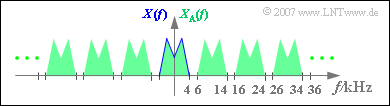
{At which frequencies does the spectral function $X_{\rm A}(f)$ have <u>no components</u> with certainty?
|type="[]"}
|type="[]"}
- Falsch
- $f = 2.5 \ \text{kHz},$
+ Richtig
+ $f= 5.5 \ \text{kHz},$
- $f= 6.5 \ \text{kHz},$
+ $f= 34.5 \ \text{kHz}.$
{What is the minimum size of the lower cut-off frequency $f_1$ that the signal is perfectly reconstructed?
'''(1)''' The distance between two adjacent samples is $T_{\rm A} = 0.1 \ \text{ms}$. Thus, for the sampling rate $f_{\rm A} = 1/ T_{\rm A} \;\underline {= 10 \ \text{kHz}}$is obtained.
[[File:P_ID1127__Sig_A_5_1_b.png|450px|right|frame|Spectrum $X_{\rm A}(f)$ of the sampled signal <br>(schematic representation)]]
'''(2)''' Proposed <u>solutions 2 and 4</u> are correct:
*The spectrum $X_{\rm A}(f)$ of the sampled signal is obtained from $X(f)$ by periodic continuation at a distance of $f_{\rm A} = 10 \ \text{kHz}$.
*From the sketch you can see that $X_{\rm A}(f)$ can have signal parts at $f = 2.5 \ \text{kHz}$ and $f = 6.5 \ \text{kHz}$;.
*In contrast, there are no components at $f = 5.5 \ \text{kHz}$.
*Also at $f = 34.5 \ \text{kHz}$ will be valid $X_{\rm A}(f) = 0$.
<br clear=all>
'''(3)''' It must be ensured that all frequencies of the analog signal are weighted with $H(f) = 1$.
'''(4)''' Likewise, it must be guaranteed that all spectral components of $X_{\rm A}(f)$, that are not contained in $X(f)$ are removed by the low-pass filter.
*According to the sketch, the following must apply:
The range between the frequencies $f_1$ and $f_2 > f_1$ is not relevant for the solution of this task.
The corner frequencies $f_1$ and $f_2$ are to be determined in such a way that the output signal $y(t)$ of the low-pass filter exactly matches the signal $x(t)$ .
(4) Likewise, it must be guaranteed that all spectral components of $X_{\rm A}(f)$, that are not contained in $X(f)$ are removed by the low-pass filter.
According to the sketch, the following must apply: