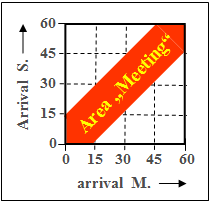
Ms. M. and Mr. S. are known to meet often for a joint breakfast:
Both promise to come to such a meeting on a certain day between 8 am and 9 am.
Further, they agree that each of them will arrive in this period (and only in this period) on "good luck" and wait up to fifteen minutes for the other.
Use the minute of arrival time as the time in the following questions: "Minute = 0" stands for 8 o'clock, "Minute = 60" for 9 o'clock.
The exercise arose before the 2002 German Bundestag elections, when both Dr. Angela Merkel and Dr. Edmund Stoiber wanted to become the CDU/CSU's candidate for chancellor.
At a joint breakfast in Wolfratshausen, Ms. Merkel renounced. The later election was won by Gerhard Schröder (SPD).
(1) If Mr. S. arrives at 8:30, he will meet Ms. M. if she arrives between 8:15 and 8:45. Thus the probability:
$$p_1 = \text{Pr(Mr. S. meets Ms. M.)}\hspace{0.15cm}\underline{=50\%}.$$
"Favorable area" for meeting
(2) If Ms. M. arrives at 8 a.m., she meets Mr. S. only if he arrives before 8:15.
If Ms. M. arrives at 9 a.m., Mr. S. must arrive after 8:45 a.m. so that they can meet.
The probability of meeting is the same in both cases:
$$p_2 = \big[\text{Min Pr(Mr. S. meets Ms. M.)}\big]\hspace{0.15cm}\underline{=25\%}.$$
(3) Of the two arrival times calculated in (2), 9 o'clock $(\underline{\text{Minute = 60}})$ is more favorable, since she – if Mr. S. is not there – can leave immediately.
(4) The probability $p_4$ is given as the ratio of the red area in the graph to the total area $1$.