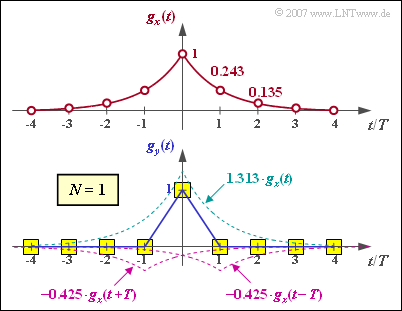
As in [[Aufgaben:Exercise_3.6:_Transversal_Filter_of_the_Optimal_Nyquist_Equalizer|Exercise 3.6]] we consider again the optimal Nyquist equalizer, $g_x(t)$ is a two-sided exponential function:
As in [[Aufgaben:Exercise_3.6:_Transversal_Filter_of_the_Optimal_Nyquist_Equalizer|Exercise 3.6]] we consider again the optimal Nyquist equalizer.
*The input pulse $g_x(t)$ is a two-sided exponential function:
:$$g_x(t) = {\rm e }^{ - |t|/T}\hspace{0.05cm}.$$
:$$g_x(t) = {\rm e }^{ - |t|/T}\hspace{0.05cm}.$$
*Through a transversal filter of $N$–th order with the impulse response
*Through a transversal filter of $N$–th order with the impulse response
'''(2)''' According to the [[Aufgaben:Exercise_3.6:_Transversal_Filter_of_the_Optimal_Nyquist_Equalizer|"solution to Exercise 3.6"]], we arrive at the following system of equations:
'''(2)''' According to [[Aufgaben:Exercise_3.6:_Transversal_Filter_of_the_Optimal_Nyquist_Equalizer|"solution to Exercise 3.6"]], we arrive at the following system of equations:
[[File:P_ID1440__Dig_Z_3_6_c.png|right|frame|Input pulse (top), output pulse for <i>N</i> = 1 (bottom)]]
*The figure shows that for this exponentially decaying pulse, the first-order transversal filter provides complete equalization.
'''(4)''' Only the <u>first statement</u> is correct:
*Outside the interval $-T < t < T$, $g_y(t)$ is identically zero, inside it results in a triangular shape.
*Since already with a first-order delay filter all precursors and trailers are compensated, also with a second-order filter and also for $N → ∞$ no further improvements result.
*However, '''this result applies exclusively to the (bilaterally) exponentially decaying input pulse'''.
'''(4)''' Only the <u>first statement</u> is correct:
*For almost any other pulse shape, the larger $N$ is, the better the result.
*Since already with a first-order delay filter all precursors and trailers are compensated, also with a second-order filter and also for $N → ∞$ no further improvements result.
*However, this result applies exclusively to the (bilaterally) exponentially decaying input pulse.
*For almost any other pulse shape, the larger $N$ is, the better the result.
{{ML-Fuß}}
{{ML-Fuß}}
Line 91:
Line 86:
[[Category:Digital Signal Transmission: Exercises|^3.5 Linear Nyquist Equalization^]]
[[Category:Digital Signal Transmission: Exercises|^3.5 Linear Nyquist Equalization^]]
[[de:Aufgaben:Aufgabe 3.6Z: Optimaler Nyquistentzerrer für Exponentialimpuls]]
The figure shows that for this exponentially decaying pulse, the first-order transversal filter provides complete equalization.
Outside the interval $-T < t < T$, $g_y(t)$ is identically zero.
Inside it results in a triangular shape.
(4) Only the first statement is correct:
Since already with a first-order delay filter all precursors and trailers are compensated, also with a second-order filter and also for $N → ∞$ no further improvements result.
However, this result applies exclusively to the (bilaterally) exponentially decaying input pulse.
For almost any other pulse shape, the larger $N$ is, the better the result.