(One intermediate revision by the same user not shown)
Line 110:
Line 110:
*According to the result of subtask '''(2)''' the zeros occur at the distance $f_0 = 1/T$ .
*According to the result of subtask '''(2)''' the zeros occur at the distance $f_0 = 1/T$ .
*With $f_0 = 1/(2T) = f = 10 \;{\rm{kHz}}$ the real part is $0$, but not the imaginary part.
*With $f_0 = 1/(2T) = f = 10 \;{\rm{kHz}}$ the real part is $0$, but not the imaginary part.
*With the arguments $f \cdot T = 0.5,\ 1.5,\ 2.5,\hspace{0.05cm}\text{ ... }$ the sine function is in each case equal in magnitude to $1$, and it holds:
*With the arguments $f \cdot T = 0.5,\ 1.5,\ 2.5,\hspace{0.05cm}\text{...}$ the sine function is in each case equal in magnitude to $1$, and it holds:
:$$\left| {X( f )} \right| = \frac{A}{ {{\rm{\pi }}\left| f \right|}} = X_{\rm S} ( f ).$$
:$$\left| {X( f )} \right| = \frac{A}{ {{\rm{\pi }}\left| f \right|}} = X_{\rm S} ( f ).$$
Line 136:
Line 136:
__NOEDITSECTION__
__NOEDITSECTION__
[[Category:Signal Representation: Exercises|^3.2 Special Cases of Pulses^]]
[[Category:Signal Representation: Exercises|^3.2 Special Cases of Pulses^]]
[[de:Aufgaben:3.3_Vom_Signal_zum_Spektrum]]
[[de:Aufgaben:Aufgabe 3.3: Vom Signal zum Spektrum]]
A rectangular pulse $x(t)$ with duration $T = 50\,\text{µs}$ and height $A = 2\,\text{V}$ is considered. At the jumping points at $t = 0$ and $t = T$ the signal value is $A/2$ in each case, but this has no influence on the solution of the task.
In the lower graph, the corresponding spectral function is sketched qualitatively according to magnitude and phase. It is valid:
$$X( f ) = \left| {X( f )} \right| \cdot {\rm e}^{ - {\rm j}\hspace{0.05cm}\cdot \hspace{0.05cm} \varphi ( f )} .$$
The analytical function progression of $X(f)$ is to be determined.
$$\left| {X( {f = 0} )} \right| = A \cdot T \hspace{0.15 cm}\underline{= 0.1 \;{\rm{mV/Hz}}}{\rm{.}}$$
This result is obvious because, according to the first Fourier integral, the spectral value at $f = 0$ corresponds exactly to the area under the time function.
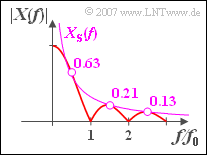
Magnitude spectrum of the rectangular pulse
(3) The proposed solutions 1 and 3 are correct:
According to the result of subtask (2) the zeros occur at the distance $f_0 = 1/T$ .
With $f_0 = 1/(2T) = f = 10 \;{\rm{kHz}}$ the real part is $0$, but not the imaginary part.
With the arguments $f \cdot T = 0.5,\ 1.5,\ 2.5,\hspace{0.05cm}\text{...}$ the sine function is in each case equal in magnitude to $1$, and it holds:
$$\left| {X( f )} \right| = \frac{A}{ {{\rm{\pi }}\left| f \right|}} = X_{\rm S} ( f ).$$
At other frequencies, $X_{\rm S}(f)$ serves as an upper bound, i.e. $|Xf)| \leq X_{\rm S}(f)$ always applies.
In the sketch, this bound is drawn as a violet curve in addition to $|X(f)|$.
(4) According to the definition on the information page, one can calculate the phase function as follows:
$$\varphi ( f ) = - \arctan \frac{ { {\mathop{\rm Im}\nolimits} ( f )}}{ { {\mathop{\rm Re}\nolimits} ( f )}}.$$
With the results from subtask (1) the following thus applies:
The argument of this function is equal to $\tan(\omega T/2) = \tan(\pi fT)$ according to the specification. From this follows a linearly increasing course with frequency: