Ein Zahlengenerator $Z$ liefert Dezimalwerte im Bereich von 1 bis 15. Diese werden in Binärzahlen umgewandelt (rot umrandeter Block). Der Ausgang besteht aus den vier Binärwerten $A$, $B$, $C$ und $D$ mit abnehmender Wertigkeit. Beispielsweise liefert $Z = 11$ die Binärwerte
$$ A = 1, B = 0, C = 1, D = 1. $$
Mengentheoretisch lässt sich dies wie folgt darstellen:
$$ Z = 11\qquad\widehat{=}\qquad A \cap\bar{ B} \cap C \cap D$$
Aus den binären Größen A, B, C und D werden drei weitere Boolsche Ausdrücke gebildet, deren Vereinigungsmenge mit X bezeichnet wird:
:<math> U = A \cap \bar{D} </math>
:<math> V = \bar{A} \cap B \cap \bar{D} </math>
$$W, wobei \, \bar{W} = \bar{A} \cup \bar{D} \cup (\bar{B} \cap C) \cup (B \cap \bar{C}). $$
Für die folgenden Fragen ist zu berücksichtigen, dass $Z = 0 ⇒ A = B = C = D = 0$ bereits durch den Zahlengenerator ausgeschlossen ist. Beachten Sie ferner, dass nicht alle Eingangsgrößen $A$, $B$, $C$ und $D$ zur Berechnung aller Zwischengrößen $U$, $V$ und $W$ herangezogen werden.
Hinweis: Diese Aufgabe bezieht sich auf den Lehrstoff von Kapitel 1.2. Eine Zusammenfassung der theoretischen Grundlagen mit Beispielen bringt das nachfolgende Lernvideo:
===Fragebogen zu "A1.2 Schaltlogik (D/B-Wandler)"===
[[File:EN_Sto_A_1_2.png|right|frame|Logical circuit for D/B converting]]
A number generator $Z$ supplies decimal values in the range $1$ to $15$.
*These are converted into binary numbers (block outlined in red).
*The output consists of the four binary values $A$, $B$, $C$ and $D$ with decreasing significance.
*For example $Z = 11$ delivers the binary values
:$$ A = 1, \ B = 0, \ C = 1, \ D = 1. $$
Set-theoretically, this can be represented as follows:
:$$ Z = 11\qquad\widehat{=}\qquad A \cap\overline{ B} \cap C \cap D.$$
Three more Boolean expressions are formed from the binary quantities $A$, $B$, $C$ and $D$ and their union set is denoted $X$ :
::<math> U = A \cap \overline{D} </math>
::<math> V = \overline{A} \cap B \cap \overline{D} </math>
*Note that $Z = 0 \ ⇒ \ A = B = C = D = 0$ is already excluded by the number generator.
*Note also that not all input quantities $A$, $B$, $C$ and $D$ are used to calculate all intermediate quantities $U$, $V$ and $W$, resp.
Hints:
*The exercise belongs to the chapter [[Theory_of_Stochastic_Signals/Mengentheoretische_Grundlagen|Set theory basic]].
*The topic of this chapter is illustrated with examples in the (German language) learning video:
:[[Mengentheoretische_Begriffe_und_Gesetzmäßigkeiten_(Lernvideo)|"Mengentheoretische Begriffe und Gesetzmäßigkeiten"]] ⇒ "Set-theoretical terms and laws".
===Questions===
<quiz display=simple>
<quiz display=simple>
{Welche Aussagen sind bezüglich der Zufallsgröße $U$ zutreffend?
{Which statements are true regarding the random variable $U$?
|type="[]"}
|type="[]"}
- $U$ beinhaltet 2 Elemente.
- $U$ contains two elements.
+ $U$ beinhaltet 4 Elemente.
+ $U$ contains four elements.
- Das kleinste Element von $U$ ist 4.
- The smallest element of $U$ is $4$.
+ Das größte Element von $U$ ist 14.
+ The largest element of $U$ is $14$.
{Welche Aussagen sind bezüglich der Zufallsgröße $V$ zutreffend?
{Which statements are true regarding the random variable $V$?
|type="[]"}
|type="[]"}
+ $V$ beinhaltet 2 Elemente.
+ $V$ contains two elements.
- $V$ beinhaltet 4 Elemente.
- $V$ contains four elements.
+ Das kleinste Element von $V$ ist 4.
+ The smallest element of $V$ is $4$.
- Das größte Element von $V$ ist 14.
- The largest element of $V$ is $14$.
{Welche Aussagen sind bezüglich der Zufallsgröße $W$ zutreffend?
{Which statements are true regarding the random variable $W$?
|type="[]"}
|type="[]"}
+ $W$ beinhaltet 2 Elemente.
+ $W$ contains two elements.
- $W$ beinhaltet 4 Elemente.
- $W$ contains four elements.
- Das kleinste Element von $W$ ist 4.
- The smallest element of $W$ is $4$.
- Das größte Element von $W$ ist 14.
- The largest element of $W$ is $14$.
{Welche Aussagen sind bezüglich der Zufallsgröße $P$ zutreffend?
{Which statements are true regarding the random quantity $P$ ?
|type="[]"}
|type="()"}
- $P$ beinhlatet alle Zweierpotenzen.
- $P$ contains all powers of two.
+ $P$ beinhaltet alle Primzahlen.
+ $P$ contains all prime numbers.
- $P$ beschreibt die leere Menge <math>\phi</math> .
- $P$ describes the empty set $\phi$.
- $P$ ist identisch mit der Grundmenge $G = {1,2, ... , 15}$.
- $P$ is identical with the universal set $G = {1,2, \ \text{...} \ , 15}$.
</quiz>
</quiz>
===Musterlösung===
===Solution===
{{ML-Kopf}}
{{ML-Kopf}}
:'''1.''' Das Ereignis $U$ beinhaltet alle diejenigen Zahlen ≥ 8 (A = 1), die gerade sind (D = 0): 8, 10, 12, 14 ⇒ Richtig sind die <u>Lösungsalternativen 2 und 4</u>.
'''(1)''' The event $U$ contains
:'''2.''' Das Ereignis $V$ besteht aus den beiden Zahlen 4 (binär 0100) und 6 (binär 0110) ⇒ Richtig sind hier die <u>Lösungsalternativen 1 und 3</u>.
*those numbers greater/equal to eight $(A = 1)$,
Für das Ereignis W gilt mit dem Theorem von de Morgan:
⇒ <u>Proposed solutions 2 and 4</u> are correct.
'''(2)''' The event $V$ consists of the two numbers $4$ (binary 0100) and $6$ (binary 0110) ⇒ The correct <u>solutions are 1 and 3</u>.
'''(3)''' For the event $W$, de Morgan's theorem holds:
:$$\overline W = \overline A \cup \overline D \cup (\overline B \cap C) \cup (B \cap \overline C)\hspace{0.3cm} \Rightarrow \hspace{0.3cm} W = \overline{\overline W} = A \cap D \cap (\overline{\overline B \cap C}) \cap (\overline{B \cap \overline C}).$$
$\bar W = \bar A \cup \bar D \cup (\bar B \cap C) \cup (B \cap \bar C)$.
*Using de Morgan's theorems, it further follows:
$ \Rightarrow W = \bar{\bar W} = A \cap D \cap (\overline{\bar B \cap C}) \cap (\overline{B \cap \bar C})$.
:$$ W = A \cap D \cap (B \cup \overline C) \cap (\overline B \cup C).$$
Mit den Sätzen von de Morgan folgt daraus weiter:
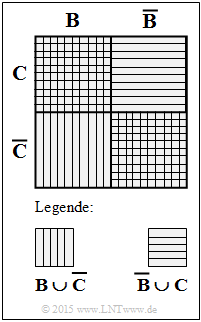
*Finally, using the Boolean relation $(B \cup \overline C) \cap (\overline B \cup C) = (B \cap C) \cup (\overline B \cap \overline C)$ we obtain (see sketch):
$ W = A \cap D \cap (B \cup \bar C) \cap (\bar B \cup C)$.
:$$W = (A \cap B \cap C \cap D) \cup (A \cap \overline B \cap \overline C \cap D).$$
Mit der Boolschen Beziehung (siehe Skizze)
*Thus, $W$ contains the numbers $15$ and $9$ ⇒ only the <u>proposed solution 1</u> is correct.
$(B \cup \bar C) \cap (\bar B \cup C) = (B \cap C) \cup (\bar B \cap \bar C)$
erhält man schließlich
$W = (A \cap B \cap C \cap D) \cup (A \cap \bar B \cap \bar C \cap D)$.
'''(4)''' The union of $U$, $V$ and $W$ contains the following numbers: $4, 6, 8, 9, 10, 12, 14, 15$.
Somit beinhaltet W die Zahlen 15 und 9 ⇒ <u>Lösungsvorschlag 1</u>.
*Accordingly, the set $P$ as the complement of this union is:
:'''4.''' Die Vereinigungsmenge von $U$, $V$ und $W$ beinhaltet folgende Zahlen: 4, 6, 8, 9, 10, 12, 14, 15. Dementsprechend gilt für die Menge $P$ als das Komplement dieser Vereinigungsmenge:
:$$P = {\{1, 2, 3, 5, 7, 11, 13\}}.$$
$P \in {\{1, 2, 3, 5, 7, 11, 13\}}$.
Dies sind genau die mit 4 Bit darstellbaren Primzahlen ⇒ <u>Lösungsvorschlag 2</u>.
*These are exactly the prime numbers which can be represented with four bits ⇒ <u>Proposed solution 2</u>.
{{ML-Fuß}}
{{ML-Fuß}}
[[Category:Aufgaben zu Stochastische Signaltheorie|^1.2 Mengentheoretische Grundlagen^]]
[[Category:Theory of Stochastic Signals: Exercises|^1.2 Set Theory Basics^]]
(2) The event $V$ consists of the two numbers $4$ (binary 0100) and $6$ (binary 0110) ⇒ The correct solutions are 1 and 3.
Auxiliary Venn diagram
(3) For the event $W$, de Morgan's theorem holds:
$$\overline W = \overline A \cup \overline D \cup (\overline B \cap C) \cup (B \cap \overline C)\hspace{0.3cm} \Rightarrow \hspace{0.3cm} W = \overline{\overline W} = A \cap D \cap (\overline{\overline B \cap C}) \cap (\overline{B \cap \overline C}).$$
Using de Morgan's theorems, it further follows:
$$ W = A \cap D \cap (B \cup \overline C) \cap (\overline B \cup C).$$
Finally, using the Boolean relation $(B \cup \overline C) \cap (\overline B \cup C) = (B \cap C) \cup (\overline B \cap \overline C)$ we obtain (see sketch):
$$W = (A \cap B \cap C \cap D) \cup (A \cap \overline B \cap \overline C \cap D).$$
Thus, $W$ contains the numbers $15$ and $9$ ⇒ only the proposed solution 1 is correct.
(4) The union of $U$, $V$ and $W$ contains the following numbers: $4, 6, 8, 9, 10, 12, 14, 15$.
Accordingly, the set $P$ as the complement of this union is:
$$P = {\{1, 2, 3, 5, 7, 11, 13\}}.$$
These are exactly the prime numbers which can be represented with four bits ⇒ Proposed solution 2.