Aufgaben:Exercise 5.5Z: About the Rake Receiver: Difference between revisions

From LNTwww
Safwen (talk | contribs)
No edit summary
Add German interlanguage link
 
(26 intermediate revisions by 4 users not shown)
Line 1: Line 1:


{{quiz-Header|Buchseite=Modulationsverfahren/Fehlerwahrscheinlichkeit der PN–Modulation
{{quiz-Header|Buchseite=Modulation_Methods/Error_Probability_of_Direct-Sequence_Spread_Spectrum_Modulation
}}
}}


[[File:P_ID1888__Mod_Z_5_5.png|right|]]
[[File:EN_Mod_Z_5_5.png|right|frame|Two-way channel <br>& rake receiver]]
Die Grafik zeigt einen Zweiwegekanal (gelbe Hinterlegung). Die entsprechende Beschreibungsgleichung lautet:
The diagram shows a two-way channel&nbsp; (yellow background).&nbsp; The corresponding descriptive equation is:
$$ r(t) =0.6 \cdot s(t) + 0.4 \cdot s (t - \tau) \hspace{0.05cm}.$$
:$$ r(t) =0.6 \cdot s(t) + 0.4 \cdot s (t - \tau) \hspace{0.05cm}.$$
Die Verzögerung auf dem Nebenpfad sei $τ = 1 μs$. Darunter gezeichnet ist die Struktur eines RAKE–Empfängers (grüne Hinterlegung) mit den allgemeinen Koeffizienten $K, h_0, h_1, τ_0$ und $τ_1$.
Let the delay on the secondary path be &nbsp;$τ = 1 \ \rm &micro; s$.&nbsp;


Der RAKE–Empfänger hat die Aufgabe, die Energie der beiden Signalpfade zu bündeln und dadurch die Entscheidung sicherer zu machen. Die gemeinsame Impulsantwort von Kanal und RAKE–Empfänger kann in der Form
Drawn below is the structure of a rake receiver&nbsp; (green background)&nbsp; with general coefficients &nbsp;$K$, &nbsp;$h_0$, &nbsp;$h_1$, &nbsp;$τ_0$&nbsp; and &nbsp;$τ_1$.
$$h_{\rm KR}(t) = A_0 \cdot \delta (t ) + A_1 \cdot \delta (t - \tau) + A_2 \cdot \delta (t - 2\tau)$$
angegeben werden, allerdings nur dann, wenn die RAKE–Koeffizienten $h_0$, $h_1$, $τ_0$ und $τ_1$ geeignet gewählt werden. Der Hauptanteil von $h_{KR}(t)$ soll bei $t = τ$ liegen.


Die Konstante K ist so zu wählen, dass die Amplitude des Hauptpfads $A_1 = 1$ ist:
*The purpose of the rake receiver is to combine the energy of the two signal paths,&nbsp; making the decision more reliable.&nbsp;
$$K= \frac{1}{h_0^2 + h_1^2}.$$
Gesucht sind außer den geeigneten RAKE–Parametern auch die Signale $r(t)$ und $b(t)$, wenn $s(t)$ ein Rechteck der Höhe 1 und der Breite $T = 5 μs$ ist.


'''Hinweis:''' Die Aufgabe bezieht sich auf der [http://en.lntwww.de/Modulationsverfahren/Fehlerwahrscheinlichkeit_der_PN%E2%80%93Modulation#Untersuchungen_zum_RAKE.E2.80.93Empf.C3.A4nger_.282.29 Untersuchungen zum RAKE–Empfänger]  von [http://en.lntwww.de/Modulationsverfahren/Fehlerwahrscheinlichkeit_der_PN%E2%80%93Modulation Kapitel 5.4].
*The combined impulse response of the channel&nbsp; (German:&nbsp; "Kanal" &nbsp; &rArr; &nbsp; subscript "K")&nbsp; and the rake receiver can be expressed in the form
:$$h_{\rm KR}(t) = A_0 \cdot \delta (t ) + A_1 \cdot \delta (t - \tau) + A_2 \cdot \delta (t - 2\tau)$$
:but only if the rake coefficients &nbsp;$h_0$, &nbsp;$h_1$, &nbsp;$τ_0$&nbsp; and &nbsp;$τ_1$&nbsp; are appropriately chosen.&nbsp;
*The main part of &nbsp;$h_{\rm KR}(t)$&nbsp; is supposed to be at &nbsp;$t = τ$.&nbsp;
*The constant &nbsp;$K$&nbsp; is to be chosen so that the amplitude of the main path &nbsp;$A_1 = 1$&nbsp;:
:$$K= \frac{1}{h_0^2 + h_1^2}.$$
Apart from the rake parameters,&nbsp; the signals &nbsp;$r(t)$&nbsp; and &nbsp;$b(t)$ are sought when&nbsp;$s(t)$&nbsp; is a rectangle of height &nbsp;$s_0 = 1$&nbsp; and width &nbsp;$T = \ \rm 5 &micro; s$.&nbsp;


===Fragebogen===
 
Notes:
*The exercise belongs to the chapter&nbsp; [[Modulation_Methods/Error_Probability_of_Direct-Sequence_Spread_Spectrum_Modulation|Error Probability of Direct-Sequence Spread Spectrum Modulation]].
*Reference is made in particular to the section&nbsp; [[Modulation_Methods/Error_Probability_of_Direct-Sequence_Spread_Spectrum_Modulation#Principle_of_the_rake_receiver |Principle of the rake receiver]].
 
 
===Questions===


<quiz display=simple>
{Welche Aussagen gelten für die Kanalimpulsantwort $h_K(t)$?
{Which statements are valid for the channel impulse response &nbsp;$h_{\rm K}(t)$?
|type="[]"}
|type="[]"}
+ $h_K(t)$ besteht aus zwei Diracfunktionen.
+ $h_{\rm K}(t)$&nbsp; consists of two Dirac delta functions.
- $h_K(t)$ ist komplexwertig.
- $h_{\rm K}(t)$&nbsp; is complex-valued.
- $h_K(t)$ ist eine mit der Verzögerungszeit τ periodische Funktion.
- $h_{\rm K}(t)$&nbsp; is a function periodic with delay time &nbsp;$\tau$.&nbsp;


{Welche Aussagen gelten für den Kanalfrequenzgang $H_K(f)$?
{Which statements are true for the channel frequency response &nbsp;$H_{\rm K}(f)$?
|type="[]"}
|type="[]"}
- Es gilt $H_K(f = 0) = 2$.
- $H_{\rm K}(f = 0) = 2$&nbsp; is true.
+ $H_K(f)$ ist komplexwertig.
+ $H_{\rm K}(f)$&nbsp; is complex-valued.
+ $|H_K(f)|$ ist eine mit der Frequenz 1/τ periodische Funktion.
+ $|H_{\rm K}(f)|$&nbsp; is a function periodic with frequency &nbsp;$1/τ$.&nbsp;


{Setzen Sie $K = 1$, $h_0 = 0.6$ und $h_1 = 0.4$. Bestimmen Sie die Verzögerungen $τ_0$ und $τ_1$, damit die $h_{KR}(t)$–Gleichung mit $A_0 = A_2$ erfüllt wird.
{Set &nbsp;$K = 1$, &nbsp;$h_0 = 0.6$&nbsp; and &nbsp;$h_1 = 0.4$.&nbsp; Determine the delays &nbsp;$τ_0$&nbsp; and &nbsp;$τ_1$ so that the &nbsp;$h_{\rm KR}(t)$ equation is satisfied with &nbsp;$A_0 = A_2$.&nbsp;
|type="{}"}
|type="{}"}
$τ_0$ ={ 1 3% } $μs$
$τ_0 \ = \ $ { 1 3% } $\ \rm &micro; s$
$τ_1$ ={ 0 3% } $μs$
$τ_1 \ = \ $ { 0. } $\ \rm &micro; s$


{Welcher Wert ist für die Konstante K zu wählen?
{What value should be chosen for the constant &nbsp;$K$?&nbsp;
|type="{}"}
|type="{}"}
$K$ = { 1.923 3% }  
$K \ = \ $ { 1.923 3% }  


{Welche Aussagen gelten für die Signale $r(t)$ und $b(t)$?
{Which statements are valid for the signals &nbsp;$r(t)$&nbsp; and &nbsp;$b(t)$?
|type="[]"}
|type="[]"}
+ Der Maximalwert von $r(t)$ ist 1.
+ The maximum value of &nbsp;$r(t)$&nbsp; is &nbsp;$1$.
- Die Breite von $r(t)$ ist $7 μs$.
- The width of &nbsp;$r(t)$&nbsp; is &nbsp;$7 \ &micro; s$.
- Der Maximalwert von $b(t)$ ist 1.
- The maximum value of &nbsp;$b(t)$&nbsp; is &nbsp;$1$.
+ Die Breite von $b(t)$ ist 7 μs.
+ The width of &nbsp;$b(t)$&nbsp; is &nbsp;$7 \ &micro; s$.


Line 56: Line 65:
</quiz>
</quiz>


===Musterlösung===
===Solution===
{{ML-Kopf}}
{{ML-Kopf}}
'''1.''' Die Impulsantwort $h_K(t)$ ergibt sich als das Empfangssignal $r(t)$, wenn am Eingang ein Diracimpuls anliegt ⇒ $s(t) = δ(t)$. Daraus folgt
'''(1)'''&nbsp; <u>Solution 1</u> is correct:
$$ h_{\rm K}(t) = 0.6 \cdot \delta (t ) + 0.4 \cdot \delta (t - \tau) \hspace{0.05cm}.$$
*The impulse response&nbsp; $h_{\rm K}(t)$&nbsp; is obtained as the received signal&nbsp; $r(t)$&nbsp; when there is a Dirac delta pulse at the input &nbsp; &nbsp;  $s(t) = δ(t)$.&nbsp; It follows that:
Richtig ist also der Lösungsvorschlag 1.
:$$ h_{\rm K}(t) = 0.6 \cdot \delta (t ) + 0.4 \cdot \delta (t - \tau) \hspace{0.05cm}.$$
 
 
'''(2)'''&nbsp; <u>Solutions 2 and 3</u>&nbsp; are correct:
*By definition,&nbsp; the channel frequency response&nbsp; $H_{\rm K}(f)$&nbsp; is the Fourier transform of the impulse response&nbsp; $h_{\rm K}(t)$.&nbsp; With the shift theorem this results in:
:$$H_{\rm K}(f) = 0.6 + 0.4 \cdot {\rm e}^{ \hspace{0.03cm}{\rm j} \hspace{0.03cm} \cdot \hspace{0.03cm}2 \pi f \tau}\hspace{0.3cm} \Rightarrow \hspace{0.3cm} H_{\rm K}(f= 0) = 0.6 + 0.4 = 1 \hspace{0.05cm}.$$
*Accordingly,&nbsp; the first proposed solution is incorrect in contrast to the other two:
#&nbsp;  $H_{\rm K}(f)$ is complex-valued and
#&nbsp;the magnitude is periodic with&nbsp; $1/τ$,&nbsp; as the following calculation shows:
:$$|H_{\rm K}(f)|^2  =  \left [0.6 + 0.4 \cdot \cos(2 \pi f \tau) \right ]^2 + \left [ 0.4 \cdot \sin(2 \pi f \tau) \right ]^2 = \left [0.6^2 + 0.4^2 \cdot \left ( \cos^2(2 \pi f \tau) + \sin^2(2 \pi f \tau)\right ) \right ] +  2 \cdot 0.6 \cdot 0.4 \cdot \cos(2 \pi f \tau).$$
*For&nbsp; $f = 0$,&nbsp;&nbsp; $|H_{\rm K}(f)| = 1$.&nbsp; This value is repeated in the respective frequency spacing&nbsp; $1/τ$.&nbsp;


'''(3)'''&nbsp; We first set&nbsp; $K = 1$ as agreed.
*Altogether we get from&nbsp; $s(t)$&nbsp; to the output signal&nbsp; $b(t)$ via four paths.
*To satisfy the given&nbsp; $h_{\rm KR}(t)$ equation, either&nbsp; $τ_0 = 0$&nbsp; must hold or&nbsp; $τ_1 = 0$.&nbsp; With&nbsp; $τ_0 = 0$&nbsp; we obtain for the impulse response:
:$$h_{\rm KR}(t)  =  0.6 \cdot h_0 \cdot \delta (t ) + 0.4 \cdot h_0 \cdot \delta (t - \tau) +  0.6 \cdot h_1 \cdot \delta (t -\tau_1) + 0.4 \cdot h_1 \cdot \delta (t - \tau-\tau_1) \hspace{0.05cm}.$$
*To be able to focus the&nbsp; "main energy"&nbsp; at a certain time point,&nbsp; $τ_1 = τ$&nbsp; would have to be chosen.&nbsp;
* With&nbsp; $h_0 = 0.6$&nbsp; and&nbsp; $h_1 = 0.4$,&nbsp; we then obtain&nbsp; $A_0 ≠ A_2$:
:$$h_{\rm KR}(t) = 0.36 \cdot \delta (t ) +0.48 \cdot \delta (t - \tau) + 0.16 \cdot \delta (t - 2\tau)\hspace{0.05cm}.$$
*In contrast, with&nbsp; $h_0 = 0.6$,&nbsp; $h_1 = 0.4$,&nbsp; $τ_0 = τ$&nbsp; and&nbsp; $τ_1 = 0$:
:$$h_{\rm KR}(t)  =  0.6 \cdot h_0 \cdot \delta (t - \tau ) + 0.4 \cdot h_0 \cdot \delta (t - 2\tau) +  0.6 \cdot h_1 \cdot \delta (t) + 0.4 \cdot h_1 \cdot \delta (t - \tau)=  0.24 \cdot \delta (t ) +0.52 \cdot \delta (t - \tau) + 0.24 \cdot \delta (t - 2\tau) \hspace{0.05cm}.$$
*Here,&nbsp; the additional condition&nbsp; $A_0 = A_2$&nbsp; is satisfied.&nbsp; Thus,&nbsp; the result we are looking for is:
:$$ \underline{\tau_0 = \tau = 1\,{\rm &micro; s} \hspace{0.05cm},\hspace{0.2cm}\tau_1 =0} \hspace{0.05cm}.$$


'''2.''' Der Kanalfrequenzgang $H_K(f)$ ist definitionsgemäß die Fouriertransformierte der Impulsantwort $h_K(t)$. Mit dem Verschiebungssatz ergibt sich hierfür:
$$H_{\rm K}(f) = 0.6 + 0.4 \cdot {\rm e}^{ \hspace{0.03cm}{\rm j} \hspace{0.03cm} \cdot \hspace{0.03cm}2 \pi f \tau}\hspace{0.3cm} \Rightarrow \hspace{0.3cm} H_{\rm K}(f= 0) = 0.6 + 0.4 = 1 \hspace{0.05cm}.$$
Der erste Lösungsvorschlag ist dementsprechend falsch im Gegensatz zu den beiden anderen: $H_K(f)$ ist komplexwertig und der Betrag ist periodisch mit 1/τ, wie die nachfolgende Rechnung zeigt:
$$|H_{\rm K}(f)|^2  =  \left [0.6 + 0.4 \cdot \cos(2 \pi f \tau) \right ]^2 + \left [ 0.4 \cdot \sin(2 \pi f \tau) \right ]^2 =$$
$$ =  \left [0.6^2 + 0.4^2 \cdot \left ( \cos^2(2 \pi f \tau) + \sin^2(2 \pi f \tau)\right ) \right ] +$$
$$  +  2 \cdot 0.6 \cdot 0.4 \cdot \cos(2 \pi f \tau)$$
Für f = 0 ist $|H_K(f)| = 1$. Im jeweiligen Frequenzabstand 1/τ wiederholt sich dieser Wert.


'''3.''' Wir setzen zunächst vereinbarungsgemäß K = 1. Insgesamt kommt man über vier Wege von $s(t)$ zum Ausgangssignal $b(t)$. Um die vorgegebene $h_{KR}(t)$–Gleichung zu erfüllen, muss entweder $τ_0 = 0$ gelten oder $τ_1 = 0$. Mit $τ_0 = 0$ erhält man für die Impulsantwort:
'''(4)'''&nbsp; The following must apply to the normalization factor:
$$h_{\rm KR}(t)  =  0.6 \cdot h_0 \cdot \delta (t ) + 0.4 \cdot h_0 \cdot \delta (t - \tau) +$$
:$$K= \frac{1}{h_0^2 + h_1^2} = \frac{1}{0.6^2 + 0.4^2} = \frac{1}{0.52} \hspace{0.15cm}\underline {\approx 1.923} \hspace{0.05cm}.$$
$$ +  0.6 \cdot h_1 \cdot \delta (t -\tau_1) + 0.4 \cdot h_1 \cdot \delta (t - \tau-\tau_1) \hspace{0.05cm}.$$
*This gives for the common impulse response&nbsp; $($it holds&nbsp; $0.24/0.52 = 6/13)$:
Um die „Hauptenergie” auf einen Zeitpunkt bündeln zu können, müsste dann $τ_1 = τ$ gewählt werden. Mit $h_0 = 0.6$ und $h_1 = 0.4$ erhält man dann $A_0 ≠ A_2$:
:$$ h_{\rm KR}(t) = \frac{6}{13} \cdot \delta (t ) + 1.00 \cdot \delta (t - \tau) + \frac{6}{13} \cdot \delta (t - 2\tau)\hspace{0.05cm}.$$
$$h_{\rm KR}(t) = 0.36 \cdot \delta (t ) +0.48 \cdot \delta (t - \tau) + 0.16 \cdot \delta (t - 2\tau)\hspace{0.05cm}.$$
Dagegen ergibt sich mit $h_0 = 0.6$, $h_1 = 0.4$, $τ_0 = τ$ und $τ_1 = 0$:
$$h_{\rm KR}(t) = 0.6 \cdot h_0 \cdot \delta (t - \tau ) + 0.4 \cdot h_0 \cdot \delta (t - 2\tau) +$$
$$ +  0.6 \cdot h_1 \cdot \delta (t) + 0.4 \cdot h_1 \cdot \delta (t - \tau)=$$
$$ =  0.24 \cdot \delta (t ) +0.52 \cdot \delta (t - \tau) + 0.24 \cdot \delta (t - 2\tau) \hspace{0.05cm}.$$
Hier ist die Zusatzbedingung $A_0 = A_2$ erfüllt. Somit lautet das gesuchte Ergebnis:
$$ \underline{\tau_0 = \tau = 1\,{\rm \mu s} \hspace{0.05cm},\hspace{0.2cm}\tau_1 =0} \hspace{0.05cm}.$$


'''4.''' Für den Normierungsfaktor muss gelten:
$$K= \frac{1}{h_0^2 + h_1^2} = \frac{1}{0.6^2 + 0.4^2} = \frac{1}{0.52} \hspace{0.15cm}\underline {\approx 1.923} \hspace{0.05cm}.$$
Damit erhält man für die gemeinsame Impulsantwort (es gilt 0.24/0.52 = 6/13):
$$ h_{\rm KR}(t) = \frac{6}{13} \cdot \delta (t ) + 1.00 \cdot \delta (t - \tau) + \frac{6}{13} \cdot \delta (t - 2\tau)\hspace{0.05cm}.$$


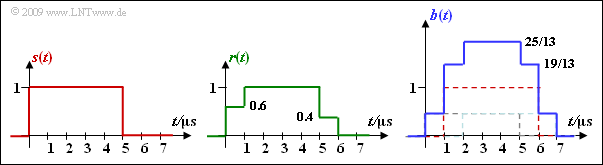
'''5.''' Für das Empfangssignal $r(t)$ und für das RAKE–Ausgangssignal $b(t)$ gilt:
$$r(t)  =  0.6 \cdot s(t) + 0.4 \cdot s (t - 1\,{\rm \mu s})\hspace{0.05cm},$$
$$b(t)  = \frac{6}{13} \cdot s(t) + 1.00 \cdot s (t - 1\,{\rm \mu s}) + \frac{6}{13} \cdot s (t - 2\,{\rm \mu s}) \hspace{0.05cm}.$$
Richtig sind die Aussagen 1 und 4, wie die folgende Grafik zeigt. Die Überhöhung des Ausgangssignals  ⇒  $b(t) > 1$ ist auf den Normierungsfaktor K = 25/13 zurückzuführen. Mit K = 1 wäre der Maximalwert von $b(t)$ tatsächlich 1.


[[File:P_ID1902__Mod_Z_5_5e.png]]
[[File:P_ID1902__Mod_Z_5_5e.png|right|frame|Signals to illustrate the rake receiver]]
'''(5)'''&nbsp; <u>Statements 1 and 4</u> are correct, as shown in the diagram:
*For the received signal&nbsp; $r(t)$&nbsp;  holds:
:$$r(t)  =  0.6 \cdot s(t) + 0.4 \cdot s (t - 1\,{\rm &micro; s})\hspace{0.05cm},$$
*and for the rake output signal&nbsp; $b(t)$:
:$$b(t)  = \frac{6}{13} \cdot s(t) + 1 \cdot s (t - 1\,{\rm &micro; s}) + \frac{6}{13} \cdot s (t - 2\,{\rm &micro; s}) \hspace{0.05cm}.$$
*The overshoot of the output signal  &nbsp; ⇒  &nbsp; $b(t) > 1$&nbsp; is due to the normalization factor&nbsp; $K = 25/13$.&nbsp;
*With&nbsp; $K = 1$,&nbsp; the maximum value of&nbsp; $b(t)$&nbsp; would actually be&nbsp; $1$.


{{ML-Fuß}}
{{ML-Fuß}}
Line 98: Line 118:


[[Category:Aufgaben zu Modulationsverfahren|^5.4 Fehlerwahrscheinlichkeit der PN–Modulation^]]
[[Category:Modulation Methods: Exercises|^5.4 BER of the PN Modulation^]]
[[de:Aufgaben:Aufgabe_5.5Z:_Zum_RAKE–Empfänger]]

Latest revision as of 14:38, 16 March 2026

Two-way channel
& rake receiver

The diagram shows a two-way channel  (yellow background).  The corresponding descriptive equation is:

$$ r(t) =0.6 \cdot s(t) + 0.4 \cdot s (t - \tau) \hspace{0.05cm}.$$

Let the delay on the secondary path be  $τ = 1 \ \rm µ s$. 

Drawn below is the structure of a rake receiver  (green background)  with general coefficients  $K$,  $h_0$,  $h_1$,  $τ_0$  and  $τ_1$.

  • The purpose of the rake receiver is to combine the energy of the two signal paths,  making the decision more reliable. 
  • The combined impulse response of the channel  (German:  "Kanal"   ⇒   subscript "K")  and the rake receiver can be expressed in the form
$$h_{\rm KR}(t) = A_0 \cdot \delta (t ) + A_1 \cdot \delta (t - \tau) + A_2 \cdot \delta (t - 2\tau)$$
but only if the rake coefficients  $h_0$,  $h_1$,  $τ_0$  and  $τ_1$  are appropriately chosen. 
  • The main part of  $h_{\rm KR}(t)$  is supposed to be at  $t = τ$. 
  • The constant  $K$  is to be chosen so that the amplitude of the main path  $A_1 = 1$ :
$$K= \frac{1}{h_0^2 + h_1^2}.$$

Apart from the rake parameters,  the signals  $r(t)$  and  $b(t)$ are sought when $s(t)$  is a rectangle of height  $s_0 = 1$  and width  $T = \ \rm 5 µ s$. 


Notes:


Questions

1 Which statements are valid for the channel impulse response  $h_{\rm K}(t)$?

$h_{\rm K}(t)$  consists of two Dirac delta functions.
$h_{\rm K}(t)$  is complex-valued.
$h_{\rm K}(t)$  is a function periodic with delay time  $\tau$. 

2 Which statements are true for the channel frequency response  $H_{\rm K}(f)$?

$H_{\rm K}(f = 0) = 2$  is true.
$H_{\rm K}(f)$  is complex-valued.
$|H_{\rm K}(f)|$  is a function periodic with frequency  $1/τ$. 

3 Set  $K = 1$,  $h_0 = 0.6$  and  $h_1 = 0.4$.  Determine the delays  $τ_0$  and  $τ_1$ so that the  $h_{\rm KR}(t)$ equation is satisfied with  $A_0 = A_2$. 

$τ_0 \ = \ $ $\ \rm µ s$
$τ_1 \ = \ $ $\ \rm µ s$

4 What value should be chosen for the constant  $K$? 

$K \ = \ $

5 Which statements are valid for the signals  $r(t)$  and  $b(t)$?

The maximum value of  $r(t)$  is  $1$.
The width of  $r(t)$  is  $7 \ µ s$.
The maximum value of  $b(t)$  is  $1$.
The width of  $b(t)$  is  $7 \ µ s$.


Solution

(1)  Solution 1 is correct:

  • The impulse response  $h_{\rm K}(t)$  is obtained as the received signal  $r(t)$  when there is a Dirac delta pulse at the input   ⇒   $s(t) = δ(t)$.  It follows that:
$$ h_{\rm K}(t) = 0.6 \cdot \delta (t ) + 0.4 \cdot \delta (t - \tau) \hspace{0.05cm}.$$


(2)  Solutions 2 and 3  are correct:

  • By definition,  the channel frequency response  $H_{\rm K}(f)$  is the Fourier transform of the impulse response  $h_{\rm K}(t)$.  With the shift theorem this results in:
$$H_{\rm K}(f) = 0.6 + 0.4 \cdot {\rm e}^{ \hspace{0.03cm}{\rm j} \hspace{0.03cm} \cdot \hspace{0.03cm}2 \pi f \tau}\hspace{0.3cm} \Rightarrow \hspace{0.3cm} H_{\rm K}(f= 0) = 0.6 + 0.4 = 1 \hspace{0.05cm}.$$
  • Accordingly,  the first proposed solution is incorrect in contrast to the other two:
  1.   $H_{\rm K}(f)$ is complex-valued and
  2.  the magnitude is periodic with  $1/τ$,  as the following calculation shows:
$$|H_{\rm K}(f)|^2 = \left [0.6 + 0.4 \cdot \cos(2 \pi f \tau) \right ]^2 + \left [ 0.4 \cdot \sin(2 \pi f \tau) \right ]^2 = \left [0.6^2 + 0.4^2 \cdot \left ( \cos^2(2 \pi f \tau) + \sin^2(2 \pi f \tau)\right ) \right ] + 2 \cdot 0.6 \cdot 0.4 \cdot \cos(2 \pi f \tau).$$
  • For  $f = 0$,   $|H_{\rm K}(f)| = 1$.  This value is repeated in the respective frequency spacing  $1/τ$. 


(3)  We first set  $K = 1$ as agreed.

  • Altogether we get from  $s(t)$  to the output signal  $b(t)$ via four paths.
  • To satisfy the given  $h_{\rm KR}(t)$ equation, either  $τ_0 = 0$  must hold or  $τ_1 = 0$.  With  $τ_0 = 0$  we obtain for the impulse response:
$$h_{\rm KR}(t) = 0.6 \cdot h_0 \cdot \delta (t ) + 0.4 \cdot h_0 \cdot \delta (t - \tau) + 0.6 \cdot h_1 \cdot \delta (t -\tau_1) + 0.4 \cdot h_1 \cdot \delta (t - \tau-\tau_1) \hspace{0.05cm}.$$
  • To be able to focus the  "main energy"  at a certain time point,  $τ_1 = τ$  would have to be chosen. 
  • With  $h_0 = 0.6$  and  $h_1 = 0.4$,  we then obtain  $A_0 ≠ A_2$:
$$h_{\rm KR}(t) = 0.36 \cdot \delta (t ) +0.48 \cdot \delta (t - \tau) + 0.16 \cdot \delta (t - 2\tau)\hspace{0.05cm}.$$
  • In contrast, with  $h_0 = 0.6$,  $h_1 = 0.4$,  $τ_0 = τ$  and  $τ_1 = 0$:
$$h_{\rm KR}(t) = 0.6 \cdot h_0 \cdot \delta (t - \tau ) + 0.4 \cdot h_0 \cdot \delta (t - 2\tau) + 0.6 \cdot h_1 \cdot \delta (t) + 0.4 \cdot h_1 \cdot \delta (t - \tau)= 0.24 \cdot \delta (t ) +0.52 \cdot \delta (t - \tau) + 0.24 \cdot \delta (t - 2\tau) \hspace{0.05cm}.$$
  • Here,  the additional condition  $A_0 = A_2$  is satisfied.  Thus,  the result we are looking for is:
$$ \underline{\tau_0 = \tau = 1\,{\rm µ s} \hspace{0.05cm},\hspace{0.2cm}\tau_1 =0} \hspace{0.05cm}.$$


(4)  The following must apply to the normalization factor:

$$K= \frac{1}{h_0^2 + h_1^2} = \frac{1}{0.6^2 + 0.4^2} = \frac{1}{0.52} \hspace{0.15cm}\underline {\approx 1.923} \hspace{0.05cm}.$$
  • This gives for the common impulse response  $($it holds  $0.24/0.52 = 6/13)$:
$$ h_{\rm KR}(t) = \frac{6}{13} \cdot \delta (t ) + 1.00 \cdot \delta (t - \tau) + \frac{6}{13} \cdot \delta (t - 2\tau)\hspace{0.05cm}.$$


Signals to illustrate the rake receiver

(5)  Statements 1 and 4 are correct, as shown in the diagram:

  • For the received signal  $r(t)$  holds:
$$r(t) = 0.6 \cdot s(t) + 0.4 \cdot s (t - 1\,{\rm µ s})\hspace{0.05cm},$$
  • and for the rake output signal  $b(t)$:
$$b(t) = \frac{6}{13} \cdot s(t) + 1 \cdot s (t - 1\,{\rm µ s}) + \frac{6}{13} \cdot s (t - 2\,{\rm µ s}) \hspace{0.05cm}.$$
  • The overshoot of the output signal   ⇒   $b(t) > 1$  is due to the normalization factor  $K = 25/13$. 
  • With  $K = 1$,  the maximum value of  $b(t)$  would actually be  $1$.