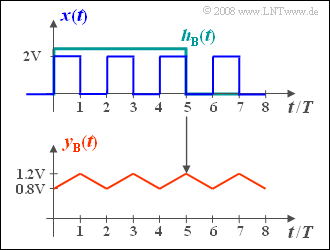
*Es ergibt sich ein um den Mittelwert This results in a triangular shape ⇒ fluctuating around the mean $1 \ \rm V$ , see bottom graph.
*This results in a triangular shape ⇒ fluctuating around the mean $1 \ \rm V$ , see bottom graph.
*Da jeweils zwei Rechtecke und drei Lücken ins Integrationsintervall fallen, gilt für $t = 0, t = 2T,$ usw.:
*Da jeweils zwei Rechtecke und drei Lücken ins Integrationsintervall fallen, gilt für $t = 0, t = 2T,$ usw.:
Periodic rectangular signal and filter with rectangular impulse response
We consider the periodic rectangular signal $x(t)$ , whose periodic duration is $T_0 = 2T$ , according to the sketch above.
This signal has spectral components at the fundamental frequency $f_0 = 1/T_0 = 1/(2T)$ and at all odd multiples thereof, that is, at $3f_0$, $5f_0,$ and so on. In addition, there is a direct component.
For this purpose, we consider two filters $\rm A$ and $\rm B$ each with rectangular impulse response $h_{\rm A}(t)$ with duration $6T$ and $h_{\rm B}(t)$ with duration $5T$, respectively.
The heights of the two impulse responses are such that the areas of the rectangles each add up to $1$ .
Die Spektralanteile des Rechtecksignals bei $f_0, 3f_0,$ usw. werden zwar nun nicht mehr unterdrückt, aber mit steigender Frequenz immer mehr abgeschwächt und zwar in der Form, dass der Rechteckverlauf in ein periodisches Dreiecksignal gewandelt wird. Der Gleichanteil $(1 \hspace{0.05cm} \rm V)$ bleibt auch hier unverändert.
Beide Filter liefern also den Mittelwert des Eingangssignals. Beim vorliegenden Signal $x(t)$ ist für die Bestimmung des Mittelwertes das Filter $\rm A$ besser geeignet als das Filter $\rm B$, da bei Ersterem die Länge der Impulsantwort ein Vielfaches der Periodendauer $T_0 = 2T$ ist.
Ist diese Bedingung – wie beim Filter $\rm B$ – nicht erfüllt, so überlagert sich dem Mittelwert noch ein (in diesem Beispiel dreieckförmiges) Fehlersignal.