*For ${\it \Omega} = \pi/2$ we thus obtain a purely real numerical value:
*For ${\it \Omega} = \pi/2$ we thus obtain a purely real numerical value:
Line 76:
Line 76:
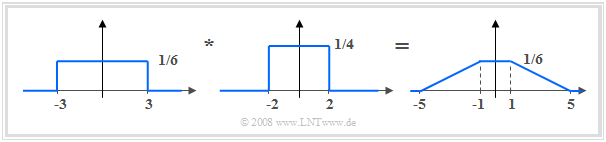
'''(3)''' From the given correspondence it can be read that ${\rm si}(3 {\it \Omega} )$ is due to an between $\pm 3$ equally distributed random variable and ${\rm si}(2 {\it \Omega} )$ gives the transform of a uniform distribution between $\pm 2$ .
'''(3)''' From the given correspondence it can be read that ${\rm si}(3 {\it \Omega} )$ is due to an between $\pm 3$ equally distributed random variable and ${\rm si}(2 {\it \Omega} )$ gives the transform of a uniform distribution between $\pm 2$.
[[File:P_ID620__Sto_A_3_4_c_neu.png|right|frame|Construction of the trapezoidal PDF]]
*In the characteristic function, these two proportions are multiplicatively linked. Thus, the resulting PDF $f_z(z)$ is the convolution of these two rectangular functions:
*In the characteristic function, these two proportions are multiplicatively linked.
[[File:P_ID620__Sto_A_3_4_c_neu.png|center|frame|Construction of trapezoidal PDF]]
*Thus, the resulting PDF $f_z(z)$ is the convolution of these two rectangular functions.
Given here are three random variables $x$, $y$ and $z$, mostly by their respective probability density functions:
Nothing else is known about the random variable $x$: This can be both a discrete or a continuous random variable, and can have any PDF $f_x(x)$ The mean is generally equal $m_x$.
The continuous random variable $y$ can take values in the range between $1$ to $3$ with equal probability. Mean: $m_y = 2.$
The random variable $z$ has the following characteristic function:
Besides, the qualitative course of the WDF $f_z(z)$ according to the blue sketch is assumed to be known. To be determined are the PDF parameters $a$, $b$, $c$ of this PDF.
The last alternative does not always hold: A two-point distributed random variable $x \in \{-1, +3\}$ with probabilities $0.75$ and $0.25$ is zero mean $(m_x = 0)$, but has still a complex characteristic function.
(3) From the given correspondence it can be read that ${\rm si}(3 {\it \Omega} )$ is due to an between $\pm 3$ equally distributed random variable and ${\rm si}(2 {\it \Omega} )$ gives the transform of a uniform distribution between $\pm 2$.
Construction of the trapezoidal PDF
In the characteristic function, these two proportions are multiplicatively linked.
Thus, the resulting PDF $f_z(z)$ is the convolution of these two rectangular functions.