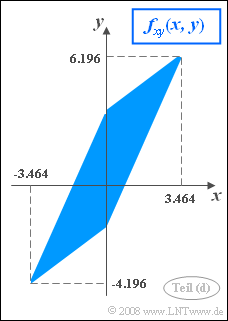
'''(3)''' With $ A = B = \sqrt{3}$ corresponding to the last subtask, two equations of determination remain for $D$ and $E$:
'''(3)''' With $ A = B = \sqrt{3}$ corresponding to the last subtask, two equations of determination remain for $D$ and $E$:
Requirements for the generation of a 2D random variable
Given statistically independent quantities $u$ and $v$, both of which are uniformly distributed between $-1$ and $+1$ and thus each have variance $\sigma^2 = 2/3$ , generate a 2D random variable $(x, y)$ where for the components:
$$x = A \cdot u + B \cdot v + C,$$
$$y= D \cdot u + E \cdot v + F.$$
The 2D–random variable $(x, y)$ to be generated should have the following statistical properties:
Let the variances be $\sigma_x^2 = 4$ and $\sigma_y^2 = 10$.
Let the random variable $x$ be mean-free $(m_x =0)$.
For the mean of $y$ let $m_y = 1$ hold.
The correlation coefficient between $x$ and $y$ is $\rho_{xy} = \sqrt{0.9} = 0.949.$
The random variable $x$ possess a triangular PDF $f_x(x)$ corresponding to the above graph.
The random variable $y$ has a trapezoidal PDF $f_y(y)$ according to the lower graph.
In particular, reference is made to the page [Theory_of_Stochastic_Signals/Linear_Combinations_of_Random_Variables#Generation_of_correlated_random_variables|Generation of correlated random variables]].
To avoid ambiguity, it is specified that all coefficients $A$, ... , $F$ should be non-negative.