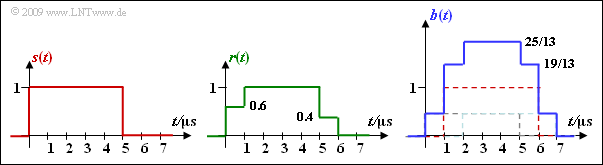
Let the delay on the secondary path be $τ = 1 \ \rm µ s$. Drawn below is the structure of a rake receiver (green background) with general coefficients $K$, $h_0$, $h_1$, $τ_0$ and $τ_1$.
Let the delay on the secondary path be $τ = 1 \ \rm µ s$.
The purpose of the rake receiver is to combine the energy of the two signal paths, making the decision more reliable.
Drawn below is the structure of a rake receiver (green background) with general coefficients $K$, $h_0$, $h_1$, $τ_0$ and $τ_1$.
The combined impulse response of the channel (German: "Kanal" ⇒ subscript "K") and the rake receiver can be expressed in the form
*The purpose of the rake receiver is to combine the energy of the two signal paths, making the decision more reliable.
*The combined impulse response of the channel (German: "Kanal" ⇒ subscript "K") and the rake receiver can be expressed in the form
but only if the rake coefficients $h_0$, $h_1$, $τ_0$ and $τ_1$ are appropriately chosen. The main part of $h_{\rm KR}(t)$ is supposed to be at $t = τ$.
:but only if the rake coefficients $h_0$, $h_1$, $τ_0$ and $τ_1$ are appropriately chosen.
*The main part of $h_{\rm KR}(t)$ is supposed to be at $t = τ$.
The constant $K$ is to be chosen so that the amplitude of the main path $A_1 = 1$ :
*The constant $K$ is to be chosen so that the amplitude of the main path $A_1 = 1$ :
:$$K= \frac{1}{h_0^2 + h_1^2}.$$
:$$K= \frac{1}{h_0^2 + h_1^2}.$$
Apart from the rake parameters, the signals $r(t)$ and $b(t)$ are sought when $s(t)$ is a rectangle of height $s_0 = 1$ and width $T = \ \rm 5 µ s$.
Apart from the rake parameters, the signals $r(t)$ and $b(t)$ are sought when $s(t)$ is a rectangle of height $s_0 = 1$ and width $T = \ \rm 5 µ s$.
The impulse response $h_{\rm K}(t)$ is obtained as the received signal $r(t)$ when there is a dirac pulse at the input ⇒ $s(t) = δ(t)$. It follows that:
By definition, the channel frequency response $H_{\rm K}(f)$ is the Fourier transform of the impulse response $h_{\rm K}(t)$. With the shift theorem this results in:
Accordingly, the first proposed solution is incorrect in contrast to the other two: $H_{\rm K}(f)$ is complex-valued and the magnitude is periodic with $1/τ$, as the following calculation shows:
To be able to focus the "main energy" on a time point, $τ_1 = τ$ would then have to be chosen. With $h_0 = 0.6$ and $h_1 = 0.4$, we then obtain $A_0 ≠ A_2$: