"Burrows–Wheeler Transform" $\rm (BWT)$ as described in Exercise 2.13; the character sets at the input and the output of the BWT are the same: $\{$ $\rm D$, $\rm E$, $\rm I$, $\rm M$, $\rm N$, $\rm S$ $\}$;
"Move–to–Front" $\rm (MTF)$, a sorting algorithm that outputs a string of the same length $($ $N = 12$ in the example$)$, but with a different alphabet $\{$0, 1, 2, 3, 4, 5$\}$;
$\rm RLC0$ – a run-length encoding specifically for 0, which is (as) frequent according to $\rm BWT$ and $\rm MTF$; all other indices are not changed by $\rm RLC0$ ;
$\rm Huffman$ as described in the chapter Entropy coding according to Huffman; frequent characters are represented by short binary sequences and rare ones by long ones.
The $\rm MTF$ algorithm can be described as follows for $M = 6$ input symbols:
The output sequence of the $\rm MTF$ is a string of indices from the set
$ I = \{$0, 1, 2, 3, 4, 5$\}$.
Before starting the actual $\rm MTF$ algorithm, the possible input symbols are sorted lexicographically and assigned to the following indices:
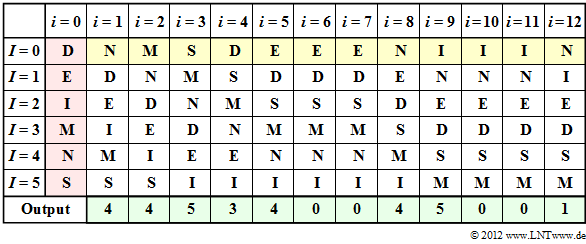
Let the $\rm MTF$ input string here be $\rm N\hspace{0.05cm}M\hspace{0.05cm}S\hspace{0.05cm}D\hspace{0.05cm}E\hspace{0.05cm}E\hspace{0.05cm}E\hspace{0.05cm}N\hspace{0.05cm}I\hspace{0.05cm}I\hspace{0.05cm}I\hspace{0.05cm}N$. This was the $\rm BWT$ result in Exercise 2.13. The first $\rm N$ is represented as $I = 4$ according to the default setting.
Then the $\rm N$ is placed at the beginning in the sorting, so that after the coding step $i = 1$ the assignment holds:
Information on the Huffman code can be found in the chapter Entropy Coding according to Huffman. This information is not necessary for the solution of the task.
(1) The graph on the information page shows that solution suggestions 1 and 2 are correct and suggestion 3 is incorrect:
$\rm E$ und $\rm I$ treten zwar gruppiert auf,
aber nicht die $\rm N$–Zeichen.
(2)Proposed solutions 2 and 3 are correct:
The input sequence is processed character by character. Thus, the output sequence also has the length $N = 12$.
In fact, the input set $\{ \hspace{0.05cm}\rm D,\hspace{0.05cm} E,\hspace{0.05cm} I,\hspace{0.05cm} M,\hspace{0.05cm} N , \hspace{0.05cm} S \}$ in die Ausgangsmenge $\{ \hspace{0.05cm}\rm 0,\hspace{0.05cm} 1,\hspace{0.05cm} 2,\hspace{0.05cm} 3,\hspace{0.05cm} 4 , \hspace{0.05cm} 5 \}$ is converted into the output set.
However, not by simple mapping, but by an algorithm which is outlined below.
Example of the MTF algorithm
(3) Correct is solution suggestion 2:
The table shows the MTF algorithm. The step $i=0$ (red background) indicates the preassignment. The input of the MTF is highlighted in yellow, the output in green.
In step $i=1$ , the input character $\rm N$ corresponding to column $i=0$ is represented by index $I = 4$ . Subsequently, $\rm N$ is sorted to the front, while the order of the other characters remains the same.
The input character $\rm M$ in the second step is also given the index $I = 4$ according to column $i=2$ . One continues in the same way until the twelfth character $\rm N$, to which the index $I = 1$ is assigned.
You can see from the above table that at the times $i=6$, $i=7$, $i=10$ and $i=11$ the output index is $I = 0$ .
(4)Statements 1 and 2 are correct:
The preprocessings "BWT" and "MTF" only have the task to generate as many zeros as possible.
(5)All statements are correct.
You can find more information on the Huffman algorithm in the chapter "Entropy coding according to Huffman".