The proposed solution 3 corresponds to the case of two independent Gaussian channels with half transmit power per channel.
(2)Proposed solutions 1, 2 and 4 are correct:
If one would replace $E_{\rm S}$ by $E_{\rm B}$ , then also the statement 3 would be correct.
For $E_{\rm B}/{N_0} < \ln (2)$ $C_{\rm Gauß} ≡ 0$ is valid and therefore also $C_{\rm BPSK} ≡ 0$ .
(3)Statements 2, 3 and 5 are correct::
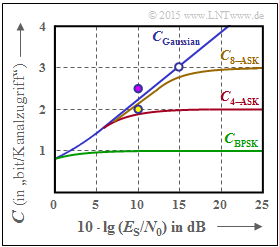
The red curve $C_{\rm red}$ is always above $C_{\rm BPSK}$ , but below $C_{\rm brown}$ and the Shannon boundary curve $C_{\rm Gauß}$.
The statements also hold if for certain $E_{\rm S}/{N_0}$ values curves are indistinguishable within the character precision.
From the limit $C_{\rm red}= 2 \ \rm bit/channel use$ for $E_{\rm S}/{N_0} → ∞$ , the symbol range $M_X = |X| = 4$.
Thus, the red curve describes the 4–ASK. $M_X = |X| = 2$ would apply to the BPSK.
The 4–QAM leads exactly to the same final value "2 bit/channel use". For small $E_{\rm S}/{N_0}$ values, however, the channel capacity $C_{\rm 4–QAM}$ is above the red curve, since $C_{\rm red}$ is bounded by the Gaussian boundary curve $C_2$ , but $C_{\rm 4–QAM}$ is bounded by $C_3$.
The designations $C_2$ and $C_3$ here refer to subtask (1).
Channel capacity limits for BPSK, 4–ASK and 8–ASK
(4)Proposed solutions 1, 2 and 5 are correct:
From the brown curve, one can see the correctness of the first two statements.
The 8–PSK with I– and Q–components – i.e. with $K = 2$ dimensions – lies slightly above the brown curve for small $E_{\rm S}/{N_0}$ values ⇒ the answer 3 is incorrect.
In the graph, the two 8–ASK–systems are also drawn as dots according to propositions 4 and 5.
The purple dot is above the $C_{\rm 8–ASK}$ curve ⇒ $R = 2.5$ and $10 \cdot \lg (E_{\rm S}/{N_0}) = 10 \ \rm dB$ are not enough to decode the 8–ASK without errors ⇒ $R > C$ ⇒ the channel coding theorem is not satisfied ⇒ answer 4 is wrong.
However, if we reduce the code rate to $R = 2 < C_{\rm 8–ASK}$ according to the yellow dot for the same $10 \cdot \lg (E_{\rm S}/{N_0}) = 10 \ \rm dB$, the channel coding theorem is satisfied ⇒ Answer 5 is correct.