We consider a two-dimensional random variable $(x,\hspace{0.08cm} y)$ whose components arise as linear combinations of two random variables $u$ and $v$:
$$x=2u-2v+1,$$
$$y=u+3v.$$
Further, note:
The two statistically independent random variables $u$ and $v$ are each uniformly distributed between $0$ and $1$.
In the figure you can see the joint PDF. Within the parallelogram drawn in blue holds:
$$f_{xy}(x,\hspace{0.08cm} y) = H = {\rm const.}$$
Outside the parallelogram no values are possible: $f_{xy}(x,\hspace{0.08cm} y) = 0$.
From this follows the value $y_0=K(x=0)\hspace{0.15cm}\underline{ = 2.5}$
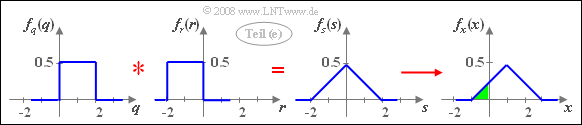
(5) With the auxiliary quantities $q= 2u$, $r= -2v$ and $s= x-1$ the relation holds: $s= q+r$.
Since $u$ and $v$ are each uniformly distributed between $0$ and $1$ , $q$ has a uniform distribution in the range from $0$ to $2$ and $r$ is uniformly distributed between $-2$ and $0$.
In addition, since $q$ and $r$ are not statistically dependent on each other, the PDF of the sum is:
Triangular PDF $f_x(x)$
$$f_s(s) = f_q(q) \star f_r(r).$$
The addition $x = s+1$ leads to a shift of the triangular–PDF by $1$ to the right.
For the sought probability (highlighted in green in the following image) therefore holds: ${\rm Pr}(x < 0)\hspace{0.15cm}\underline{ = 0.125}$.
Trapezoidal PDF $f_y(y)$
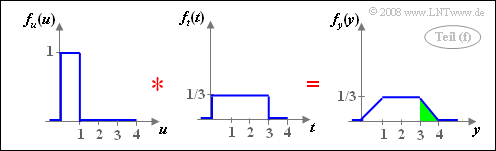
(6) Analogous to the sample solution for the subtask (5) holds with $t = 3v$:
$$f_y(y) = f_u(u) \star f_t(t).$$
The convolution between two rectangles of different widths results in a trapezoid.
For the probability we are looking for, we get ${\rm Pr}(y>3) =1/6\hspace{0.15cm}\underline{ \approx 0.167}$.
This probability is highlighted in green in the right sketch.