We consider here a binärsignal $b(t)$ and a quaternaryärsignal $q(t)$, where:
The two signals are rectangular in shape, and the duration of each rectangle is $T$ (symbol duration).
The symbols represented by the pulse heights of the individual rectangular pulses $($with step number $M = 2$ or $M = 4)$ are statistically independent.
Because of the bipolar signal constellation, both signals are equal-signal-free if the symbol probabilities are chosen appropriately (symmetrically).
Because of the latter property, it follows for the probabilities of the binary symbols:
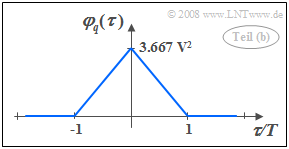
(1) The ACF value at the point $\tau = 0$ corresponds to the mean signal power, i.e. the root mean square value of $q(t)$. For this holds:
Triangular ACF
Thus, the ACF we are looking for has the shape sketched on the right.
In the range $-T \le \tau \le +T$ the ACF is sectionwise linear, i.e. triangular, due to the rectangular pulse shape.
(3) The ACF $\varphi_b(\tau)$ of the binary signal is also identically zero due to the statistically independent symbols in the range $| \tau| > T$ and for $-T \le \tau \le +T$ also results in a triangular shape.
For the quadratic mean, one obtains:
$$\varphi_b (\tau = 0) = b_{\rm 0}^{\rm 2}.$$
With $b_0\hspace{0.15cm}\underline{= 1.915\, \rm V}$ the two autocorrelation functions $\varphi_q(\tau)$ and $\varphi_b(\tau)$ are identical.
(4) Correct are the proposed solutions 1, 3, and 4.
From the autocorrelation function we can actually determine:
the period $T_0$: this is the same for the pattern signals and the ACF;
the linear mean: root of the final value of the ACF for $\tau \to \infty$ and
the variance: difference of the ACF values of $\tau = 0$ and $\tau \to \infty$.
Cannot be determined:
the probability density function: despite $\varphi_q(\tau) =\varphi_b(\tau)$ is $f_q(q) \ne f_b(b)$;
the moments of higher order: for their calculation one needs the PDF;
All phase relations and symmetry properties are not recognizable from the ACF.