We consider here a binay signal $b(t)$ and a quaternary signal $q(t)$.
The two signals are rectangular in shape. The duration of each rectangle is $T$ (symbol duration).
The symbols represented by the pulse heights of the individual rectangular pulses $($with step number $M = 2$ or $M = 4)$ are statistically independent.
Because of the bipolar signal constellation, both signals have no DC component if the symbol probabilities are chosen appropriately (symmetrically).
Because of the latter property, it follows for the probabilities of the binary symbols:
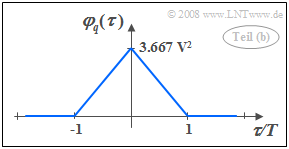
Thus, the ACF we are looking for has the shape sketched on the right.
In the range $-T \le \tau \le +T$ the ACF is sectionwise linear, i.e. triangular, due to the rectangular pulse shape.
(3) The ACF $\varphi_b(\tau)$ of the binary signal is also identically zero due to the statistically independent symbols in the range $| \tau| > T$ and for $-T \le \tau \le +T$ also results in a triangular shape.
For the quadratic mean, one obtains:
$$\varphi_b (\tau = 0) = b_{\rm 0}^{\rm 2}.$$
With $b_0\hspace{0.15cm}\underline{= 1.915\, \rm V}$ the two autocorrelation functions $\varphi_q(\tau)$ and $\varphi_b(\tau)$ are identical.
(4) Correct are the proposed solutions 1, 3, and 4.
From the autocorrelation function we can actually determine:
the period $T_0$: this is the same for the pattern signals and the ACF;
the linear mean: root of the final value of the ACF for $\tau \to \infty$ and
the variance: difference of the ACF values of $\tau = 0$ and $\tau \to \infty$.
Cannot be determined:
the probability density function: despite $\varphi_q(\tau) =\varphi_b(\tau)$ is $f_q(q) \ne f_b(b)$;
the moments of higher order: for their calculation one needs the PDF;
All phase relations and symmetry properties are not recognizable from the ACF.