* Or use the interaction module [[Applets:Complementary_Gaussian_Error_Functions|Complementary Gaussian Error Functions]] provided by $\rm LNTwww$.
* Or use the interaction module [[Applets:Komplementäre_Gaußsche_Fehlerfunktionen|Complementary Gaussian Error Functions]] provided by $\rm LNTwww$.
===Questionnaire===
===Questions===
<quiz display=simple>
<quiz display=simple>
{Would $P_{\rm E}$ be sufficient without consideration of the lognormal–fading?
{Would $P_{\rm E}$ be sufficient if the loss $V_S$ due to shadowing is not present?
|type="()"}
|type="()"}
+ Yes,
+ Yes,
Line 55:
Line 54:
</quiz>
</quiz>
===Sample solution===
===Solution===
{{ML-Kopf}}
{{ML-Kopf}}
'''(1)''' The correct answer is <u>YES</u>:
'''(1)''' The correct answer is <u>YES</u>:
Line 62:
Line 61:
*You can also solve this problem directly with the logarithmic quantities:
*You can also solve this problem directly with the logarithmic quantities:
*Only the limit value $-80 \ \rm dBm$ is required.
*Only the limit value $-80 \ \rm dBm$ is required.
Line 69:
Line 67:
'''(2)''' Lognormal fading with $\sigma_{\rm S} = 0 \ \rm dB$ is equivalent to a constant receive power $P_{\rm E}$.
'''(2)''' Lognormal fading with $\sigma_{\rm S} = 0 \ \rm dB$ is equivalent to a constant received power $P_{\rm E}$.
*Compared to the subtask '''(1)''' this is $m_{\rm S} = 20 \ \ \rm dB$ smaller ⇒ $P_{\rm E} = \ –60 \ \ \rm dBm$.
*Compared to the subtask '''(1)''' this is $m_{\rm S} = 20 \ \ \rm dB$ smaller ⇒ $P_{\rm E} = \ –60 \ \ \rm dBm$.
*But it is still greater than the specified limit value ($-80 \ \rm dBm$).
*But it is still greater than the specified limit value $(-80 \ \rm dBm)$.
*It follows: The system is (almost) <u>100% functional</u>. "Almost" because with a Gaussian random quantity there is always a (small) residual uncertainty.
*It follows: The system is (almost) <u>100% functional</u>. "Almost" because with a Gaussian random quantity there is always a (small) residual uncertainty.
'''(3)''' The receive power is too low (less than $–80 \ \rm dBm$) if the power loss due to the lognormal–term is $40 \ \rm dB$ or more.
'''(3)''' The received power is too low $($less than $–80 \ \rm dBm)$ if the power loss due to the lognormal–term is $40 \ \rm dB$ or more.
*The variable portion $V_{\rm S}$ must therefore not be greater than $20 \ \rm dB$.
[[File:EN_Mob_A_1_2c.png|right|frame|Loss due to lognormal fading]]
*The distance-dependent path loss $V_{\rm S}$ must therefore not be greater than $20 \ \rm dB$.
[[File:EN_Mob_A_1_2c.png|right|frame|loss due to lognormal fading]]
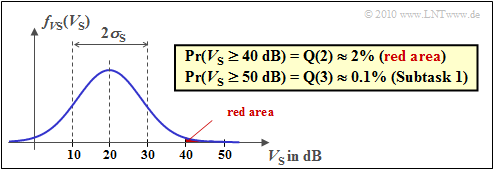
The graphic illustrates the result.
The graphic illustrates the result.
*The probability density $f_{\rm VS}(V_{\rm S})$ of the path loss due to shadowing (Longnormal–Fading) is shown here.
*The probability density $f_{\rm VS}(V_{\rm S})$ of the path loss due to shadowing (Longnormal Fading) is shown here.
*The probability that the system will fail is marked in red.
*The probability that the system will fail is marked in red.
<br clear=all>
'''(4)''' From the availability probability $99.9 \%$ follows the failure probability $10^{\rm –3} \approx \ {\rm Q}(3)$.
*If the distance-dependent path loss $V_0$ is reduced by $10 \ \ \rm dB$ to $\underline {70 \ \rm dB}$, a failure will only occur when $V_{\rm S} ≥ 50 \ \ \rm dB$.
'''(4)''' From the availability probability $99.9 \%$ follows the failure probability $10^{\rm -3} \approx \ {\rm Q}(3)$.
*If the distance-dependent path loss $V_0$ is reduced by $10 \ \ \rm dB$ to $\underline {70 \ \rm dB}$, a failure will only occur when $V_{\rm S} ≥ 50 \ \ \rm dB$.
*This would achieve exactly the required reliability, as the following calculation shows:
*This would achieve exactly the required reliability, as the following calculation shows:
We consider a mobile radio cell in an urban area and a vehicle that is approximately at a fixed distance $d_0$ from the base station. For example, it moves on an arc around the base station.
Thus the total path loss can be described by the following equation:
The probability density $f_{\rm VS}(V_{\rm S})$ of the path loss due to shadowing (Longnormal Fading) is shown here.
The probability that the system will fail is marked in red.
(4) From the availability probability $99.9 \%$ follows the failure probability $10^{\rm -3} \approx \ {\rm Q}(3)$.
If the distance-dependent path loss $V_0$ is reduced by $10 \ \ \rm dB$ to $\underline {70 \ \rm dB}$, a failure will only occur when $V_{\rm S} ≥ 50 \ \ \rm dB$.
This would achieve exactly the required reliability, as the following calculation shows: