Aufgaben:Exercise 2.08: Generator Polynomials for Reed-Solomon: Difference between revisions

From LNTwww
Hussain (talk | contribs)
No edit summary
Fix interlanguage link: resolve redirect chain
 
(42 intermediate revisions by 5 users not shown)
Line 1: Line 1:
{{quiz-Header|Buchseite=Kanalcodierung/Definition und Eigenschaften von Reed–Solomon–Codes}}
{{quiz-Header|Buchseite=Channel_Coding/Definition_and_Properties_of_Reed-Solomon_Codes}}


[[File:P_ID2525__KC_A_2_8.png|right|frame|Vier Generatormatrizen, drei davon beschreiben Reed–Solomon–Codes]]
[[File:P_ID2525__KC_A_2_8.png|right|frame|Four generator matrices, three of which describe Reed-Solomon codes]]
In der [[Aufgaben:2.07_Reed%E2%80%93Solomon%E2%80%93Code_(7,_3,_5)(Base_8)|Aufgabe A2.7]] sollten Sie die Codeworte des $\rm RSC \, (7, \, 3, \, 5)_8$ über ein Polynom ermitteln. Man kann aber das Codewort $\underline{c}$ auch aus dem Informationswort $\underline{u}$ und der Generatormatrix $\mathbf{G}$ gemäß der folgenden Gleichung bestimmen:
In the  [[Aufgaben:Exercise_2.07:_Reed-Solomon_Code_(7,_3,_5)_to_Base_8|"Exercise 2.7"]]  you should determine the code words of the  $\rm RSC \, (7, \, 3, \, 5)_8$  via a polynomial.  However,  you can also determine the code word  $\underline{c}$   from the information word  $\underline{u}$  and the generator matrix  $\mathbf{G}$  according to the following equation:
:$$\underline {c} = \underline {u} \cdot { \boldsymbol{\rm G}}
:$$\underline {c} = \underline {u} \cdot { \boldsymbol{\rm G}}\hspace{0.05cm}.$$
\hspace{0.05cm}.$$


Zwei der vorgegebenen Generatormatrizen beschreiben den $\rm RSC \, (7, \, 3, \, 5)_8$. In der Teilaufgabe (1) ist explizit gefragt, welche. Eine weitere Generatormatrix gehört zum $\rm RSC \, (7, \, 3, \, 5)_8$, der in der Teilaufgabe (3) betrachtet wird.
*Two of these generator matrices describe the  $\rm RSC \, (7, \, 3, \, 5)_8$.  In the subtask  '''(1)'''  is explicitly asked which.
*Another generator matrix belongs to  $\rm RSC \, (7, \, 5, \, 3)_8$,  which is considered in subtask  '''(3)'''.


''Hinweise:''
* Die Aufgabe gehört zum Themengebiet des Kapitels [[Kanalcodierung/Definition_und_Eigenschaften_von_Reed%E2%80%93Solomon%E2%80%93Codes| Definition und Eigenschaften von Reed–Solomon–Codes]].
* Wichtige Informationen zu den Reed–Solomon–Codes finden Sie auch in der Angabe zur [[Aufgaben:2.07_Reed%E2%80%93Solomon%E2%80%93Code_(7,_3,_5)(Base_8)| Aufgabe A2.7]].


===Fragebogen===
 
Hints:
* This exercise belongs to the chapter  [[Channel_Coding/Definition_and_Properties_of_Reed-Solomon_Codes| "Definition and Properties of Reed-Solomon Codes"]].
 
* Important information about Reed–Solomon codes can also be found in  [[Aufgaben:Exercise_2.07:_Reed-Solomon_Code_(7,_3,_5)_to_Base_8| "Exercise 2.7"]].


===Questions===
<quiz display=simple>
{Multiple-Choice
{Which of the generator polynomials describe the&nbsp; $\rm RSC \, (7, \, 3, \, 5)_8$?
|type="[]"}
|type="[]"}
+ correct
- the matrix&nbsp; $\mathbf{G}_{\rm A}$,
- false
+ the matrix&nbsp; $\mathbf{G}_{\rm B}$,
+ the matrix&nbsp; $\mathbf{G}_{\rm C}$,
- the matrix&nbsp; $\mathbf{G}_{\rm D}$.


{Input-Box Frage
{The information sequence starts with&nbsp; $\alpha^4, \, 1, \, \alpha^3, \, 0, \, \alpha^6$.&nbsp; Determine the first code word for the&nbsp; $\rm RSC \, (7, \, 3, \, 5)_8$.
|type="{}"}
|type="[]"}
$xyz \ = \ ${ 5.4 3% } $ab$
+ It holds&nbsp; $c_0 = \alpha^2$,
+ It holds&nbsp; $c_1 = \alpha^3$,
- It holds&nbsp; $c_6 = 0$.
 
{What is the code word for the&nbsp; $\rm RSC \, (7, \, 5, \, 3)_8$ given the same sequence of information?
|type="[]"}
+ It holds&nbsp; $c_0 = 1$,
+ It holds&nbsp; $c_1 = 0$,
+ It holds&nbsp; $c_6 = \alpha^6$.
</quiz>
</quiz>


===Musterlösung===
===Solution===
{{ML-Kopf}}
{{ML-Kopf}}
'''(1)'''&nbsp;  
'''(1)'''&nbsp; Correct are the&nbsp; <u>solutions 2 and 3</u> &nbsp; &#8658; &nbsp; matrices&nbsp; $\mathbf{G}_{\rm B}$&nbsp; and&nbsp; $\mathbf{G}_{\rm C}$.
'''(2)'''&nbsp;  
*In the matrix&nbsp; $\mathbf{G}_{\rm C}$&nbsp; the allowed transformations&nbsp; $\alpha^8 = \alpha, \ \alpha^{10} = \alpha^3$&nbsp; and&nbsp; $\alpha^{12} = \alpha^5$&nbsp; have already been considered.
'''(3)'''&nbsp;  
'''(4)'''&nbsp;  
*The matrix&nbsp; $\mathbf{G}_{\rm A}$&nbsp; holds for the&nbsp; $(7, \, 5, \, 3)$&nbsp; Hamming code and&nbsp; $\mathbf{G}_{\rm D}$&nbsp; belongs to the&nbsp; $\rm RSC \, (7, \, 5, \, 3)_8$.&nbsp; See subtask&nbsp; '''(3)'''&nbsp; for more details.
'''(5)'''&nbsp;  


'''(2)'''&nbsp; In the&nbsp; $\rm RSC \, (7, \, 3, \, 5)_8$,&nbsp;  in each coding step are processed&nbsp;  $k = 3$&nbsp; information symbols, &nbsp; <br>in coding step 1 according to the specification the symbols&nbsp; $\alpha^4, \ 1$ and $\alpha^3$.
 
*With the generator matrix $\mathbf{G}_{\rm C}$ thus holds:
:$$\underline {c} = \underline {u} \cdot { \boldsymbol{\rm G}}_{\rm C} =\begin{pmatrix}\alpha^4 & 1 & \alpha^3\end{pmatrix} \cdot\begin{pmatrix}1 & 1 & 1 & 1 & 1 & 1 & 1\\1 & \alpha^1 & \alpha^2 & \alpha^3 & \alpha^4 & \alpha^5 & \alpha^6\\1 & \alpha^2 & \alpha^4 & \alpha^6 & \alpha^1 & \alpha^{3} & \alpha^{5}\end{pmatrix}\hspace{0.05cm}. $$
[[File:EN_KC_Z_2_5_neu.png|right|frame|$\rm GF(2^3)$&nbsp; representation as powers, polynomials, vectors]]
*This results according to the adjacent auxiliary table:
:$$c_0 \hspace{-0.15cm} \ = \ \hspace{-0.15cm}  \alpha^{4}\cdot 1  + 1 \cdot 1 +  \alpha^{3}\cdot 1 =(110) + (001) + (011)= (100) = \alpha^{2} \hspace{0.05cm},$$
:$$c_1 \hspace{-0.15cm} \ = \ \hspace{-0.15cm}  \alpha^{4}\cdot 1 + 1 \cdot \alpha + \alpha^{3}\cdot \alpha^{2}=(110)  + (010) + (110) = (011) = \alpha^{3} \hspace{0.05cm},$$
:$$c_2 \hspace{-0.15cm} \ = \ \hspace{-0.15cm}    \alpha^{4}\cdot 1 + 1 \cdot \alpha^{2} + \alpha^{3}\cdot \alpha^{4}=(110) + (100) + (001) = (011) = \alpha^{3} \hspace{0.05cm},$$
:$$c_3 \hspace{-0.15cm} \ = \ \hspace{-0.15cm}  \alpha^{4}\cdot 1 + 1 \cdot \alpha^{3} + \alpha^{3}\cdot \alpha^{6}=$(110) + (011) + (100) = (001) = 1 \hspace{0.05cm},$$
:$$c_4 \hspace{-0.15cm} \ = \ \hspace{-0.15cm}    \alpha^{4}\cdot 1 + 1 \cdot \alpha^{4} + \alpha^{3}\cdot \alpha^{1}= \alpha^{4} \hspace{0.05cm},$$
:$$c_5 \hspace{-0.15cm} \ = \ \hspace{-0.15cm}    \alpha^{4}\cdot 1 + 1 \cdot \alpha^{5} + \alpha^{3}\cdot \alpha^{3}=(110) + (111) + (101) =  (100) = \alpha^{2} \hspace{0.05cm},$$
:$$c_6 \hspace{-0.15cm} \ = \ \hspace{-0.15cm}  \alpha^{4}\cdot 1 + 1 \cdot \alpha^{6} + \alpha^{3}\cdot \alpha^{5}=(\alpha^{2} + \alpha) + (\alpha^2 +1) + \alpha = 1 \hspace{0.05cm}.$$
 
*You get exactly the same result as in subtask&nbsp; '''(4)'''&nbsp; of&nbsp; [[Aufgaben:Exercise_2.07:_Reed-Solomon_Code_(7,_3,_5)_to_Base_8|"Exercise 2.7"]].&nbsp; Correct are the&nbsp; <u>solutions 1 and 2</u>.
*So it is not&nbsp; $c_6 = 0$,&nbsp; but $c_6 = 1$.


'''(3)'''&nbsp; At the&nbsp; $\rm RSC \, (7, \, 5, \, 3)_8$,&nbsp; the information word&nbsp; $\underline{u} = (u_0, \, u_1, \, u_2, \, u_3, \, u_4)$&nbsp; must be considered.
*With the generator matrix&nbsp; $\mathbf{G}_{\rm D}$&nbsp; one obtains:
:$$\underline {c} = \underline {u} \cdot { \boldsymbol{\rm G}}_{\rm D} =\begin{pmatrix}\alpha^4 & 1 & \alpha^3 & 0 & \alpha^6\end{pmatrix} \cdot\begin{pmatrix}1 & 1 & 1 & 1 & 1 & 1 & 1\\1 & \alpha^1 & \alpha^2 & \alpha^3 & \alpha^4 & \alpha^5 & \alpha^6\\1 & \alpha^2 & \alpha^4 & \alpha^6 & \alpha^1 & \alpha^{3} & \alpha^{5}\\1 & \alpha^3 & \alpha^6 & \alpha^2 & \alpha^5 & \alpha^{1} & \alpha^{4}\\1 & \alpha^4 & \alpha^1 & \alpha^5 & \alpha^2 & \alpha^{6} & \alpha^{3}\end{pmatrix}\hspace{0.05cm}. $$
 
*From this it follows:
:$$c_0 \hspace{-0.15cm} \ = \ \hspace{-0.15cm}  \alpha^{4}\cdot 1  + 1 \cdot 1 +  \alpha^{3}\cdot 1  + 0 \cdot 1 +  \alpha^{6}\cdot 1= (110) + (001) + (011) + (000) +  (101) = (001) = 1 \hspace{0.05cm},$$
:$$c_1 \hspace{-0.15cm} \ = \ \hspace{-0.15cm}  \left [ \alpha^{4}\cdot 1 + 1 \cdot \alpha + \alpha^{3}\cdot \alpha^{2} \right ] + 0 \cdot \alpha^{3} +  \alpha^{6}\cdot \alpha^{4}=  \left [ \alpha^{3} \right ] + \alpha^{3} = 0 \hspace{0.05cm}.$$
 
*This takes into account that the bracket expression&nbsp; $[ \ \text{...} \ ]$&nbsp; corresponds exactly to the result&nbsp; $c_1$&nbsp; of subtask&nbsp; '''(2)'''.
 
*Corresponding is also considered in the following calculations:
:$$c_2 \hspace{-0.15cm} \ = \ \hspace{-0.15cm}    \left [ \alpha^{3} \right ] + \alpha^{6}\cdot \alpha^{1}=\left [ \alpha^{3} \right ] + \alpha^{7} =(011) + (001) = (010) = \alpha^{1} \hspace{0.05cm},$$
:$$c_3 \hspace{-0.15cm} \ = \ \hspace{-0.15cm}  \left [ 1 \right ] + \alpha^{6}\cdot \alpha^{5}=\left [ 1 \right ] + \alpha^{4}=(001) + (110)  = (111) = \alpha^{5} \hspace{0.05cm},$$
:$$c_4 \hspace{-0.15cm} \ = \ \hspace{-0.15cm}    \left [ \alpha^{4} \right ] + \alpha^{6}\cdot \alpha^{2}=\left [ \alpha^{4} \right ] + \alpha^{1} = (110) + (010) = (100)= \alpha^{2} \hspace{0.05cm},$$
:$$c_5 \hspace{-0.15cm} \ = \ \hspace{-0.15cm}    \left [ \alpha^{2} \right ] + \alpha^{6}\cdot \alpha^{6}=\left [ \alpha^{2} \right ] + \alpha^{5} =(100) + (111) = (011) = \alpha^{3} \hspace{0.05cm},$$
:$$c_6 \hspace{-0.15cm} \ = \ \hspace{-0.15cm}  \left [ 1 \right ] + \alpha^{6}\cdot \alpha^{3}= \left [ 1 \right ] + \alpha^{2}=  (001) + (100) = (101) = \alpha^{6} \hspace{0.05cm}.$$
 
*This means:&nbsp; <u>All proposed solutions</u>&nbsp; are correct.
{{ML-Fuß}}
{{ML-Fuß}}


[[Category:Aufgaben zu  Kanalcodierung|^2.3 Definition und Eigenschaften von Reed–Solomon–Codes^]]
[[Category:Channel Coding: Exercises|^2.3 Reed–Solomon Codes^]]
[[de:Aufgaben:Aufgabe 2.08: Generatorpolynome für Reed-Solomon]]

Latest revision as of 17:56, 16 March 2026

Four generator matrices, three of which describe Reed-Solomon codes

In the  "Exercise 2.7"  you should determine the code words of the  $\rm RSC \, (7, \, 3, \, 5)_8$  via a polynomial.  However,  you can also determine the code word  $\underline{c}$   from the information word  $\underline{u}$  and the generator matrix  $\mathbf{G}$  according to the following equation:

$$\underline {c} = \underline {u} \cdot { \boldsymbol{\rm G}}\hspace{0.05cm}.$$
  • Two of these generator matrices describe the  $\rm RSC \, (7, \, 3, \, 5)_8$.  In the subtask  (1)  is explicitly asked which.
  • Another generator matrix belongs to  $\rm RSC \, (7, \, 5, \, 3)_8$,  which is considered in subtask  (3).


Hints:

  • Important information about Reed–Solomon codes can also be found in  "Exercise 2.7".


Questions

1 Which of the generator polynomials describe the  $\rm RSC \, (7, \, 3, \, 5)_8$?

the matrix  $\mathbf{G}_{\rm A}$,
the matrix  $\mathbf{G}_{\rm B}$,
the matrix  $\mathbf{G}_{\rm C}$,
the matrix  $\mathbf{G}_{\rm D}$.

2 The information sequence starts with  $\alpha^4, \, 1, \, \alpha^3, \, 0, \, \alpha^6$.  Determine the first code word for the  $\rm RSC \, (7, \, 3, \, 5)_8$.

It holds  $c_0 = \alpha^2$,
It holds  $c_1 = \alpha^3$,
It holds  $c_6 = 0$.

3 What is the code word for the  $\rm RSC \, (7, \, 5, \, 3)_8$ given the same sequence of information?

It holds  $c_0 = 1$,
It holds  $c_1 = 0$,
It holds  $c_6 = \alpha^6$.


Solution

(1)  Correct are the  solutions 2 and 3   ⇒   matrices  $\mathbf{G}_{\rm B}$  and  $\mathbf{G}_{\rm C}$.

  • In the matrix  $\mathbf{G}_{\rm C}$  the allowed transformations  $\alpha^8 = \alpha, \ \alpha^{10} = \alpha^3$  and  $\alpha^{12} = \alpha^5$  have already been considered.
  • The matrix  $\mathbf{G}_{\rm A}$  holds for the  $(7, \, 5, \, 3)$  Hamming code and  $\mathbf{G}_{\rm D}$  belongs to the  $\rm RSC \, (7, \, 5, \, 3)_8$.  See subtask  (3)  for more details.


(2)  In the  $\rm RSC \, (7, \, 3, \, 5)_8$,  in each coding step are processed  $k = 3$  information symbols,  
in coding step 1 according to the specification the symbols  $\alpha^4, \ 1$ and $\alpha^3$.

  • With the generator matrix $\mathbf{G}_{\rm C}$ thus holds:
$$\underline {c} = \underline {u} \cdot { \boldsymbol{\rm G}}_{\rm C} =\begin{pmatrix}\alpha^4 & 1 & \alpha^3\end{pmatrix} \cdot\begin{pmatrix}1 & 1 & 1 & 1 & 1 & 1 & 1\\1 & \alpha^1 & \alpha^2 & \alpha^3 & \alpha^4 & \alpha^5 & \alpha^6\\1 & \alpha^2 & \alpha^4 & \alpha^6 & \alpha^1 & \alpha^{3} & \alpha^{5}\end{pmatrix}\hspace{0.05cm}. $$
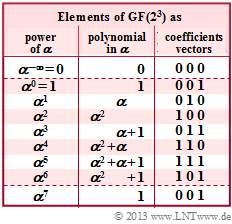
$\rm GF(2^3)$  representation as powers, polynomials, vectors
  • This results according to the adjacent auxiliary table:
$$c_0 \hspace{-0.15cm} \ = \ \hspace{-0.15cm} \alpha^{4}\cdot 1 + 1 \cdot 1 + \alpha^{3}\cdot 1 =(110) + (001) + (011)= (100) = \alpha^{2} \hspace{0.05cm},$$
$$c_1 \hspace{-0.15cm} \ = \ \hspace{-0.15cm} \alpha^{4}\cdot 1 + 1 \cdot \alpha + \alpha^{3}\cdot \alpha^{2}=(110) + (010) + (110) = (011) = \alpha^{3} \hspace{0.05cm},$$
$$c_2 \hspace{-0.15cm} \ = \ \hspace{-0.15cm} \alpha^{4}\cdot 1 + 1 \cdot \alpha^{2} + \alpha^{3}\cdot \alpha^{4}=(110) + (100) + (001) = (011) = \alpha^{3} \hspace{0.05cm},$$
$$c_3 \hspace{-0.15cm} \ = \ \hspace{-0.15cm} \alpha^{4}\cdot 1 + 1 \cdot \alpha^{3} + \alpha^{3}\cdot \alpha^{6}=$(110) + (011) + (100) = (001) = 1 \hspace{0.05cm},$$
$$c_4 \hspace{-0.15cm} \ = \ \hspace{-0.15cm} \alpha^{4}\cdot 1 + 1 \cdot \alpha^{4} + \alpha^{3}\cdot \alpha^{1}= \alpha^{4} \hspace{0.05cm},$$
$$c_5 \hspace{-0.15cm} \ = \ \hspace{-0.15cm} \alpha^{4}\cdot 1 + 1 \cdot \alpha^{5} + \alpha^{3}\cdot \alpha^{3}=(110) + (111) + (101) = (100) = \alpha^{2} \hspace{0.05cm},$$
$$c_6 \hspace{-0.15cm} \ = \ \hspace{-0.15cm} \alpha^{4}\cdot 1 + 1 \cdot \alpha^{6} + \alpha^{3}\cdot \alpha^{5}=(\alpha^{2} + \alpha) + (\alpha^2 +1) + \alpha = 1 \hspace{0.05cm}.$$
  • You get exactly the same result as in subtask  (4)  of  "Exercise 2.7".  Correct are the  solutions 1 and 2.
  • So it is not  $c_6 = 0$,  but $c_6 = 1$.


(3)  At the  $\rm RSC \, (7, \, 5, \, 3)_8$,  the information word  $\underline{u} = (u_0, \, u_1, \, u_2, \, u_3, \, u_4)$  must be considered.

  • With the generator matrix  $\mathbf{G}_{\rm D}$  one obtains:
$$\underline {c} = \underline {u} \cdot { \boldsymbol{\rm G}}_{\rm D} =\begin{pmatrix}\alpha^4 & 1 & \alpha^3 & 0 & \alpha^6\end{pmatrix} \cdot\begin{pmatrix}1 & 1 & 1 & 1 & 1 & 1 & 1\\1 & \alpha^1 & \alpha^2 & \alpha^3 & \alpha^4 & \alpha^5 & \alpha^6\\1 & \alpha^2 & \alpha^4 & \alpha^6 & \alpha^1 & \alpha^{3} & \alpha^{5}\\1 & \alpha^3 & \alpha^6 & \alpha^2 & \alpha^5 & \alpha^{1} & \alpha^{4}\\1 & \alpha^4 & \alpha^1 & \alpha^5 & \alpha^2 & \alpha^{6} & \alpha^{3}\end{pmatrix}\hspace{0.05cm}. $$
  • From this it follows:
$$c_0 \hspace{-0.15cm} \ = \ \hspace{-0.15cm} \alpha^{4}\cdot 1 + 1 \cdot 1 + \alpha^{3}\cdot 1 + 0 \cdot 1 + \alpha^{6}\cdot 1= (110) + (001) + (011) + (000) + (101) = (001) = 1 \hspace{0.05cm},$$
$$c_1 \hspace{-0.15cm} \ = \ \hspace{-0.15cm} \left [ \alpha^{4}\cdot 1 + 1 \cdot \alpha + \alpha^{3}\cdot \alpha^{2} \right ] + 0 \cdot \alpha^{3} + \alpha^{6}\cdot \alpha^{4}= \left [ \alpha^{3} \right ] + \alpha^{3} = 0 \hspace{0.05cm}.$$
  • This takes into account that the bracket expression  $[ \ \text{...} \ ]$  corresponds exactly to the result  $c_1$  of subtask  (2).
  • Corresponding is also considered in the following calculations:
$$c_2 \hspace{-0.15cm} \ = \ \hspace{-0.15cm} \left [ \alpha^{3} \right ] + \alpha^{6}\cdot \alpha^{1}=\left [ \alpha^{3} \right ] + \alpha^{7} =(011) + (001) = (010) = \alpha^{1} \hspace{0.05cm},$$
$$c_3 \hspace{-0.15cm} \ = \ \hspace{-0.15cm} \left [ 1 \right ] + \alpha^{6}\cdot \alpha^{5}=\left [ 1 \right ] + \alpha^{4}=(001) + (110) = (111) = \alpha^{5} \hspace{0.05cm},$$
$$c_4 \hspace{-0.15cm} \ = \ \hspace{-0.15cm} \left [ \alpha^{4} \right ] + \alpha^{6}\cdot \alpha^{2}=\left [ \alpha^{4} \right ] + \alpha^{1} = (110) + (010) = (100)= \alpha^{2} \hspace{0.05cm},$$
$$c_5 \hspace{-0.15cm} \ = \ \hspace{-0.15cm} \left [ \alpha^{2} \right ] + \alpha^{6}\cdot \alpha^{6}=\left [ \alpha^{2} \right ] + \alpha^{5} =(100) + (111) = (011) = \alpha^{3} \hspace{0.05cm},$$
$$c_6 \hspace{-0.15cm} \ = \ \hspace{-0.15cm} \left [ 1 \right ] + \alpha^{6}\cdot \alpha^{3}= \left [ 1 \right ] + \alpha^{2}= (001) + (100) = (101) = \alpha^{6} \hspace{0.05cm}.$$
  • This means:  All proposed solutions  are correct.