Aufgaben:Exercise 2.5: Ternary Signal Transmission: Difference between revisions

From LNTwww
Hussain (talk | contribs)
No edit summary
Fix interlanguage link: resolve redirect chain
 
(29 intermediate revisions by 7 users not shown)
Line 1: Line 1:


{{quiz-Header|Buchseite=Digitalsignalübertragung/Redundanzfreie Codierung
{{quiz-Header|Buchseite=Digital_Signal_Transmission/Redundancy-Free_Coding
}}
}}
[[File:P_ID1327__Dig_A_2_5.png|right|frame|WDF eines verrauschten Ternärsignals]]
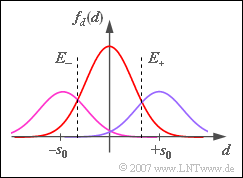
[[File:P_ID1327__Dig_A_2_5.png|right|frame|Probability density function  $\rm (PDF)$  of a noisy ternary signal]]
Betrachtet wird ein ternäres Übertragungssystem ($M = 3$) mit den möglichen Amplitudenwerten $–s_0$, $0$ und $+s_0$. Bei der Übertragung addiert sich dem Signal ein additives Gaußsches Rauschen mit dem Effektivwert $\sigma_d$. Die Rückgewinnung des dreistufigen Digitalsignals beim Empfängers geschieht mit Hilfe von zwei Entscheiderschwellen bei $E_{–}$ bzw. $E_{+}$.
A ternary transmission system  $(M = 3)$  with the possible amplitude values  $-s_0$,   $0$   and  $+s_0$  is considered.  
*During transmission,  additive Gaussian noise with rms value  $\sigma_d$  is added to the signal.  


Zunächst werden die Auftrittswahrscheinlichkeiten von den drei Eingangssymbolen als gleichwahrscheinlich angenommen
*The recovery of the three-level digital signal at the receiver is done with the help of two decision thresholds at  $E_{–}$  and  $E_{+}$.
:$$p_{\rm -} = {\rm Pr}(-s_0) = {1}/{ 3}, \hspace{0.15cm}  p_{\rm 0} = {\rm Pr}(0) = {1}/{ 3},
\hspace{0.15cm} p_{\rm +} = {\rm Pr}(+s_0) ={1}/{ 3}\hspace{0.05cm}.$$


Die Entscheiderschwellen liegen vorerst mittig bei $E_{–} = \, –s_0/2$ und $E_{+} = +s_0/2$.
*First, the occurrence probabilities of the three input symbols are assumed to be equally probable:
:$$p_{\rm -} = {\rm Pr}(-s_0) = {1}/{ 3}, \hspace{0.15cm}  p_{\rm 0} = {\rm Pr}(0) = {1}/{ 3},\hspace{0.15cm} p_{\rm +} = {\rm Pr}(+s_0) ={1}/{ 3}\hspace{0.05cm}.$$


Ab der Teilaufgabe (3) gelten für die Symbolwahrscheinlichkeiten $p_{–} = p_+ = 1/4$ und $p_0 = 1/2$, wie in der Grafik dargestellt. Für diese Konstellation soll durch Variation der Entscheiderschwellen $E_{–}$ und $E_+$ die Symbolfehlerwahrscheinlichkeit $p_{\rm S}$ minimiert werden.  
*For the time being,  the decision thresholds are centered at  $E_{–} = \, –s_0/2$ and $E_{+} = +s_0/2$.


''Hinweise:''
*From subtask  '''(3)'''  on,  the symbol probabilities are  $p_{–} = p_+ = 1/4$  and  $p_0 = 1/2$,  as shown in the diagram.   
* Die Aufgabe bezieht sich auf das Kapitel [[http://en.lntwww.de/Digitalsignal%C3%BCbertragung/Redundanzfreie_Codierung| Redundanzfreie Codierung]].
* Für die Symbolfehlerwahrscheinlichkeit $p_{\rm S}$ eines $M$–stufigen Nachrichtenübertragungssystems mit gleichwahrscheinlichen Eingangssymbolen und Schwellenwerten genau in der Mitte zwischen zwei benachbarten Amplitudenstufen gilt:
:$$p_{\rm S} =
\frac{ 2  \cdot (M-1)}{M} \cdot {\rm Q} \left( {\frac{s_0}{(M-1) \cdot \sigma_d}}\right)
\hspace{0.05cm}.$$
* Die Fehlerwahrscheinlichkeitswerte gemäß der ${\rm Q}$– bzw. der ${\rm erfc}$–Funktion können Sie mit folgendem Interaktionsmodul numerisch ermitteln: [[Komplementäre Gaußsche Fehlerfunktionen]]


Verwenden Sie zur Überprüfung der Ergebnisse das Berechnungsmodul [[Symbolfehlerwahrscheinlichkeit von Digitalsystemen]]
*For this constellation,  the symbol error probability  $p_{\rm S}$  is to be minimized by varying the decision thresholds  $E_{–}$  and  $E_+$. 


===Fragebogen===
Notes:
* The exercise refers to the chapter  [[Digital_Signal_Transmission/Redundancy-Free_Coding|"Redundancy-Free Coding"]].
 
* For the symbol error probability  $p_{\rm S}$  of a  $M$–level transmission system
:*with equally probable input symbols
:*and threshold values exactly in the middle between two adjacent amplitude levels holds:
:$$p_{\rm S} =\frac{ 2  \cdot (M-1)}{M} \cdot {\rm Q} \left( {\frac{s_0}{(M-1) \cdot \sigma_d}}\right)\hspace{0.05cm}.$$
* You can numerically determine the error probability values according to  our applet  [[Applets:Komplementäre_Gaußsche_Fehlerfunktionen|"Complementary Gaussian Error Functions"]].
 
* To check your results,  use our  (German language)  SWF applet  [[Applets:Fehlerwahrscheinlichkeit|"Symbol error probability of digital communications systems"]].


===Questions===
<quiz display=simple>
{Multiple-Choice
{What symbol error probability results with the&nbsp; (normalized)&nbsp; noise rms value &nbsp;$\sigma_d/s_0 = 0.25$&nbsp; for equally probable symbols?
|type="[]"}
|type="{}"}
+ correct
$p_0 = 1/3, \ \sigma_d = 0.25 \text{:} \hspace{0.4cm} p_{\rm S} \ = \ ${ 3 3% } $\ \%$
- false


{Input-Box Frage
{How does the symbol error probability change with &nbsp;$\sigma_d/s_0 = 0.5$?
|type="{}"}
|type="{}"}
$xyz \ = \ ${ 5.4 3% } $ab$
$p_0 = 1/3, \ \sigma_d = 0.5 \text{:} \hspace{0.4cm} p_{\rm S} \ = \ ${ 21.2 3% } $\ \%$
 
{What value results with &nbsp;$p_{&ndash;} = p_+ = 0.25$&nbsp; and &nbsp;$p_0 = 0.5$?
|type="{}"}
$p_0 = 1/2, \ \sigma_d = 0.5 \text{:} \hspace{0.4cm} p_{\rm S} \ = \ ${ 23.8 3% } $\ \%$
 
{Determine the optimal thresholds &nbsp;$E_+$&nbsp; and &nbsp;$E_{&ndash;} = \, &ndash;E_+$&nbsp; for &nbsp;$p_0 = 1/2$.
|type="{}"}
$p_0 = 1/2, \ \sigma_d = 0.5 \text{:} \hspace{0.4cm} E_{\rm +, \ opt} \ = \ ${ 0.673 3% }
 
{What is the symbol error probability for optimal thresholds?
|type="{}"}
${\rm optimal \ thresholds} \text{:} \hspace{0.4cm} p_{\rm S} \ = \ ${ 21.7 3% } $\ \%$
 
{What are the optimal thresholds for &nbsp;$p_0 = 0.2$&nbsp; and $&nbsp;p_{&ndash;} = p_+ = 0.4$?
|type="{}"}
$p_0 = 0.2, \ \sigma_d = 0.5 \text{:} \hspace{0.4cm} E_{\rm +, \ opt} \ = \ ${ 0.327 3% }
 
{What is the symbol error probability now? Interpretation.
|type="{}"}
${\rm optimal \ thresholds} \text{:} \hspace{0.4cm} p_{\rm S} \ = \ ${ 17.4 3% } $\ \%$
</quiz>
</quiz>


===Musterlösung===
===Solution===
{{ML-Kopf}}
{{ML-Kopf}}
'''(1)'''&nbsp;  
'''(1)'''&nbsp; According to the given equation,&nbsp; with&nbsp; $M = 3$&nbsp; and&nbsp; $\sigma_d/s_0 = 0.25$:
'''(2)'''&nbsp;  
:$$p_{\rm S} =\frac{ 2  \cdot (M-1)}{M} \cdot {\rm Q} \left( {\frac{s_0}{(M-1) \cdot\sigma_d}}\right)= {4}/{ 3}\cdot {\rm Q}(2) ={4}/{ 3}\cdot 0.0228\hspace{0.15cm}\underline {\approx 3 \,\%}\hspace{0.05cm}.$$
'''(3)'''&nbsp;  
 
'''(4)'''&nbsp;  
 
'''(5)'''&nbsp;  
'''(2)'''&nbsp; When the noise rms value is doubled,&nbsp; the error probability increases significantly:
:$$p_{\rm S} = {4}/{ 3}\cdot {\rm Q}(1)= {4}/{ 3}\cdot 0.1587 \hspace{0.15cm}\underline {\approx 21.2 \,\%}\hspace{0.05cm}.$$
 
 
'''(3)'''&nbsp; The two outer symbols are each falsified with probability&nbsp; $p = {\rm Q}(s_0/(2 \cdot \sigma_d)) = 0.1587$.
*The falsification probability of the symbol &nbsp;$0$&nbsp; is twice as large&nbsp; (it is limited by two thresholds).
* Considering the individual symbol probabilities,&nbsp; we obtain:
:$$p_{\rm S} = {1}/{ 4}\cdot p + {1}/{ 2}\cdot 2p +{1}/{ 4}\cdot p = 1.5 \cdot p  = 1.5 \cdot 0.1587\hspace{0.15cm}\underline {\approx23.8 \,\%}\hspace{0.05cm}.$$
 
 
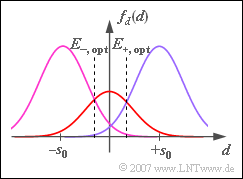
'''(4)'''&nbsp; Since the symbol &nbsp;$0$&nbsp; occurs more frequently and can also be falsified in both directions,&nbsp; the thresholds should be shifted outward.
*The optimal decision threshold&nbsp; $E_{\rm +, \ opt}$&nbsp; is obtained from the intersection of the two Gaussian functions shown in the graph.&nbsp; It must hold:
 
[[File:P_ID1328__Dig_A_2_5e.png|right|frame|Optimal thresholds for subtask&nbsp; '''(4)''']]
 
:$$\frac{ 1/2}{ \sqrt{2\pi} \cdot \sigma_d} \cdot  {\rm exp} \left[ - \frac{ E_{\rm +}^2}{2 \cdot \sigma_d^2}\right]= \frac{ 1/4}{ \sqrt{2\pi} \cdot \sigma_d} \cdot  {\rm exp} \left[ - \frac{ (s_0 -E_{\rm +})^2}{2 \cdot \sigma_d^2}\right]$$
:$$\Rightarrow \hspace{0.3cm}  {\rm exp} \left[  \frac{ (s_0 -E_{\rm +})^2 - E_{\rm +}^2}{2 \cdot\sigma_d^2}\right]= {1}/{ 2}\Rightarrow \hspace{0.3cm}  {\rm exp} \left[  \frac{ 1 -2 \cdot E_{\rm +}/s_0}{2 \cdot\sigma_d^2/s_0^2}\right]= {1}/{ 2}$$
:$$\Rightarrow \hspace{0.3cm}\frac{ E_{\rm +}}{s_0}= \frac{1}{ 2}+ \frac{\sigma_d^2} {s_0^2} \cdot {\rm ln}(2)\hspace{0.15cm}\underline {=0.673}\hspace{0.15cm}\approx{2}/ {3} \hspace{0.05cm}.$$
 
 
'''(5)'''&nbsp; Using the approximate result from subtask&nbsp; '''(4)''',&nbsp; we obtain:
:$$p_{\rm S} \ = \{ 1}/{4} \cdot {\rm Q} \left( {\frac{s_0/3}{\sigma_d}}\right)+ 2 \cdot { 1}/{2} \cdot {\rm Q} \left( {\frac{2s_0/3}{\sigma_d}}\right) +{ 1}/{4} \cdot {\rm Q} \left( {\frac{s_0/3}{\sigma_d}}\right)$$
[[File:P_ID1329__Dig_A_2_5g.png|right|frame|Optimal thresholds for subtask&nbsp; '''(6)''']]
 
 
:$$\Rightarrow \hspace{0.3cm}p_{\rm S} \ = \ =  { 1}/{2}  \cdot {\rm Q} \left( 2/3 \right)+ {\rm Q} \left( 4/3\right)={ 1}/{2} \cdot 0.251 + 0.092 \hspace{0.15cm}\underline {\approx 21.7 \,\%}\hspace{0.05cm}.$$
 
 
'''(6)'''&nbsp;  After a similar calculation as in subtask&nbsp; '''(4)'''&nbsp; we get
*$E_+ = 1 \, &ndash;0.0673 \ \underline{= 0.327} \approx 1/3$.
*$E_{&ndash;} = \, &ndash;E_+$ is still valid.


'''(7)'''&nbsp; Similar to the solution for subtask&nbsp; '''(5)''',&nbsp; we now obtain:
:$$p_{\rm S} \ = \ 0.4 \cdot {\rm Q} \left( 4/3 \right)+ 2 \cdot 0.2 \cdot{\rm Q} \left( 2/3\right)+0.4 \cdot {\rm Q} \left( 4/3 \right)$$
:$$\Rightarrow \hspace{0.3cm}p_{\rm S} \ = \0.4 \cdot (0.092 + 0.251 + 0.092)\hspace{0.15cm}\underline {\approx 17.4 \,\%}\hspace{0.05cm}.$$
 
$\text{Discussion of the result:}$
*Accordingly,&nbsp; there is a smaller symbol error probability&nbsp; $(17.4 \ \%$ versus $21.2 \ \%)$&nbsp; than with equal probability amplitude coefficients.
 
*However,&nbsp; redundancy-free coding is no longer present,&nbsp; even if the amplitude coefficients are statistically independent of each other.
 
*While for equally probable ternary symbols
:*the entropy is&nbsp; $H = {\rm log}_2(3) = 1.585 \ {\rm bit/ternary \ symbol}$
:*from which the equivalent bit rate can be calculated according to&nbsp; $R_{\rm B} = H/T$,&nbsp;
:*here applies with probabilities&nbsp; $p_0 = 0.2$&nbsp; and&nbsp; $p_{&ndash;} = p_+ = 0.4$:
::$$H  \ = \ 0.2 \cdot {\rm log_2} (5) + 2 \cdot 0.4 \cdot {\rm log_2} (2.5)=  0.2 \cdot 2.322 + 0.8 \cdot 1.322 \hspace{0.15cm}\underline {\approx 1.522\,\, {\rm bit/ternary \ symbol}}\hspace{0.05cm}.$$
 
*Thus,&nbsp; the equivalent bit rate here is&nbsp; $\approx 4 \ \%$&nbsp; smaller than the maximum possible equivalent bit rate for&nbsp; $M = 3$.
{{ML-Fuß}}
{{ML-Fuß}}


[[Category:Aufgaben zu Digitalsignalübertragung|^2.2 Redundanzfreie Codierung^]]
[[Category:Digital Signal Transmission: Exercises|^2.2 Redundancy-Free Coding^]]
[[de:Aufgaben:Aufgabe 2.5: Ternäre Signalübertragung]]

Latest revision as of 17:57, 16 March 2026

Probability density function  $\rm (PDF)$  of a noisy ternary signal

A ternary transmission system  $(M = 3)$  with the possible amplitude values  $-s_0$,   $0$   and  $+s_0$  is considered.

  • During transmission,  additive Gaussian noise with rms value  $\sigma_d$  is added to the signal.
  • The recovery of the three-level digital signal at the receiver is done with the help of two decision thresholds at  $E_{–}$  and  $E_{+}$.
  • First, the occurrence probabilities of the three input symbols are assumed to be equally probable:
$$p_{\rm -} = {\rm Pr}(-s_0) = {1}/{ 3}, \hspace{0.15cm} p_{\rm 0} = {\rm Pr}(0) = {1}/{ 3},\hspace{0.15cm} p_{\rm +} = {\rm Pr}(+s_0) ={1}/{ 3}\hspace{0.05cm}.$$
  • For the time being,  the decision thresholds are centered at  $E_{–} = \, –s_0/2$ and $E_{+} = +s_0/2$.
  • From subtask  (3)  on,  the symbol probabilities are  $p_{–} = p_+ = 1/4$  and  $p_0 = 1/2$,  as shown in the diagram. 
  • For this constellation,  the symbol error probability  $p_{\rm S}$  is to be minimized by varying the decision thresholds  $E_{–}$  and  $E_+$. 


Notes:

  • For the symbol error probability  $p_{\rm S}$  of a  $M$–level transmission system
  • with equally probable input symbols
  • and threshold values exactly in the middle between two adjacent amplitude levels holds:
$$p_{\rm S} =\frac{ 2 \cdot (M-1)}{M} \cdot {\rm Q} \left( {\frac{s_0}{(M-1) \cdot \sigma_d}}\right)\hspace{0.05cm}.$$


Questions

1 What symbol error probability results with the  (normalized)  noise rms value  $\sigma_d/s_0 = 0.25$  for equally probable symbols?

$p_0 = 1/3, \ \sigma_d = 0.25 \text{:} \hspace{0.4cm} p_{\rm S} \ = \ $ $\ \%$

2 How does the symbol error probability change with  $\sigma_d/s_0 = 0.5$?

$p_0 = 1/3, \ \sigma_d = 0.5 \text{:} \hspace{0.4cm} p_{\rm S} \ = \ $ $\ \%$

3 What value results with  $p_{–} = p_+ = 0.25$  and  $p_0 = 0.5$?

$p_0 = 1/2, \ \sigma_d = 0.5 \text{:} \hspace{0.4cm} p_{\rm S} \ = \ $ $\ \%$

4 Determine the optimal thresholds  $E_+$  and  $E_{–} = \, –E_+$  for  $p_0 = 1/2$.

$p_0 = 1/2, \ \sigma_d = 0.5 \text{:} \hspace{0.4cm} E_{\rm +, \ opt} \ = \ $

5 What is the symbol error probability for optimal thresholds?

${\rm optimal \ thresholds} \text{:} \hspace{0.4cm} p_{\rm S} \ = \ $ $\ \%$

6 What are the optimal thresholds for  $p_0 = 0.2$  and $ p_{–} = p_+ = 0.4$?

$p_0 = 0.2, \ \sigma_d = 0.5 \text{:} \hspace{0.4cm} E_{\rm +, \ opt} \ = \ $

7 What is the symbol error probability now? Interpretation.

${\rm optimal \ thresholds} \text{:} \hspace{0.4cm} p_{\rm S} \ = \ $ $\ \%$


Solution

(1)  According to the given equation,  with  $M = 3$  and  $\sigma_d/s_0 = 0.25$:

$$p_{\rm S} =\frac{ 2 \cdot (M-1)}{M} \cdot {\rm Q} \left( {\frac{s_0}{(M-1) \cdot\sigma_d}}\right)= {4}/{ 3}\cdot {\rm Q}(2) ={4}/{ 3}\cdot 0.0228\hspace{0.15cm}\underline {\approx 3 \,\%}\hspace{0.05cm}.$$


(2)  When the noise rms value is doubled,  the error probability increases significantly:

$$p_{\rm S} = {4}/{ 3}\cdot {\rm Q}(1)= {4}/{ 3}\cdot 0.1587 \hspace{0.15cm}\underline {\approx 21.2 \,\%}\hspace{0.05cm}.$$


(3)  The two outer symbols are each falsified with probability  $p = {\rm Q}(s_0/(2 \cdot \sigma_d)) = 0.1587$.

  • The falsification probability of the symbol  $0$  is twice as large  (it is limited by two thresholds).
  • Considering the individual symbol probabilities,  we obtain:
$$p_{\rm S} = {1}/{ 4}\cdot p + {1}/{ 2}\cdot 2p +{1}/{ 4}\cdot p = 1.5 \cdot p = 1.5 \cdot 0.1587\hspace{0.15cm}\underline {\approx23.8 \,\%}\hspace{0.05cm}.$$


(4)  Since the symbol  $0$  occurs more frequently and can also be falsified in both directions,  the thresholds should be shifted outward.

  • The optimal decision threshold  $E_{\rm +, \ opt}$  is obtained from the intersection of the two Gaussian functions shown in the graph.  It must hold:
Optimal thresholds for subtask  (4)
$$\frac{ 1/2}{ \sqrt{2\pi} \cdot \sigma_d} \cdot {\rm exp} \left[ - \frac{ E_{\rm +}^2}{2 \cdot \sigma_d^2}\right]= \frac{ 1/4}{ \sqrt{2\pi} \cdot \sigma_d} \cdot {\rm exp} \left[ - \frac{ (s_0 -E_{\rm +})^2}{2 \cdot \sigma_d^2}\right]$$
$$\Rightarrow \hspace{0.3cm} {\rm exp} \left[ \frac{ (s_0 -E_{\rm +})^2 - E_{\rm +}^2}{2 \cdot\sigma_d^2}\right]= {1}/{ 2}\Rightarrow \hspace{0.3cm} {\rm exp} \left[ \frac{ 1 -2 \cdot E_{\rm +}/s_0}{2 \cdot\sigma_d^2/s_0^2}\right]= {1}/{ 2}$$
$$\Rightarrow \hspace{0.3cm}\frac{ E_{\rm +}}{s_0}= \frac{1}{ 2}+ \frac{\sigma_d^2} {s_0^2} \cdot {\rm ln}(2)\hspace{0.15cm}\underline {=0.673}\hspace{0.15cm}\approx{2}/ {3} \hspace{0.05cm}.$$


(5)  Using the approximate result from subtask  (4),  we obtain:

$$p_{\rm S} \ = \{ 1}/{4} \cdot {\rm Q} \left( {\frac{s_0/3}{\sigma_d}}\right)+ 2 \cdot { 1}/{2} \cdot {\rm Q} \left( {\frac{2s_0/3}{\sigma_d}}\right) +{ 1}/{4} \cdot {\rm Q} \left( {\frac{s_0/3}{\sigma_d}}\right)$$
Optimal thresholds for subtask  (6)


$$\Rightarrow \hspace{0.3cm}p_{\rm S} \ = \ = { 1}/{2} \cdot {\rm Q} \left( 2/3 \right)+ {\rm Q} \left( 4/3\right)={ 1}/{2} \cdot 0.251 + 0.092 \hspace{0.15cm}\underline {\approx 21.7 \,\%}\hspace{0.05cm}.$$


(6)  After a similar calculation as in subtask  (4)  we get

  • $E_+ = 1 \, –0.0673 \ \underline{= 0.327} \approx 1/3$.
  • $E_{–} = \, –E_+$ is still valid.


(7)  Similar to the solution for subtask  (5),  we now obtain:

$$p_{\rm S} \ = \ 0.4 \cdot {\rm Q} \left( 4/3 \right)+ 2 \cdot 0.2 \cdot{\rm Q} \left( 2/3\right)+0.4 \cdot {\rm Q} \left( 4/3 \right)$$
$$\Rightarrow \hspace{0.3cm}p_{\rm S} \ = \0.4 \cdot (0.092 + 0.251 + 0.092)\hspace{0.15cm}\underline {\approx 17.4 \,\%}\hspace{0.05cm}.$$

$\text{Discussion of the result:}$

  • Accordingly,  there is a smaller symbol error probability  $(17.4 \ \%$ versus $21.2 \ \%)$  than with equal probability amplitude coefficients.
  • However,  redundancy-free coding is no longer present,  even if the amplitude coefficients are statistically independent of each other.
  • While for equally probable ternary symbols
  • the entropy is  $H = {\rm log}_2(3) = 1.585 \ {\rm bit/ternary \ symbol}$
  • from which the equivalent bit rate can be calculated according to  $R_{\rm B} = H/T$, 
  • here applies with probabilities  $p_0 = 0.2$  and  $p_{–} = p_+ = 0.4$:
$$H \ = \ 0.2 \cdot {\rm log_2} (5) + 2 \cdot 0.4 \cdot {\rm log_2} (2.5)= 0.2 \cdot 2.322 + 0.8 \cdot 1.322 \hspace{0.15cm}\underline {\approx 1.522\,\, {\rm bit/ternary \ symbol}}\hspace{0.05cm}.$$
  • Thus,  the equivalent bit rate here is  $\approx 4 \ \%$  smaller than the maximum possible equivalent bit rate for  $M = 3$.