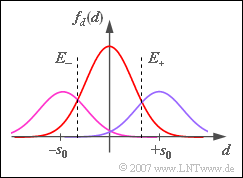
[[File:P_ID1327__Dig_A_2_5.png|right|frame|Probability density function of a noisy ternary signal]]
[[File:P_ID1327__Dig_A_2_5.png|right|frame|Probability density function $\rm (PDF)$ of a noisy ternary signal]]
A ternary transmission system $(M = 3)$ with the possible amplitude values $-s_0$, $0$ and $+s_0$ is considered.
A ternary transmission system $(M = 3)$ with the possible amplitude values $-s_0$, $0$ and $+s_0$ is considered.
*During transmission, additive Gaussian noise with rms value $\sigma_d$ is added to the signal.
*During transmission, additive Gaussian noise with rms value $\sigma_d$ is added to the signal.
*The recovery of the three-level digital signal at the receiver is done with the help of two decision thresholds at $E_{–}$ and $E_{+}$.
*The recovery of the three-level digital signal at the receiver is done with the help of two decision thresholds at $E_{–}$ and $E_{+}$.
*First, the occurrence probabilities of the three input symbols are assumed to be equally probable:
*First, the occurrence probabilities of the three input symbols are assumed to be equally probable:
*For the time being, the decision thresholds are centered at $E_{–} = \, –s_0/2$ and $E_{+} = +s_0/2$.
*For the time being, the decision thresholds are centered at $E_{–} = \, –s_0/2$ and $E_{+} = +s_0/2$.
*From subtask '''(3)''' on, the symbol probabilities are $p_{–} = p_+ = 1/4$ and $p_0 = 1/2$, as shown in the diagram.
From subtask '''(3)''' on, the symbol probabilities are $p_{–} = p_+ = 1/4$ and $p_0 = 1/2$, as shown in the diagram. For this constellation, the symbol error probability $p_{\rm S}$ is to be minimized by varying the decision thresholds $E_{–}$ and $E_+$.
*For this constellation, the symbol error probability $p_{\rm S}$ is to be minimized by varying the decision thresholds $E_{–}$ and $E_+$.
Notes:
* The exercise refers to the chapter [[Digital_Signal_Transmission/Redundancy-Free_Coding|"Redundancy-Free Coding"]].
* For the symbol error probability $p_{\rm S}$ of a $M$–level transmission system
:*with equally probable input symbols
:*and threshold values exactly in the middle between two adjacent amplitude levels holds:
* You can numerically determine the error probability values according to our applet [[Applets:Komplementäre_Gaußsche_Fehlerfunktionen|"Complementary Gaussian Error Functions"]].
* To check your results, use our (German language) SWF applet [[Applets:Fehlerwahrscheinlichkeit|"Symbol error probability of digital communications systems"]].
''Notes:''
* The exercise refers to the chapter [[Digital_Signal_Transmission/Redundancy-Free_Coding|Redundancy-Free Coding]].
* For the symbol error probability $p_{\rm S}$ of a $M$–level message transmission system with equally probable input symbols and threshold values exactly in the middle between two adjacent amplitude levels holds:
* You can numerically determine the error probability values according to the ${\rm Q}$ or ${\rm erfc}$ function using the [[Applets:Komplementäre_Gaußsche_Fehlerfunktionen|Complementary Gaussian Error Functions]] interaction module.
* To check the results, use the calculation module [[Applets:Fehlerwahrscheinlichkeit|Symbol error probability of digital communications systems]].
Line 36:
Line 36:
===Questions===
===Questions===
<quiz display=simple>
<quiz display=simple>
{What symbol error probability results with the (normalized) noise rms value $\sigma_d/s_0 = 0.25$ for equally probable symbols?
{What symbol error probability results with the (normalized) noise rms value $\sigma_d/s_0 = 0.25$ for equally probable symbols?
*The falsification probability of the symbol $0$ is twice as large (it is limited by two thresholds).
\hspace{0.05cm}.$$
* Considering the individual symbol probabilities, we obtain:
:$$p_{\rm S} = {1}/{ 4}\cdot p + {1}/{ 2}\cdot 2p +{1}/{ 4}\cdot p = 1.5 \cdot p = 1.5 \cdot 0.1587\hspace{0.15cm}\underline {\approx23.8 \,\%}\hspace{0.05cm}.$$
'''(3)''' The two outer symbols are each distorted with probability $p = {\rm Q}(s_0/(2 \cdot \sigma_d)) = 0.1587$.
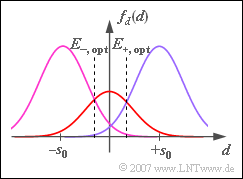
'''(4)''' Since the symbol $0$ occurs more frequently and can also be falsified in both directions, the thresholds should be shifted outward.
*The distortion probability of the symbol $0$ is twice as large (it is limited by two thresholds).
*The optimal decision threshold $E_{\rm +, \ opt}$ is obtained from the intersection of the two Gaussian functions shown in the graph. It must hold:
* Considering the individual symbol probabilities, we obtain:
:$$p_{\rm S} = {1}/{ 4}\cdot p + {1}/{ 2}\cdot 2p +{1}/{ 4}\cdot p = 1.5 \cdot p = 1.5 \cdot 0.1587
\hspace{0.15cm}\underline {\approx
23.8 \,\%}
\hspace{0.05cm}.$$
[[File:P_ID1328__Dig_A_2_5e.png|right|frame|Optimal thresholds for subtask '''(4)''']]
'''(4)''' Since the symbol $0$ occurs more frequently and can also be biased in both directions, the thresholds should be shifted outward.
*Accordingly, there is a smaller symbol error probability $(17.4 \ \%$ versus $21.2 \ \%)$ than with equal probability amplitude coefficients.
\hspace{0.05cm}.$$
*However, redundancy-free coding is no longer present, even if the amplitude coefficients are statistically independent of each other.
Discussion of the result:
*While for equally probable ternary symbols
*Accordingly, there is a smaller symbol error probability ($17.4 \ \%$ versus $21.2 \ \%$) than with equal probability amplitude coefficients.
*However, redundancy-free coding is no longer present, even if the amplitude coefficients are statistically independent of each other.
:*from which the equivalent bit rate can be calculated according to $R_{\rm B} = H/T$,
*While for equally probable ternary symbols the entropy is $H = {\rm log}_2(3) = 1.585 \ {\rm bit/ternary \ symbol}$ beträgt ⇒ equivalent bit rate (the information flow) $R_{\rm B} = H/T$, with probabilities $p_0 = 0.2$ and $p_{–} = p_+ = 0.4$: