Diese Funktion ist rechts dargestellt. Es ist zu erkennen, dass an der Sprungstelle $r = 0$ der rechtsseitige Grenzwert gültig ist.
*This function is shown on the right.
*It can be seen that at the unit step point $r = 0$ the right-hand side limit is valid.
''Hinweise:''
*Die Aufgabe gehört zum Kapitel [[Stochastische_Signaltheorie/Verteilungsfunktion|Verteilungsfunktion]].
*Bezug genommen wird auch auf das Kapitel [[Stochastische_Signaltheorie/Wahrscheinlichkeitsdichtefunktion|Wahrscheinlichkeitsdichtefunktion]].
*Eine Zusammenfassung der hier behandelten Thematik bietet das Lernvideo [[Zusammenhang zwischen WDF und VTF]].
*Sollte die Eingabe des Zahlenwertes „0” erforderlich sein, so geben Sie bitte „0.” ein.
===Fragebogen===
Hints:
*The exercise belongs to the chapter [[Theory_of_Stochastic_Signals/Cumulative_Distribution_Function|Cumulative Distribution Function]].
*Reference is made to the chapter [[Theory_of_Stochastic_Signals/Probability_Density_Function|Probability Density Function]].
*The topic of this chapter is illustrated with examples in the (German language) learning video <br> [[Zusammenhang_zwischen_WDF_und_VTF_(Lernvideo)|"Zusammenhang zwischen WDF und VTF"]] $\Rightarrow$ "Relationship between PDF and CDF".
===Questions===
<quiz display=simple>
<quiz display=simple>
{Welche Eigenschaften einer Verteilungsfunktion (VTF) gelten allgemein, also nicht nur bei diesem konkreten Beispiel?
{What properties of the CDF hold when the random variable has no limits?
|type="[]"}
|type="[]"}
+ Die VTF steigt von 0 auf 1 zumindest schwach monoton an.
+ The CDF increases from $0$ to $1$ at least weakly monotonically.
- Die <i>F<sub>x</sub></i>(<i>r</i>)-Werte 0 und 1 sind für endliche <i>r</i>-Werte möglich.
- The $F_x(r)$ values $0$ and $1$ are possible for finite $r$ values.
+ Ein horizontaler Abschnitt weist darauf hin, dass in diesem Bereich die Zufallsgröße keine Anteile besitzt.
+A horizontal section indicates that in this range the random size has no proportions.
+Vertikale Abschnitte sind möglich.
+Vertical sections are possible.
{Wie groß ist die Wahrscheinlichkeit, dass <i>x</i> positiv ist?
{What is the probability that $x$ is positive?
|type="{}"}
|type="{}"}
$Pr(x > 0)$ = { 0.25 3% }
${\rm Pr}(x > 0) \ = \ $ { 0.25 3% }
{Wie groß ist die Wahrscheinlichkeit, dass |<i>x</i>| größer ist als 0.5?
{What is the probability that $|\hspace{0.05cm}x\hspace{0.05cm}|$ is larger than $0.5$?
{Geben Sie die zugehörige WDF <i>f<sub>x</sub></i>(<i>x</i>) allgemein und den Wert für <i>x</i> = 1 an.
{Specify the associated PDF $f_x(x)$ in general and the value for $x = 1$.
|type="{}"}
|type="{}"}
$f_x(x\ =\ 1)$ = { 0.0677 3% }
$f_x(x =1)\ = \ $ { 0.0677 3% }
{Wie groß ist die Wahrscheinlichkeiten, dass <i>x</i> genau gleich 1 ist?
{What is the probability that $x$ is exactly equal to $1$ ?
|type="{}"}
|type="{}"}
$Pr(x = 1)$= { 0 3% }
${\rm Pr}(x = 1)\ = \ $ { 0. }
{Wie groß ist die Wahrscheinlichkeiten, dass <i>x</i> genau gleich 0 ist?
{What is the probability that $x$ is exactly equal to $0$ ?
|type="{}"}
|type="{}"}
$Pr(x = 0)$ = { 0.5 3% }
${\rm Pr}(x = 0)\ = \ $ { 0.5 3% }
</quiz>
</quiz>
===Musterlösung===
===Solution===
{{ML-Kopf}}
{{ML-Kopf}}
:<b>1.</b> Die <u>Aussagen 1, 3 und 4</u> sind immer richtig. Ist jedoch <i>x</i> auf den Bereich von <i>x</i><sub>min</sub> bis <i>x</i><sub>max</sub> begrenzt, so ist <i>F<sub>x</sub></i>(<i>r</i>) = 0 für <i>r</i> < <i>x</i><sub>min</sub> und <i>F<sub>x</sub></i>(<i>r</i>) = 1 für <i>r</i> > <i>x</i><sub>max</sub>. In diesem Sonderfall wäre auch die Aussage 2 zutreffend.
'''(1)''' The <u>statements 1, 3 and 4</u> are always correct:
*A horizontal intercept in the CDF indicates that the random variable has no values in that region.
*In contrast, a vertical intercept in the CDF indicates a Dirac delta function in the PDF $($at the same location $x_0)$.
*This means that the random variable takes the value $x_0$ very frequently, namely with finite probability.
*All other values occur exactly with probability $0$.
*If, however $x$ is limited to the range from $x_{\rm min}$ to $x_{\rm max}$ then $F_x(r) = 0$ for $r < x_{\rm min}$ and $F_x(r) = 1$ for $r > x_{\rm max}$.
*In this special case, the second statement would also be true.
'''(2)''' The sought probability can be calculated from the difference of the CDF values at the boundaries:
:Ein horizontaler Abschnitt in der VTF weist darauf hin, dass die Zufallsgröße in diesem Bereich keine Werte besitzt. Dagegen weist ein vertikaler Abschnitt in der VTF auf eine Diracfunktion in der WDF (an gleicher Stelle <i>x</i><sub>0</sub>) hin. Dies bedeutet, dass die Zufallsgröße den Wert <i>x</i><sub>0</sub> sehr häufig annimmt, nämlich mit endlicher Wahrscheinlichkeit. Alle anderen Werte treten exakt mit der Wahrscheinlichkeit 0 auf.
:<b>2.</b> Die gesuchte Wahrscheinlichkeit kann man aus der Differenz der VTF-Werte an den Grenzen berechnen:
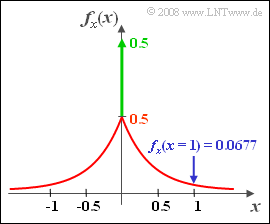
[[File: P_ID116__Sto_Z_3_2_c.png|right|frame|PDF of Laplace distribution]]
:<b>4.</b> Die WDF erhält man aus der zugehörigen VTF durch Differenzieren der zwei Bereiche. Es ergibt sich eine zweiseitige Exponentialfunktion sowie eine Diracfunktion bei <i>x</i> = 0:
'''(5)''' In the range around $1$ describes $x$ a continuous valued random variable.
[[File: P_ID116__Sto_Z_3_2_c.png|right|]]
*The probability that $x$ has exactly the value $1$ is therefore ${\rm Pr}(x = 1)\hspace{0.15cm}\underline{= \rm 0}.$
:Für <i>x</i> = 1 ergibt sich der Zahlenwert <u>0.0677</u>.
:<br><i>Hinweis.</i> Für die zweiseitige Exponentialverteilung ist der Begriff „Laplaceverteilung” gebräuchlich.
:<br><b>5.</b> Im Bereich um 1 beschreibt <i>x</i> eine kontinuierliche Zufallsgröße. Die Wahrscheinlichkeit, dass <i>x</i> exakt den Wert 1 aufweist, ist deshalb <u>0</u>.
'''(6)''' In $50\%$ of time $x = 0$ will hold: ${\rm Pr}(x = 0)\hspace{0.15cm}\underline{= \rm 0.5}.$
:<b>6.</b> In 50% der Zeit wird <i>x</i> = 0 gelten: <u>Pr(<i>x</i> = 0) = 0.5</u>. <i>Hinweis</i>: Die WDF eines Sprachsignals wird häufig durch eine zweiseitige Exponentialfunktion beschrieben (siehe Lernvideo zu Kap. 3.1). Die Diracfunktion bei <i>x</i> = 0 berücksichtigt vor allem Sprachpausen – hier in 50% aller Zeiten.
*The PDF of a speech signal is often described by a two-sided exponential function.
*The Dirac delta function at $x = 0$ mainly takes into account speech pauses – here in $50\%$ of all times.
{{ML-Fuß}}
{{ML-Fuß}}
[[Category:Aufgaben zu Stochastische Signaltheorie|^3.2 Verteilungsfunktion^]]
[[Category:Theory of Stochastic Signals: Exercises|^3.2 Cumulative Distribution Function^]]
[[de:Aufgaben:Aufgabe 3.2Z: Zusammenhang zwischen WDF und VTF]]
The topic of this chapter is illustrated with examples in the (German language) learning video "Zusammenhang zwischen WDF und VTF" $\Rightarrow$ "Relationship between PDF and CDF".
A horizontal intercept in the CDF indicates that the random variable has no values in that region.
In contrast, a vertical intercept in the CDF indicates a Dirac delta function in the PDF $($at the same location $x_0)$.
This means that the random variable takes the value $x_0$ very frequently, namely with finite probability.
All other values occur exactly with probability $0$.
If, however $x$ is limited to the range from $x_{\rm min}$ to $x_{\rm max}$ then $F_x(r) = 0$ for $r < x_{\rm min}$ and $F_x(r) = 1$ for $r > x_{\rm max}$.
In this special case, the second statement would also be true.
(2) The sought probability can be calculated from the difference of the CDF values at the boundaries: